

Why in news?
The Sri Lanka Navy rescued 11 fishermen on 6 August 2026; their Indian trawler had grounded on a reef. The incident occurred south of Delft Island. All crew members were brought to safety.
The Navy said the vessel crossed the International Maritime Boundary Line; it also alleged bottom trawling.
After the rescue, Delft Police received the fishermen, trawler and belongings. Legal proceedings were to follow.
The crossing and fishing claims come from the Navy’s account; the completed rescue is a separate humanitarian outcome.
Delft Island and its location
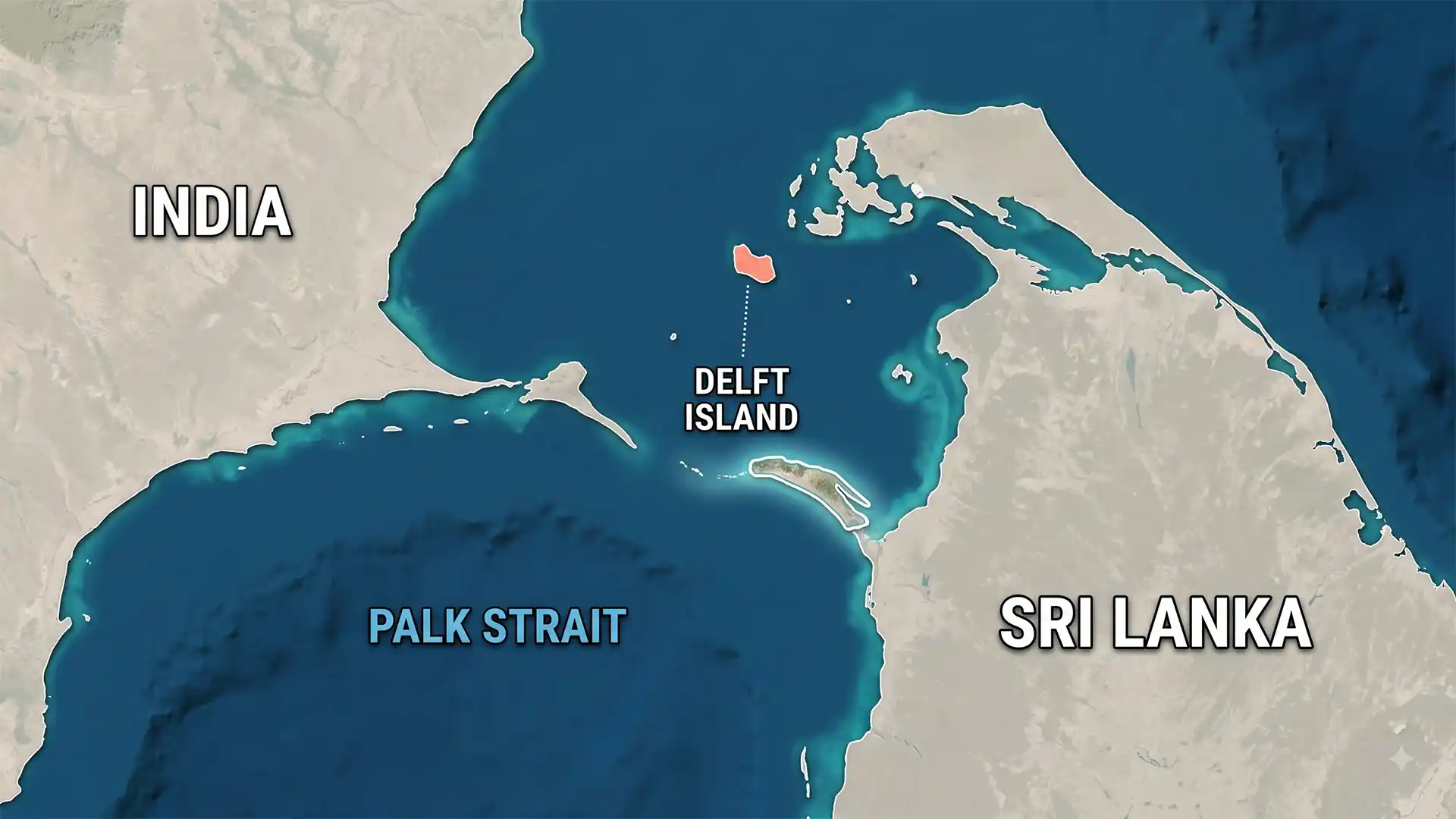
Delft is also known as Neduntivu; it is a low-lying island in Sri Lanka’s Jaffna district. The island lies in the Palk Strait, south-west of Jaffna peninsula; official publications place it near 48–50 square kilometres.
The Tamil name remains widely used. The English name “Delft” reflects colonial history.
Delft is distinct from Katchatheevu; the latter island also appears frequently in bilateral fisheries debate.
Coral limestone, shallow soils and limited freshwater shape Delft’s dry landscape. Fishing is central to local livelihoods. Weather can disrupt transport to the Jaffna peninsula; this makes island access and service delivery more difficult.
The surrounding shallow sea contains reefs and seagrass; these waters provide nursery habitat for fish and invertebrates.
Sri Lanka declared Delft National Park in 2015; the official protected area is 1,846.2 hectares.
The park covers a substantial land area. Adjoining marine ecology still depends on fisheries management and pollution control.
Why the Palk Bay dispute persists
India and Sri Lanka have a legally defined maritime boundary. Fishing communities still share a narrow and connected sea. Tamil Nadu fishers have historically travelled towards Sri Lankan waters. Northern Sri Lanka’s civil conflict disrupted local fishing for years.
Competition sharpened after Sri Lankan fishing revived. Arrests and boat seizures made the issue politically sensitive.
Injuries and occasional deaths added a humanitarian dimension; the dispute therefore extends beyond maritime enforcement.
Bottom trawling is a central point of contention. Heavy nets and gear are dragged along the seabed; the method can catch shrimp and fish efficiently. Repeated operation can damage benthic habitat.
Seagrass and juvenile fish grounds may be disturbed; the method can also produce large by-catch.
Northern Sri Lankan fishers say Indian mechanised trawlers threaten ecosystems and small livelihoods. Indian crews face their own pressures.
These include debt and limited near-shore catch; vessel conversion and new fishing methods can also be costly.
Rescue and enforcement are separate duties
Saving people in distress at sea is an immediate duty; a suspected fisheries offence does not remove it. Investigation, consular access and legal process come afterwards; the rescue does not prove every allegation.
Likewise, disputing an arrest does not diminish the rescue. All 11 crew members survived.
Ecology, livelihoods and diplomacy
The grounding shows how shallow and sensitive these waters are. Salvage must prevent further reef damage and fuel leakage. Seagrass, reefs and spawning grounds support long-term catches; their protection is both ecological and economic.
Enforcement can suppress or displace fishing temporarily; it cannot create alternative livelihoods or convert a trawler fleet.
India and Sri Lanka maintain a Joint Working Group on Fisheries. Fishing associations also have dialogue mechanisms.
The agenda includes releasing fishermen and boats. Safety at sea and ecological concerns are also discussed; another goal is transition away from destructive fishing. Progress needs reliable meeting schedules and rapid information exchange.
Information must move quickly after detention or distress. Humane treatment and consular access remain essential.
Clear repatriation procedures can reduce uncertainty. Vessel monitoring and emergency communication can prevent accidental crossings and delayed rescues.
The harder task is reducing economic dependence on bottom trawling. Vessel conversion or buy-backs could be time-bound options. Deep-sea support should proceed only where ecologically and commercially viable. Alternative gear may suit some fisheries.
Harbour and cold-chain improvements can reduce losses. Insurance and transition support may protect livelihoods.
Crew members and small fishers need a voice in these programmes. Boat owners cannot be the only participants.
Moving the same pressure farther offshore is not reform; fishing effort must fit ecological limits.
Conclusion
The Delft incident ended without loss of life after a prompt rescue; it also returned attention to the fisheries dispute. Law, livelihoods and marine ecology cannot be separated; a durable approach must preserve search-and-rescue cooperation.
It must also ensure fair legal treatment. Fishing communities need support for methods that the shallow Palk Bay can sustain.