

Why in news?
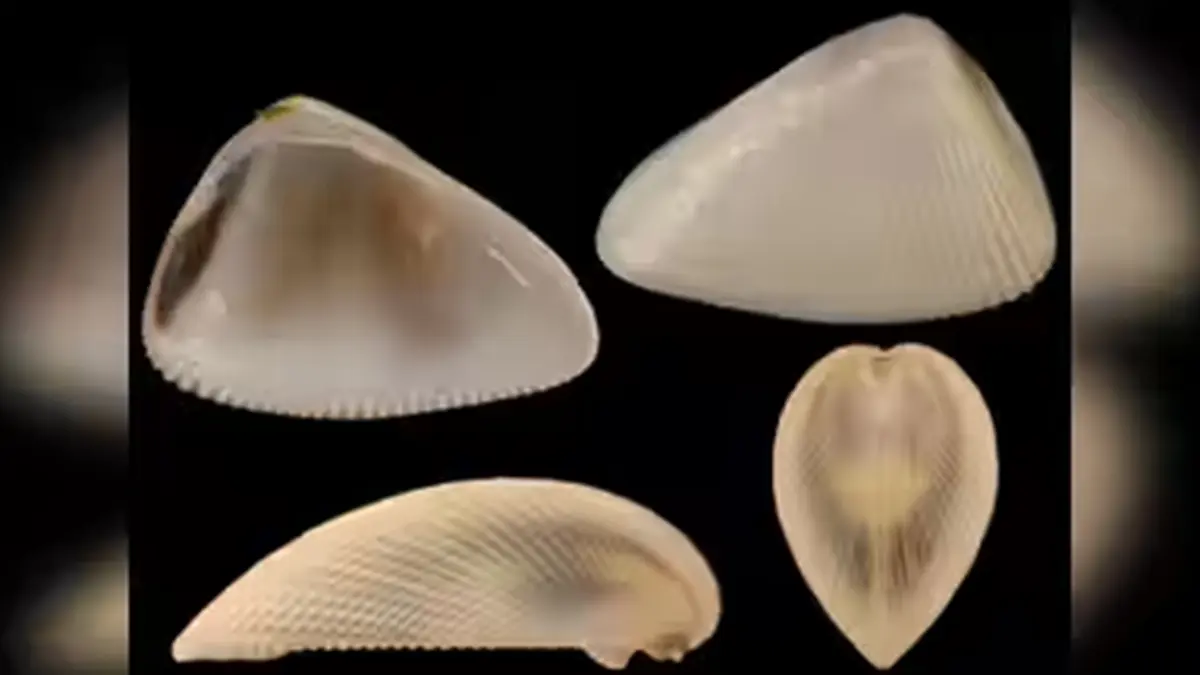
Researchers have described Deltachion ravenshaw, a previously unnamed bivalve species found near the Devi estuary in Odisha. The Times of India reported the research on 12 September 2026, following its publication in the journal Basteria. Bivalves are soft-bodied animals protected by two hinged shell halves; familiar examples include clams and mussels. This species belongs to the Donacidae family, commonly associated with sandy coastal habitats. Its description adds a recognised species to biological records, rather than announcing that a new animal suddenly evolved this year. The estuary setting also raises a question about the conditions in which it lives. Shell evidence supports its identification, but finding living animals and studying their biology will be needed to establish habitat preferences more firmly.
What the taxonomic record establishes
The marine-science catalogue maintained by the Flanders Marine Institute records the study by Sanjaya Dalai, Aparna Mishra, H. Raven and Dipti Raut. It identifies the publication as a new-species description in Basteria, volume 90, issue 2, pages 215–219. That bibliographic record distinguishes the scientific publication from the later newspaper account.
The scientific name has two parts. Deltachion is the genus, a grouping of related species; ravenshaw identifies the species within it. The name honours Ravenshaw University’s contribution to the research. A formally described species provides a reference that other researchers can compare with future specimens, rather than relying on a local or informal name.
The reported specimens were less than seven millimetres long. Researchers compared shell shape and surface markings with those of related species. The report highlights a pointed front end and patterned ribs towards the rear. Such combinations of features can be more useful for identification than size alone, which may change as an animal grows.
How a bivalve differs from a fish
Bivalves belong to the molluscs, a group of invertebrate animals. They are not small fish enclosed in shells. Their two shell halves protect a soft body and are joined along a hinge. The National Oceanic and Atmospheric Administration describes a diverse group occupying marine and freshwater environments, with different species suited to different habitats.
Many bivalves obtain food by filtering particles from water passing across their gills. This connects them with material suspended in their surroundings. However, a general description of bivalve feeding should not be mistaken for a measured feeding rate in this newly described clam. Its particular ecological role still needs direct study.
The distinction matters when a discovery is discussed in environmental terms. A species can belong to a group important in coastal food webs without its own abundance or contribution being known. Identification supplies the starting point for those questions. It does not automatically establish commercial value, pollution-removal capacity or a special medical application.
Why the Devi estuary is an informative setting
The collection area is near Astaranga in Puri district, on Odisha’s Bay of Bengal coast. State environmental documentation places the local fishing harbour near the Devi River’s mouth. This is a river-to-sea transition, not an isolated inland lake. The surrounding coast supports both biological habitats and fishing activity.
An estuary is a coastal waterbody where river water and seawater meet and mix. The balance changes with freshwater flow and tides. Salinity therefore need not remain constant through the day or year. Organisms living there must cope with the conditions at their particular location, which may differ from those in the nearby open sea.
Intertidal ground is alternately covered and exposed as the tide changes. A sandy estuary can consequently contain several small-scale environments. Depth, water movement and sediment differ across them. Recording the precise collection setting helps researchers interpret a specimen, but it cannot substitute for observing living animals across seasons and sites.
What remains to be learned
The researchers called for living specimens and molecular work to clarify habitat preferences and relationships. Molecular study examines biological information such as genetic material, complementing the shell’s visible features. The next question is whether the species regularly occupies variable-salinity estuarine conditions or also occurs in surrounding marine habitats.
A first documented location is not necessarily the species’ entire range. Other populations may remain unrecorded, especially where surveys are limited. Conversely, a new name does not establish that the animal is abundant or secure. Distribution, population trends and threats require their own evidence before a conservation assessment can be made.
Conclusion
The discovery gives researchers a defined species to recognise and investigate along Odisha’s coast. Its immediate contribution is taxonomic: an overlooked form of life has entered the scientific record. Researchers can now investigate its distribution, feeding and habitat. Those findings will explain how it fits into the estuary’s wider community of organisms.