

Why in news?
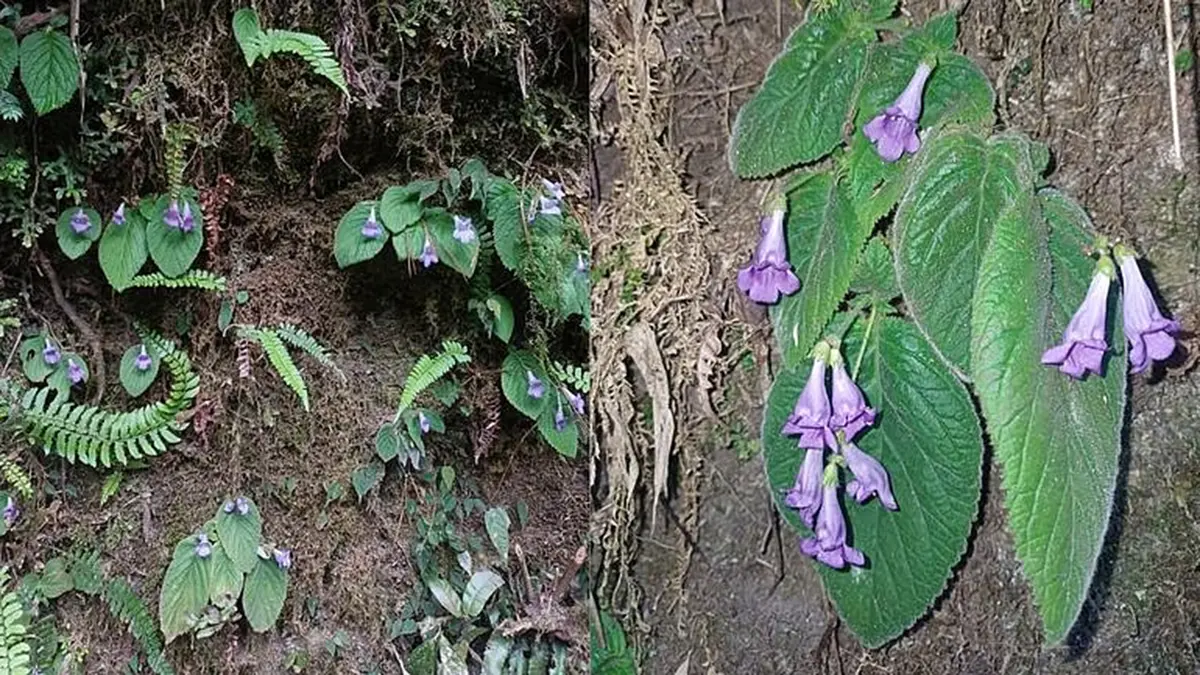
A newly described flowering plant from Arunachal Pradesh, Didymocarpus nautiyalii, features in the 30 September current-affairs coverage. Its scientific description appeared in the journal Taiwania on 13 August 2026, following fieldwork in Shi-Yomi district. It is a small, rock-growing member of the Gesneriaceae family. Researchers distinguished it from a similar species using a combination of structural features, including its blue-purple flowers. The finding adds a documented species to scientific knowledge; it does not mean the plant evolved recently. The authors proposed a Data Deficient conservation assessment because its distribution and population remain insufficiently known. That uncertainty is part of the discovery, not evidence that the plant faces no threats.
What was found in the field
The original description records material collected near Hone in April 2025, at about 1,142 metres. The plant grows on moist rock surfaces in a subtropical forest setting. Its stem is two to five centimetres long, compared with about seventeen centimetres in Didymocarpus albiflorus. Its blue-purple flowers and leathery leaves also differ from that species’ white flowers and thinner leaves. The authors observed nineteen flowering individuals in two nearby groups. This was a field observation, not a demonstrated total for the species worldwide.
How a new species is established
Recognising an unfamiliar plant is the beginning of the scientific task, not the conclusion. Botanists must compare it with species already described, including specimens collected elsewhere. Otherwise, an unusual local form or a previously named species could be described again. Kew’s explanation of plant discovery emphasises the combination of field observations, existing literature and preserved collections used to make these comparisons.
Flower structure can be particularly useful because plants that look similar in leaf may differ in their reproductive parts. Researchers examine combinations of characters rather than treating one attractive colour as sufficient proof. The purpose is to identify consistent differences that another botanist can check. Photographs help document appearance, while measurements and specimens allow more detailed examination than a photograph alone.
A type specimen provides a physical reference for a scientific name. A herbarium preserves plant material together with information such as where and when it was collected. This makes the name something that later researchers can investigate, rather than a label dependent only on the original author’s memory. It also allows future comparisons when closely related plants are found.
Names, evidence and later revision
Kew explains why scientific names are important even when local names already exist. The same common name may refer to different plants, while one plant may have several names. A published scientific name connects a description with reference material. It does not make later investigation unnecessary: botanists may revise classifications when additional specimens or new evidence change their understanding of relationships.
This is why a description should be read as a documented scientific argument. The evidence must support the distinction being proposed, and the limits of the observations must remain visible. Morphology concerns observable structure; genetic analysis examines inherited information. These approaches answer related questions, but they are not interchangeable. Understanding the method helps a reader understand exactly what a study has demonstrated.
What Data Deficient actually means
The International Union for Conservation of Nature uses Data Deficient when information is inadequate to assess extinction risk reliably. This can reflect gaps in distribution or population evidence even when some aspects of a species are understood. It is not a category meaning safe, common or unimportant. Further work may show that a threatened category is appropriate.
The authors’ proposed assessment must also be distinguished from a separately published official Red List assessment. A new-species paper can apply conservation criteria and explain its judgement without completing that separate process. For readers, the useful question is what evidence is missing. Repeated surveys, better distribution information and observations of habitat condition would help turn an initial account into a stronger assessment.
There is an important difference between finding few individuals and proving that few exist. Search effort, season and access influence what a survey detects. At the same time, incomplete knowledge is not a reason to disregard damage at a known site. A sensible research response combines further investigation with attention to the habitat already documented, rather than waiting for an apparently precise global number.
Conclusion
The description of Didymocarpus nautiyalii gives botanists a testable identity and a starting point for further study. Its significance lies in documenting a previously unrecognised plant while making the evidence gaps explicit. The next step is to understand its range, variation and habitat more fully. That work can strengthen both the scientific classification and decisions about conservation.