

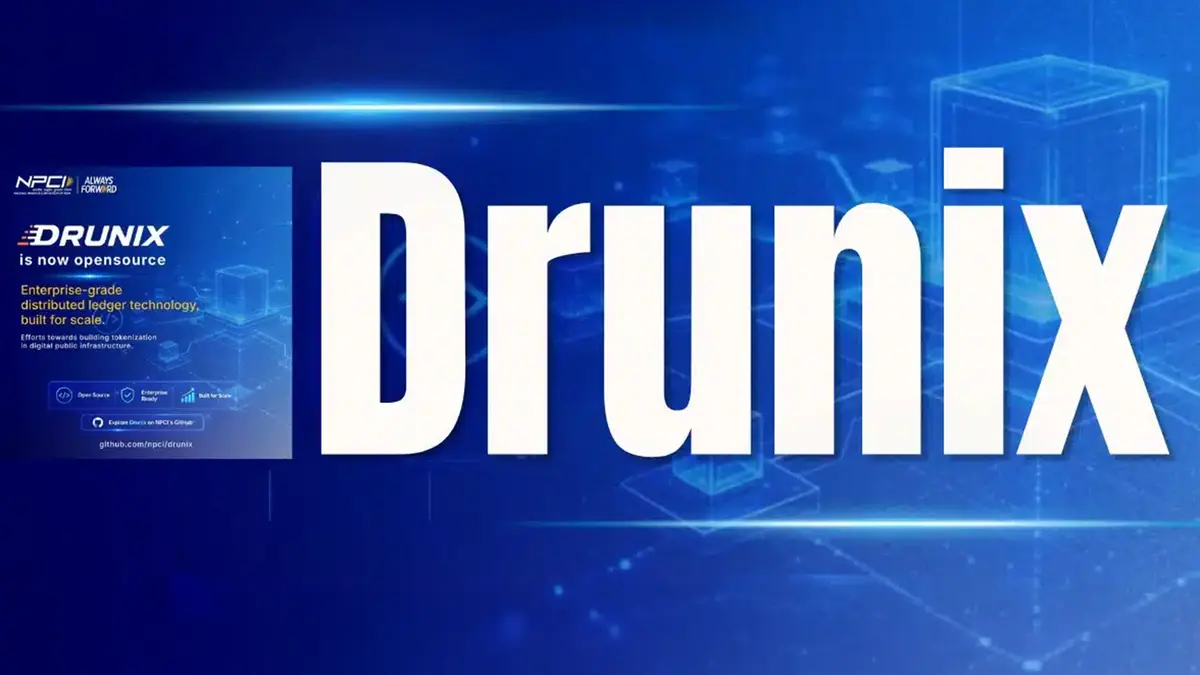
Why in news?
The National Payments Corporation of India (NPCI) recently unveiled Drunix, an open‑source blockchain platform. The platform enables businesses and government agencies to build tokenisation systems and manage digital assets at scale while maintaining privacy and security.
Background
NPCI is known for pioneering digital payment systems such as the Unified Payments Interface. In 2023 it open-sourced Falcon, a Hyperledger Fabric deployment and orchestration helper for Kubernetes (a tool for deploying and managing Fabric-based blockchain networks). Drunix is its second major open‑source contribution. It is based on Hyperledger Fabric, a permissioned blockchain framework maintained by the Linux Foundation. NPCI has enhanced the core design to suit Indian regulatory and scalability requirements.
Key features and significance
- Rapid deployment: Drunix allows organisations to set up permissioned blockchain networks quickly. It supports the creation and management of digital tokens linked to physical or intangible assets. This can underpin projects such as central bank digital currencies, carbon credits or supply chain tracking.
- Architectural enhancements: NPCI has split peer roles into “Lite Peer” and “Committing Peer” to improve throughput. It integrates an SQL‑based distributed database (YugabyteDB) for efficient storage and queries, and adds a stateless validation service to verify transactions. These changes address scalability bottlenecks in standard Hyperledger Fabric implementations.
- Privacy and governance: The platform maintains strong access controls and allows consortium members to manage their own nodes. Data is shared only with authorised participants, ensuring compliance with Indian data protection rules. Governance policies can be tailored to sectoral needs.
- Open‑source community: By releasing Drunix as open source, NPCI encourages developers to contribute improvements and build applications. This reduces dependence on foreign technology and fosters innovation within India.
- Complement to existing systems: The platform complements NPCI’s payment infrastructure and can integrate with UPI and other digital public goods. It lays the foundation for secure digital asset ecosystems and strengthens India’s digital economy.
Conclusion
Drunix demonstrates India’s commitment to open‑source innovation. Its enhanced blockchain architecture can help businesses and governments deploy trustworthy digital assets and explore new financial products while keeping data sovereign.