

Why in news?
Satellite-image analysis has drawn attention to reported construction at Russia's Alabuga drone-production complex in Tatarstan. A 20 September Times of India report described analysts' assessment that an underground complex could protect parts of the manufacturing network. Alabuga is associated with Geran-2, Russia's version of the Iranian-designed Shahed-136 one-way attack drone used in Ukraine. The news concerns an interpretation of industrial construction, not independently confirmed underground production figures. Its significance lies in the connection between weapons supply and the survival of manufacturing capacity during a prolonged war. The imagery can support observations about construction without revealing everything occurring inside the facility.
What the Geran-2 designation means
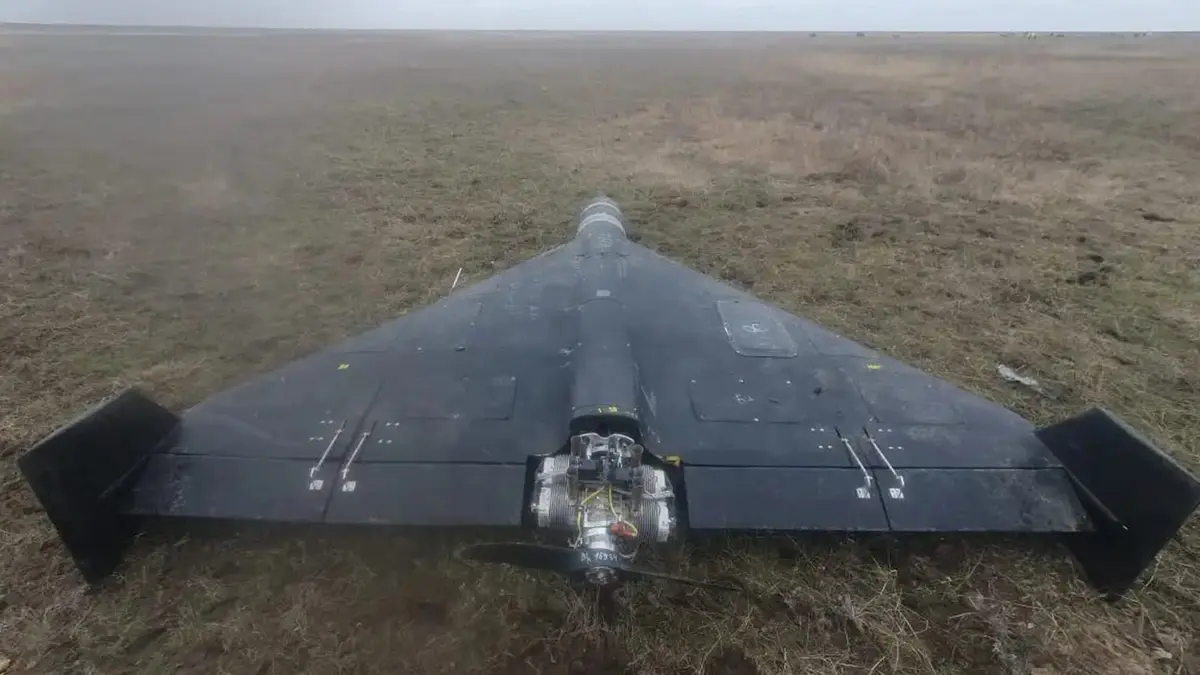
Geran-2 is the Russian designation associated with the Shahed-136 design and its domestically produced adaptations. It is a one-way attack drone: an uncrewed aircraft intended to strike a target rather than return for reuse. This separates it from a reconnaissance aircraft that repeatedly collects information. The designation describes a family of weapons with an evolving production history, not necessarily a single unchanged configuration across every recovered example.
A British examination circulated at the United Nations in 2023 describes the Shahed-136's triangular, delta-wing shape and piston-engine propulsion. This is a fixed-wing aircraft, not a helicopter-like drone held aloft by several lifting rotors. It carries an explosive payload as part of the aircraft itself. Those broad features explain its one-way role, while the equipment fitted to particular Russian adaptations can change over time.
The design's Iranian origin and Russian production are therefore compatible statements. Technology can be transferred, assembled locally and later modified. Saying that a drone was manufactured in Russia does not establish that every component originated there. Conversely, a design derived from an Iranian aircraft does not mean every later example was shipped fully assembled from Iran. Identifying origin requires distinguishing the design, final assembly and the sources of individual parts.
How domestic production became established
Conflict Armament Research examined the remains of two Geran-2 aircraft used in Ukraine in July 2023. Comparing their design and components with earlier examples, its investigators assessed that Russia had begun fielding a domestic Shahed-136 variant. This was evidence drawn from recovered equipment, not simply from a manufacturer's claim. It established an important part of the production history well before the September 2026 report about new construction.
A separate 2023 investigation by the Institute for Science and International Security examined internal Alabuga documents. Its assessment described a planned progression from assembly of supplied aircraft towards more local manufacturing, with Iranian assistance. The documents also showed the importance of outside components and expertise. Expanding a factory is therefore not just a matter of adding floor space. Production depends on equipment, materials, trained workers and continuing supply relationships.
Alabuga's place in the wider industrial network
Alabuga is a special economic zone in Tatarstan, within the Russian Federation. Tatarstan is a republic of Russia, not an independent country. The zone's association with drone production is supported by earlier investigations and by United States sanctions designations. In February 2024, the United States Treasury identified Alabuga and associated figures in connection with Iranian-designed drone production. Those designations are an official sanctions action, distinct from independent verification of every production estimate.
An industrial programme needs several activities to work together: component delivery, assembly, testing and the movement of finished equipment. A building visible from a satellite may house only one part of that chain. Equally, activity inside an existing structure can change without a large alteration to its roof. This is why imagery, recovered hardware, company records and supply-chain evidence answer different questions. Their value increases when they can be compared rather than treated as interchangeable proof.
What underground construction would—and would not—show
The latest report attributes the underground-complex assessment to open-source intelligence analysts. Open-source intelligence means analysis using publicly obtainable material, such as commercial imagery and published records. Satellite images can reveal excavation, structural change or new buildings. They do not by themselves establish what underground rooms contain or how many production lines are functioning. Measuring actual output requires further evidence about finished drones leaving the site.
Protection of manufacturing capacity is a reasonable explanation to examine in wartime, especially where facilities face attack. However, a possible purpose remains different from a confirmed operational result. Construction can be incomplete, equipment can arrive later, and output can be constrained elsewhere in the supply chain. The September report therefore supports attention to a possible change in industrial protection, without supporting a precise new production total.
Why the distinction matters for understanding the war
One-way attack systems connect battlefield use with repeated production: an expended aircraft must be replaced if attacks are to continue. Industrial resilience consequently matters alongside the performance of individual weapons. Yet broad claims of invulnerability, unlimited range or immunity to electronic interference are not justified by a photograph of a factory. Those claims concern separate technical questions and may differ between versions, operating conditions and countermeasures.
The civilian consequences also remain central to the subject. Discussion of manufacturing growth concerns the ability to sustain a destructive campaign, not an abstract industrial achievement. At the same time, analysis must distinguish documented production, proposed expansion and uncertain capacity estimates. That separation allows the seriousness of the development to be explained without amplifying wartime publicity or turning an analyst's inference into an established fact.
Conclusion
The reported Alabuga construction is relevant because Geran-2 has an established place in Russia's wartime drone-production network. It may indicate an effort to protect that network, but the operational status and output of the reported underground facilities remain unconfirmed. The next useful evidence would connect visible construction with independently documented production activity. Until then, the strongest account combines the known manufacturing history with clearly attributed, limited conclusions from the new imagery.