

Why in news?
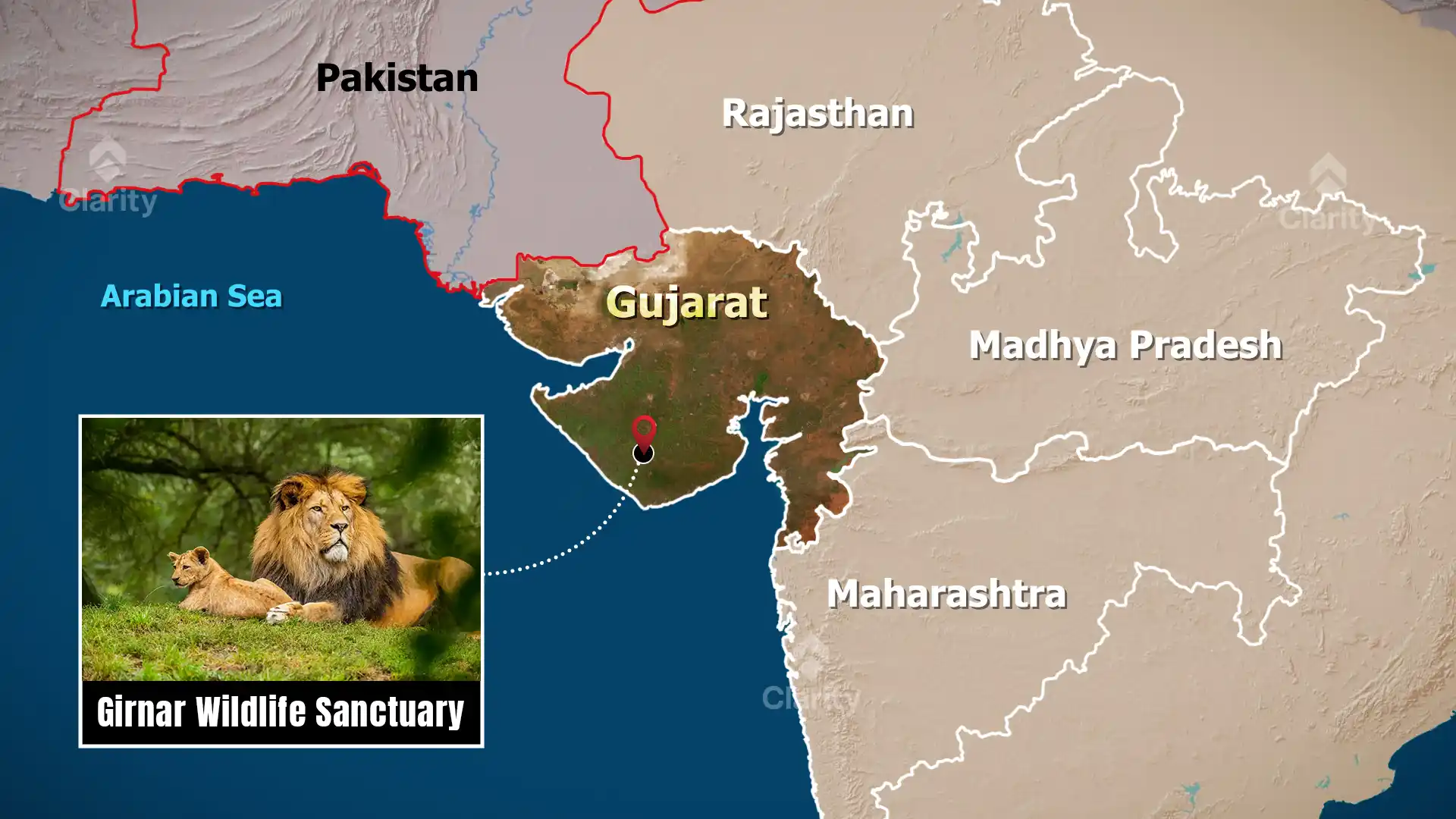
A group of monks from the Girnar hill temples demanded in April 2026 that the eco‑sensitive zone (ESZ) around Girnar Wildlife Sanctuary in Gujarat be abolished. They argued that the ESZ restrictions hinder religious activities and called for roads, electricity connections and permission to organise large festivals. Conservationists and forest officials warned that removing the ESZ could harm the sanctuary’s fragile ecosystem and increase human–wildlife conflict.
About Girnar Wildlife Sanctuary
Girnar Wildlife Sanctuary lies in Junagadh district, Gujarat, and covers roughly 179 square kilometres in and around the Girnar hills. Established in 2008, it provides habitat for Asiatic lions that roam outside the main Gir National Park. The sanctuary is about 50 kilometres from Gir and includes several Hindu and Jain pilgrimage sites on Mount Girnar.
Flora and fauna
- Major mammals: Around 50 Asiatic lions inhabit the sanctuary. Other species include leopards, spotted deer (chital), sambar, nilgai (blue bull), chousingha (four‑horned antelope), chinkara (Indian gazelle), wild boars and Indian golden jackals.
- Birdlife: More than 300 bird species have been recorded, including raptors, peafowl and migratory waterfowl.
- Vegetation: The hills support dry deciduous forests dominated by teak, dhavdo (Anogeissus latifolia), jamun, kadaya and acacia species. These trees provide shade and fodder during the hot summer months.
The Eco‑Sensitive Zone and the monks’ demands
The Ministry of Environment notified a buffer area around the sanctuary as an eco‑sensitive zone in 2016 to regulate construction and limit disturbances. The Girnar Sanrakshan Samiti — a committee of monks and priests — now wants this protection removed. Their memorandum includes 60 demands such as building permanent roads and electricity lines up to the Dattatreya peak, allowing night stays and festivals, and exempting religious sites from forest rules. They also ask for 200–250 acres of land to host the annual Maha Shivratri fair.
Conservation concerns
- Forest officials note that lion numbers on Girnar have risen from just four in 1999 to over 50 due to conservation efforts. Relaxing rules could degrade habitat and raise the risk of encounters between lions and pilgrims.
- Environmentalists emphasise that roads and power lines could fragment forests, increase vehicle traffic and open the door to illegal grazing and resource extraction.
- Under Indian law any changes to ESZ limits require approval from both state and national wildlife boards, ensuring that ecological impacts are fully assessed.