

Why in news?
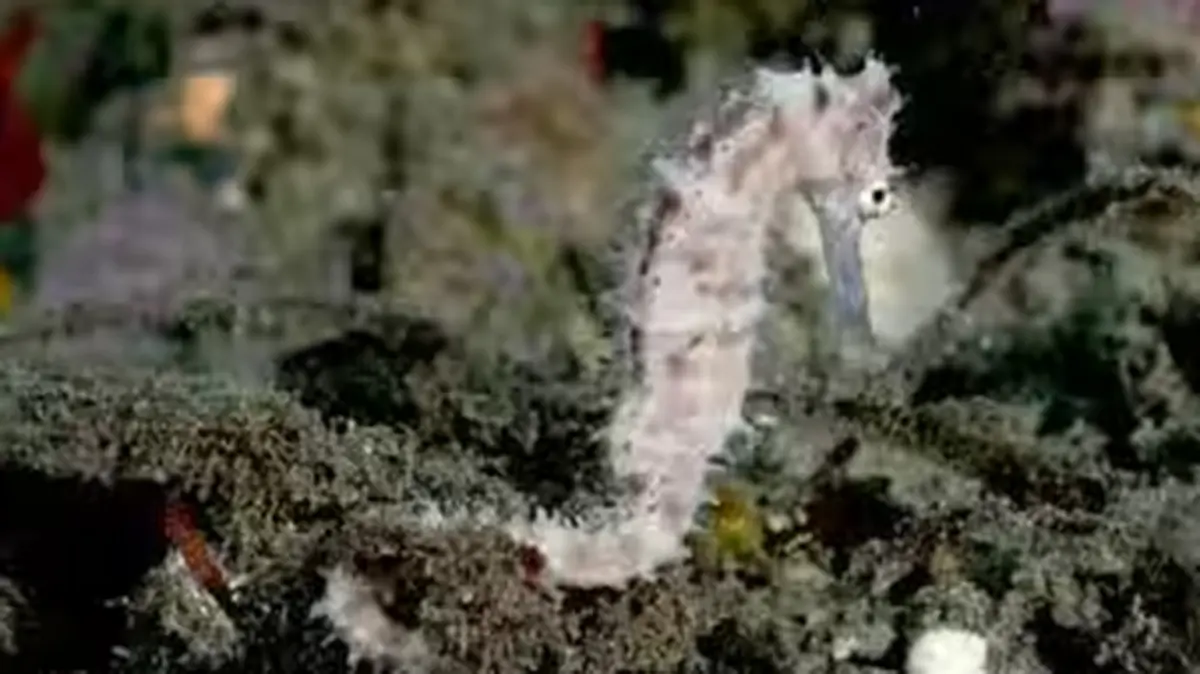
Researchers formally described an Indian Ocean seahorse named Hippocampus amandavincentae. Specimens had previously been grouped with the Pacific thorny seahorse. Anatomy and molecular evidence revealed separate evolutionary lineages. The revision also changes how older Indian Ocean records should be interpreted.
Background
Seahorses are marine fishes belonging to the family Syngnathidae; this family also includes pipefishes and seadragons. Their upright posture and curved neck produce the familiar horse-like profile.
Bony rings support the body instead of ordinary overlapping scales. A small dorsal fin provides forward movement, while pectoral fins guide direction. Their prehensile tails grip seagrass, corals and other structures.
Female seahorses transfer eggs into a specialised male brood pouch; the male fertilises, carries and later releases developing young. This unusual reproductive system does not remove the female's biological contribution.
Many species inhabit seagrass beds, mangroves, reefs and estuaries; their camouflage and low mobility make surveys difficult. Bycatch and dried-animal trade can further obscure population information.
How the identification changed
The name Hippocampus histrix once covered thorny seahorses across a vast Indo-Pacific range. Researchers suspected that this broad grouping concealed more than one species; similar external appearance had encouraged repeated misidentification.
A Kerala University of Fisheries and Ocean Studies-led team reassessed that complex. Shalu Kannan led the research with Indian and international collaborators; the description appeared in the taxonomic journal Zootaxa.
Kannan first encountered relevant bycatch specimens at Tuticorin harbour in Tamil Nadu. The team compared body proportions, spines and other diagnostic features; molecular sequences then tested relationships suggested by morphology.
The combined evidence separated three species within the former grouping. True Hippocampus histrix was restricted to Pacific waters and the South China Sea. Hippocampus jayakari remained distinct in the northwestern Indian Ocean.
The researchers described the remaining Indian Ocean lineage as Hippocampus amandavincentae; its name honours marine biologist Amanda Vincent. She has made major contributions to seahorse research and conservation.
Evidence from Indian waters
The collected Indian material came from Tuticorin bycatch on the southeast coast. A photographed individual was also documented near Anchuthengu in Kerala; that image arose during a coastal biodiversity project.
The Kerala record raised the state's documented seahorse count from four to five. This number concerns records from Kerala's coast; it is neither India's total nor the species' complete distribution.
Older museum specimens and online photographs require renewed examination. Records labelled Hippocampus histrix may represent the new species; location alone cannot settle identification without adequate diagnostic details.
A single harbour specimen may also have travelled in fishing bycatch. Researchers therefore combine collection data with habitat records and genetic evidence; wider sampling should refine the actual range.
Why taxonomy affects conservation
A supposedly widespread species may appear secure across its combined range. Splitting it can reveal smaller populations facing different threats. Management must then use each species' real distribution.
Fisheries data also become more useful when catches carry correct names; misidentification can hide local decline or inflate abundance. Identification guides and trained observers will need updating.
All seahorses are regulated internationally through Appendix II of the Convention on International Trade in Endangered Species. That listing controls trade through permits; it does not mean every species faces the same extinction risk.
A new taxonomic name also lacks an automatic global threat category. The International Union for Conservation of Nature needs population and threat evidence. Formal assessment should follow rather than precede that work.
Pressures and research needs
Bottom trawling can capture seahorses incidentally and damage benthic habitat. Coastal construction, pollution and seagrass loss create additional pressure. Dried specimens may enter medicinal, souvenir or curio markets.
Future surveys should sample both Indian coasts and neighbouring Indian Ocean regions. Environmental DNA could complement nets and visual observations; voucher specimens remain necessary for a defensible taxonomic record.
Fishers can help identify seasonal bycatch locations and release practices; port monitoring should record effort alongside species counts. Otherwise, changing catch numbers may merely reflect changing fishing activity.
Conclusion
Hippocampus amandavincentae corrects a long-standing identification problem within thorny seahorses; that clarity now enables more realistic distribution and conservation work.