

Why in news?
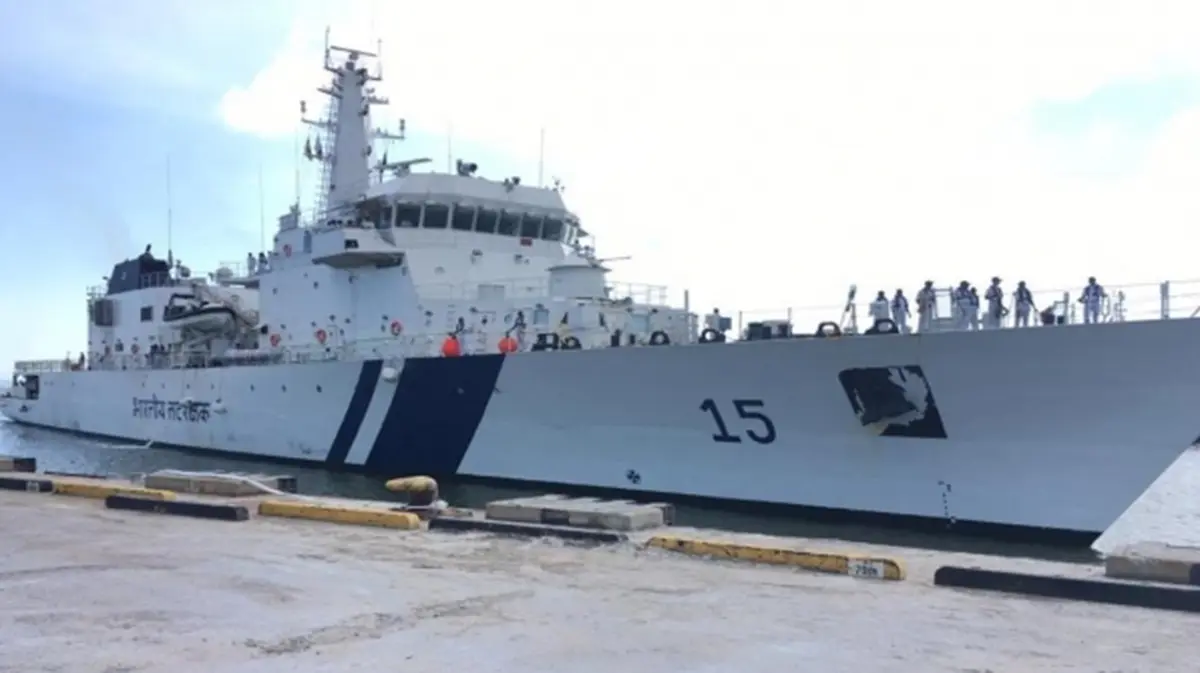
Indian Coast Guard Ship (ICGS) Shaunak sailed from Chennai for Perth on 25 September with six Sea Rider personnel aboard. Two were from Japan, one from Australia, one from the United States and two from India. The deployment places officers from the four Quad countries together on an Indian patrol vessel for professional exchanges at sea. Such cooperation can improve familiarity with the procedures used in maritime safety and law-enforcement work. Shaunak is an offshore patrol vessel, not a newly commissioned ship. The announcement confirms its departure and the exchange arrangement; it does not establish arrival in Australia or the completion of the planned activities.
What kind of vessel is Shaunak?
Shaunak was commissioned at Goa on 21 February 2017. Goa Shipyard designed and built the 105-metre vessel, the fourth in a series of six offshore patrol vessels. This history matters because the current news concerns a new deployment by an existing ship. Commissioning brought it into service years earlier; sailing with international participants is a different milestone.
An offshore patrol vessel is designed to remain at sea and carry out a range of maritime duties. Those duties can include surveillance, rescue, boarding operations and assistance during pollution incidents. Its usefulness depends on endurance, communications, boats and support facilities, not only on armament. This makes it a suitable setting for officers to observe how different tasks are organised during an extended voyage.
The commissioning record gives Shaunak a maximum speed of 26 knots and an economical-speed endurance of 6,500 nautical miles. These are different measures. Speed describes how quickly the vessel moves, while endurance describes how far it can operate under stated conditions. The two figures should not be combined into a claim that it maintains maximum speed across its full economical range.
The equipment connects several kinds of work
The ship was designed to carry a twin-engine light helicopter and five high-speed boats, including two quick-reaction inflatable boats. These extend the reach of the larger vessel. A patrol ship cannot always approach a casualty or another vessel as closely as a small boat can. A helicopter can support observation or assistance over a wider area, subject to the equipment and operating conditions actually available.
The original record also identifies external firefighting capability and provision for pollution-response equipment. These features show why coast-guard work cannot be reduced to interception alone. An incident at sea may involve injured people, fire, a damaged vessel or spilled oil. The response may therefore require several skills and agencies. Design capability should still be distinguished from a claim about which equipment is embarked on this particular voyage.
Why officers travel together
The official announcement calls the visiting personnel “Sea Riders”. The arrangement allows officers to participate in professional exchanges while observing the host vessel's work. Training ashore can explain procedures, but a voyage also reveals how those procedures fit together in daily operations. Watchkeeping, communications, coordination and responses to changing conditions are practical activities rather than abstract descriptions.
Shared experience can make future contact easier. Officers who understand a partner's terminology and organisation may be better placed to exchange information during an incident. That is a plausible purpose of the programme, not a measured result already established by departure. Its value will depend on the exchanges undertaken and how the participating services use what they learn.
The Quad context and its limits
The Quad brings together India, Australia, Japan and the United States. This voyage places their coast-guard personnel within a practical maritime-cooperation activity. Coast guards have their own responsibilities and operating arrangements, which are not identical to those of navies. A professional exchange should therefore not be described as a combat deployment merely because it involves the same four countries.
Nor does embarkation on an Indian ship transfer authority over it to the visiting officers. The announced activity concerns cooperation aboard the host vessel. It does not, by itself, establish joint command, a new treaty or unlimited enforcement powers in another country's waters. These distinctions allow the significance of the exchange to be understood without attaching commitments that the announcement does not contain.
From the Bay of Bengal to the eastern Indian Ocean
Chennai is on India's south-eastern coast, facing the Bay of Bengal. Perth lies in Western Australia, on the Indian Ocean side of the continent. The voyage therefore links two parts of the wider Indian Ocean region. The official departure notice identifies those endpoints but does not provide a complete sailing track. It would be misleading to insert a particular strait or intermediate port as though it had been confirmed.
The distance helps explain the relevance of an offshore patrol ship. Maritime cooperation often involves waters far beyond the immediate coastline, where communication and sustained presence matter. At the same time, search-and-rescue responsibilities must be distinguished from ownership of the sea. Coordinating assistance in a designated rescue region does not make that entire region a country's sovereign territory.
Rescue depends on coordination as well as vessels
The Indian Coast Guard coordinates maritime search and rescue within India's designated search-and-rescue region. Its reporting arrangements help identify suitable assets and vessels that may require assistance. A patrol ship operates within this wider system. Receiving information, identifying a problem and directing help are as important as having equipment at sea. International familiarity can support that coordination when incidents cross operational boundaries.
Conclusion
Shaunak's voyage combines an established patrol vessel with a new opportunity for shared professional experience. Its importance lies in the practical connections between maritime services, not in portraying an officer exchange as a new military alliance. The departure is the confirmed development. The substantive outcome will depend on the training, cooperation and working relationships built during the deployment.