

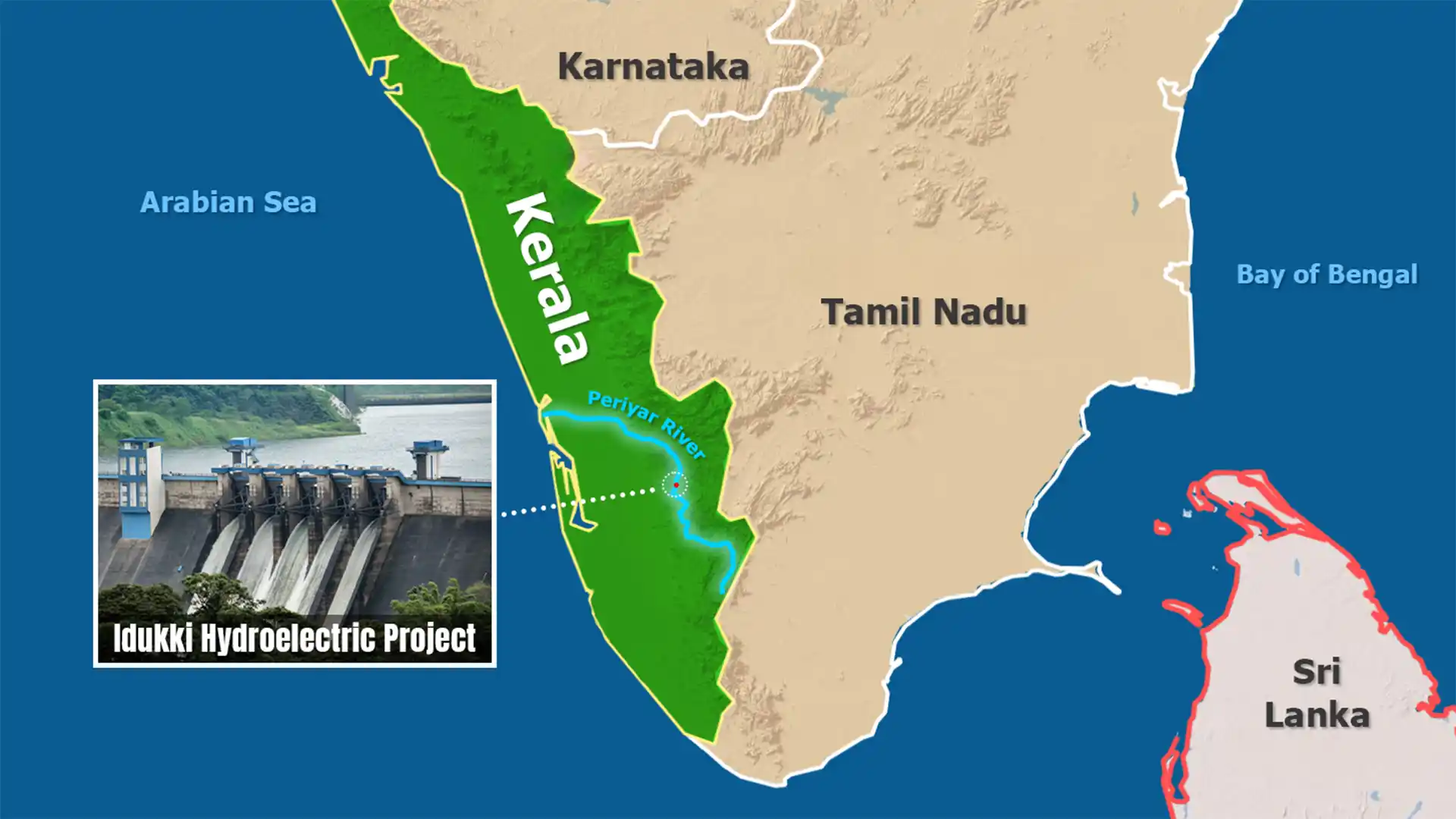
Why in news?
Kerala’s largest hydropower station – the Idukki hydroelectric project – completed fifty years of operation. The Moolamattom underground powerhouse has generated more than 115 852 million units (MU) of electricity since its commissioning in 1976. The state government used the milestone to highlight how renovation of the original generators has kept the facility running efficiently.
Background
Situated across the Periyar River in Idukki district, the project harnesses the steep hills of the Western Ghats. Construction began in the late 1960s with assistance from Canada. Three major dams – Idukki Arch Dam, Cheruthoni Dam and Kulamavu Dam – form a reservoir that channels water through tunnels to the powerhouse at Moolamattom. The first stage, comprising three 130 MW generators, was commissioned on 12 February 1976, while a second stage added three more units in 1986, bringing the total installed capacity to 780 MW.
Key features
- Longest underground powerhouse: The Moolamattom station is carved deep inside the hills and is India’s longest underground power station. The pressure shaft that carries water to the turbines is one of the largest in the country.
- Three dams: The Idukki dam is a double‑curvature arch dam spanning between two granite hills (Kuravanmala and Kurathimala). It ranks among the world’s highest arch dams and is the first of its kind in Asia. Cheruthoni and Kulamavu dams form additional barriers to create the reservoir.
- Low cost energy: Officials estimate the current cost of power generation at less than 20 paise per unit. During the 1980s the project produced surplus electricity, enabling Kerala to attract industries by offering cheap power.
Impact and significance
The project altered Kerala’s energy landscape. By ensuring a reliable supply of electricity, it encouraged industrial growth and provided drinking water and irrigation through the Malankara dam. Roads built for the project, such as the Thodupuzha–Puliyanmala highway, opened up remote areas and promoted tourism around the scenic dams. The Cheruthoni bridge, built in the 1960s, famously survived the devastating floods of 2018, underlining the engineering strength of the project.
The reservoir’s creation, however, displaced early settlers and submerged the village of Ayyappankovil, sparking protests in the 1970s. Despite these challenges, the Idukki scheme remains a cornerstone of Kerala’s infrastructure.
Sources: The Hindu