

Why in news?
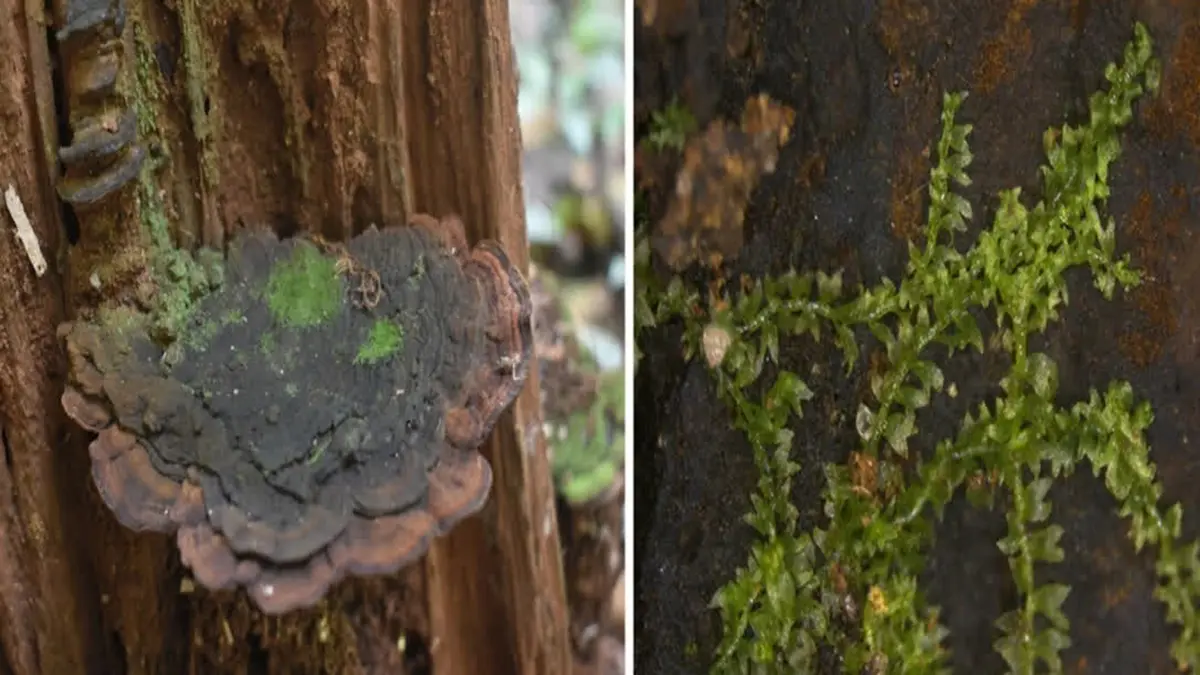
Botanists recently identified a new genus and species of liverwort, named Indocolea devendrae, from the forests of northern Kerala. This discovery is significant because it is only the fifth bryophyte genus ever reported from India.
Background
Liverworts are small, non‑vascular plants belonging to the phylum Marchantiophyta. They lack true roots, stems and leaves and have flattened, lobed bodies called thalli. These plants absorb water directly through their surfaces and often grow on moist soil, rocks or tree bark. Liverworts play a role in soil formation and provide food for invertebrates. They are considered among the earliest land plants, with fossil records dating back more than 470 million years.
Discovery details
- Research team: Scientists from the University of Calicut and Guruvayurappan College (Kozhikode) conducted fieldwork in the evergreen forests of northern Kerala.
- Habitat: The new plant grows on the fruiting bodies of a bracket fungus Phellinus fastuosus that develops on fallen tree trunks. This association with a fungus is unusual for liverworts.
- Naming: The genus Indocolea honours India as the place of discovery, and the species epithet devendrae commemorates bryologist Dr Devendra Kumar Singh. Earlier new genera of bryophytes from India include Aitchisoniella (1914), Sewardiella (1915), Indopottia (2010) and Ramudaria (2018).
Importance
The discovery broadens our understanding of bryophyte diversity and emphasises the ecological richness of the Western Ghats. Liverworts are sensitive to microclimatic changes; finding a new genus after nearly a century underscores how much remains to be discovered in India’s forests. Protecting microhabitats like decaying logs and fungi is vital for the survival of such species.
Conclusion
Indocolea devendrae reminds us that even tiny plants can reveal big stories about evolution and ecology. Continued exploration and conservation of India’s forests will likely lead to more such discoveries, enriching our knowledge of the natural world.