

Why in news?
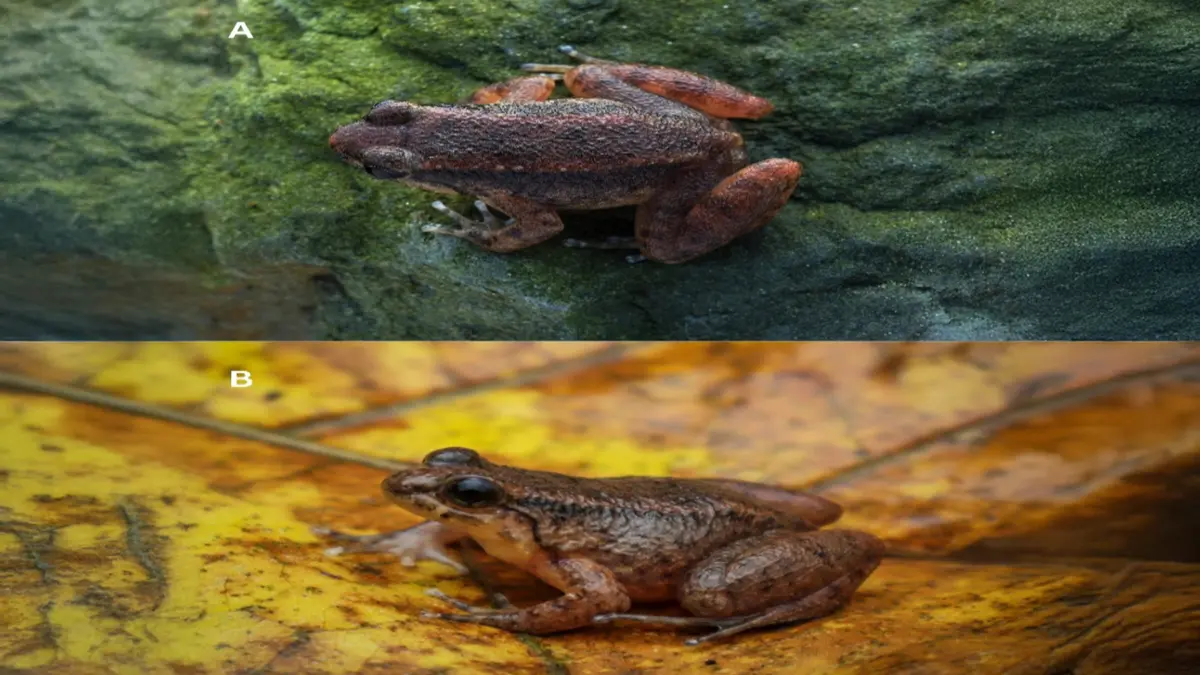
Researchers have described Ingerana aizawl, a frog named after Mizoram’s capital, in a paper published on 14 September 2026. The finding changes the identification of frogs previously recorded in Mizoram as Ingerana borealis. Comparisons of their physical features and genetic material showed that they belong to a distinct species. A report from Northeast Now traced the investigation to streams around the Mizoram University campus and other surveyed locations. This is a new scientific recognition, not evidence that the frog recently appeared in the landscape. It also creates a practical conservation question: how widely does this newly distinguished species occur, and how secure are its stream habitats?
Why a familiar frog can become a new species
A species name connects observations from different places and years. If two different species share one identification, their records become mixed together. Scientists may then overestimate the distribution of one species while overlooking the other. The new description therefore does more than add a name. It allows researchers to reconsider which earlier observations actually belong to this frog.
The study in Zootaxa used an integrative taxonomic approach, combining body characteristics with genetic evidence. Its comparisons included related frogs such as Ingerana borealis, Ingerana occidens and Ingerana tenasserimensis. Differences in size, skin, the visible eardrum and body proportions contributed to the diagnosis. These features matter together; one unusual colour or a small size difference would be weaker evidence.
What genetic comparison adds
The researchers examined a mitochondrial gene associated with 16S ribosomal ribonucleic acid, or RNA. Mitochondria are structures within cells that carry their own genetic material. Comparing the same gene across specimens helps reveal whether apparently similar animals belong to distinct lineages. Here, genetic separation supported the differences found through examination of the frogs’ bodies.
Genetic identification is useful because amphibians can be difficult to distinguish by appearance alone. Earlier research on amphibian identification has shown how short genetic sequences can connect otherwise confusing specimens and life stages. However, a percentage difference is not a universal species test. The interpretation still depends on the animals compared, the gene examined and the wider biological evidence.
The frog and its setting
Northeast Now’s account describes a small, brown to reddish-brown frog with a wrinkled back and a clearly visible circular eardrum. It reports males measuring roughly 22–25.5 millimetres from snout to vent, with females slightly larger in the examined material. The relevant measurement excludes the legs. This avoids confusing body length with the much greater length of a fully stretched frog.
The same report places the frogs around streams and wet areas, including Hratdawng Stream near the university. They were observed on wet rocks at night and sheltering in crevices or leaf litter during daylight. These observations help guide future surveys. They should not, however, be treated as a complete account of the species’ breeding cycle, population or ecological requirements.
Mizoram’s geography places this discovery within a wider borderland landscape. The state adjoins Myanmar to the east and south and Bangladesh to the west. Within India, it borders Tripura, Assam and Manipur. Its steep hills and intervening valleys create many locally distinct environments. A record from Aizawl therefore cannot establish that the same frog occupies every similar-looking stream across the region.
Names, reference specimens and future surveys
In zoological naming, a reference specimen anchors the application of a species name. The International Code of Zoological Nomenclature also defines the type locality: the place of origin of that name-bearing specimen. This provides a stable reference for later comparisons. It does not mean that the species occurs only at that place, or that its entire distribution is already known.
This distinction makes older collections valuable. Specimens labelled with the previous name can be re-examined against the new description. Some records may need correction; others may remain uncertain because the necessary features were not recorded. A responsible distribution map should distinguish confirmed identifications from records that still require examination, instead of transferring every historical locality automatically.
The discovery also changes how conservation evidence should be assembled. A population estimate for the formerly used name cannot simply be assigned to the new species. Nor should another frog’s threat category be inherited. Targeted surveys would need to establish occurrence, habitat condition and possible pressures before drawing conclusions about population security or conservation status.
Conclusion
Ingerana aizawl shows why biodiversity research remains important even around familiar institutions and settlements. Careful comparison has revealed a distinct frog within material once grouped under another name. The next task is to connect that taxonomic finding with reliable field knowledge. Clear identification, traceable specimens and repeated habitat surveys will make the discovery useful for understanding and protecting Mizoram’s amphibians.