

Why in news?
Indian Railways has approved Kavach Version 4.0 for more than 600 route kilometres in North Eastern Railway's Lucknow Division. Akashvani reported the approval on 19 September, putting the project's cost above ₹250 crore. Kavach is an automatic train-protection system that monitors permitted movement and speed, and can apply brakes when required. The approved work concerns identified remaining sections of the division and is intended to strengthen operational safety. Approval does not mean that every installation is already operational. The safety layer links trackside equipment, station signalling, communications and equipped locomotives. These components must work together before trains receive the intended protection.
The problem an automatic protection system addresses
A locomotive driver must respond correctly to signals and speed restrictions while controlling a train that cannot stop instantly. Fog, workload or an error can make a dangerous situation worse. Automatic train protection (ATP) adds technical supervision to this process. Kavach checks whether the train is operating within the permitted conditions and can intervene through braking. It supplements the driver's work; it does not make the train driverless.
A central risk is passing a signal that requires a train to stop. This is called signal passing at danger. Another is exceeding the permitted speed. An automatic intervention can reduce the chance that such an error develops into a collision. The distinction is important: the system addresses defined operational hazards. It is not a universal detector of every broken rail, track obstruction or mechanical defect that could cause an accident.
How the equipment works together
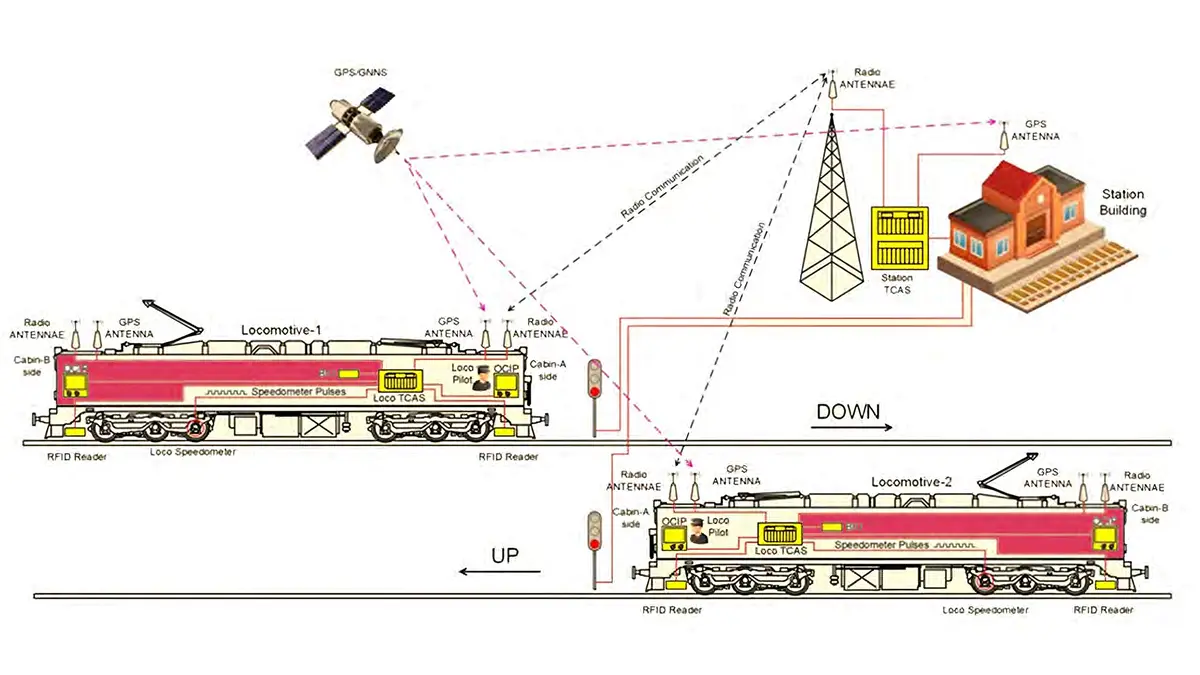
Kavach relies on information about the train's location and the movement permitted by the signalling system. Radio-frequency identification tags placed along the track provide location references to equipment on the locomotive. Station equipment interfaces with signalling, while a radio network exchanges information with locomotives. Optical-fibre connections support communication between installations. Each component contributes to a shared picture of where a train is and what it may safely do next.
The locomotive installation is connected to the braking system. It can display signal information inside the cab and supervise the train's speed. When intervention is required, this connection allows automatic braking rather than merely sounding an advisory warning. However, receiving reliable information remains essential. Trackside devices, station interfaces, communications and onboard equipment must be installed and integrated properly for the complete protection arrangement to function.
What Version 4.0 changes
The Research Designs and Standards Organisation approved the Version 4.0 specification on 16 July 2024. The Railways described improvements in location accuracy, signal information in large yards and interfaces between stations. The specification also provides a direct interface with existing electronic interlocking. An interlocking coordinates signals and track points so that conflicting train movements are not authorised together. Better interfaces help Kavach use this established safety information.
The sequence from specification to service is important. A technical standard defines the required system, but individual routes still need equipment, testing and commissioning. Version 4.0 was commissioned on the Mathura–Kota section in July 2025. That earlier operation demonstrates deployment of the version; it does not establish that the newly approved Lucknow sections are already covered. Each project's progress must be assessed on its own installation and operational record.
Understanding coverage and safety claims
The new approval concerns North Eastern Railway's Lucknow Division. The divisional name should not be confused with the separate Lucknow Division of Northern Railway. Its reported extent is measured in route kilometres, describing the length of railway routes covered. That is different from counting every parallel track separately. A double-track route can therefore have more track kilometres than route kilometres, without any contradiction in the figures.
Kavach is designed to Safety Integrity Level 4, a demanding category for safety-related systems. This concerns the reliability requirements for the system's safety functions. It should not be translated into a promise of zero accidents across the railway. Actual protection also depends on installation, equipment condition, operating rules and the hazards involved. A high safety-design standard strengthens one layer of defence without removing the need for other layers.
From sanction to dependable everyday operation
Rolling out the system involves work beside active railway lines and inside locomotives and stations. Equipment must be integrated without compromising ongoing passenger and freight services. Staff also need training to operate and maintain it. A route's announced coverage therefore says less about readiness than a completed sequence of installation, tests and operational acceptance. Monitoring that sequence helps distinguish expenditure and construction progress from safety capability actually available to trains.
Conventional safeguards remain necessary after commissioning. Track maintenance, signalling discipline, rolling-stock inspection and competent driving address risks outside automatic protection's complete reach. These measures are complementary, not alternatives competing for relevance. Kavach's particular contribution is to intervene when specified movement or speed conditions are breached. Understanding that role makes its expansion significant without suggesting that a single technology can solve every railway-safety problem.
Conclusion
The Lucknow approval expands the planned reach of Kavach 4.0, but its benefit will arrive through complete, tested deployment. The decisive outcome is not the approval figure alone: equipped trains must receive dependable protection on the approved sections. By joining accurate location, signalling information and automatic braking, Kavach can strengthen operational safety. Its value is greatest when it works alongside the railway's wider maintenance and operating safeguards.