

Why in news?
During bilateral meetings in New Delhi on 20 February 2026, India’s Agriculture Minister and his Brazilian counterparts discussed deepening cooperation in agriculture and allied sectors. This engagement provides a timely opportunity to revisit essential facts about Brazil’s geography and natural resources.
Background
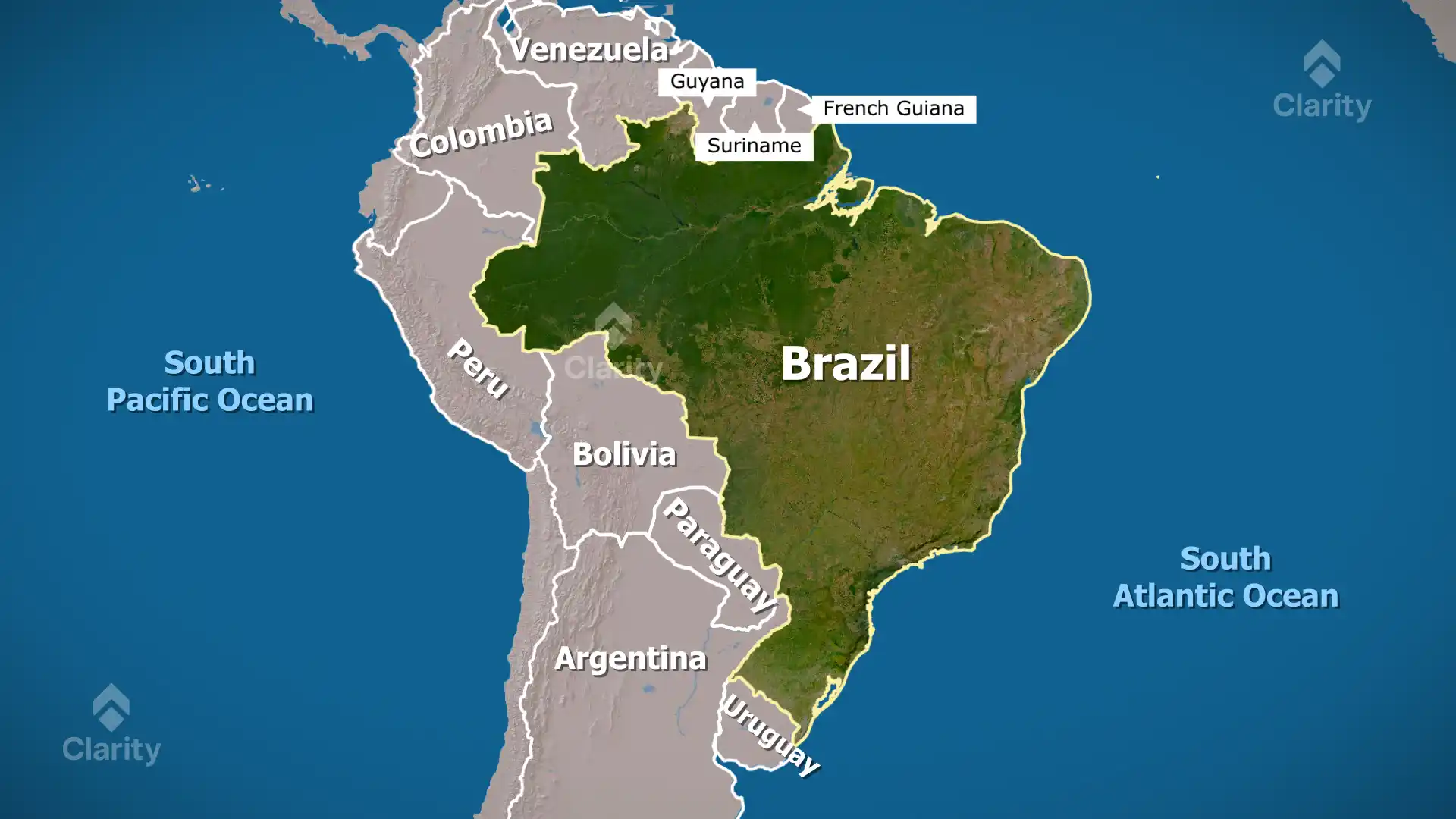
Brazil, officially the Federative Republic of Brazil, is the largest country in South America and the fifth largest in the world by area. Occupying nearly half of South America’s landmass, it is geographically straddled by the Equator and the Tropic of Capricorn and shares borders with every South American country except Chile and Ecuador. The country’s capital is Brasília, while its largest city and economic powerhouse is São Paulo. Portuguese is the official language, making Brazil the largest Portuguese‑speaking nation worldwide.
Geography and neighbours
- Location: Brazil is situated in the eastern and central part of South America and is bordered by the Atlantic Ocean to the east. Its extensive coastline extends for about 7,500 km.
- Borders: It shares frontiers with Colombia, Venezuela, Guyana, Suriname and French Guiana to the north; Peru and Bolivia to the west; Argentina and Paraguay to the southwest; and Uruguay to the south.
- Regions: Major physiographic zones include the Brazilian Highlands (a plateau occupying much of the centre and south), the Amazon Basin (home to the world’s largest tropical rainforest) and the Pantanal wetlands (one of the world’s largest freshwater marshes).
- Highest peak: The country’s highest point is Pico da Neblina at 2,999 m, located near the Venezuelan border in the Guiana Highlands.
Rivers and ecosystems
- Amazon River: The second‑longest river in the world, it drains a basin covering over 40 per cent of Brazil and supports unparalleled biodiversity.
- São Francisco River: Flowing entirely within Brazil, it runs north–south through the semi‑arid Northeast before emptying into the Atlantic.
- Iguaçu (Iguazu) River: A tributary of the Paraná River in southern Brazil, known for the spectacular Iguazu Falls on the border with Argentina.
- Rainforest and wetlands: The Amazon rainforest holds more than 60 per cent of its area within Brazil, while the Pantanal wetlands are rich in birdlife and other wildlife.
Natural resources
- Mineral wealth: Brazil is the world’s largest producer of niobium and a leading producer of iron ore, manganese, bauxite (aluminium ore) and tin. Significant deposits of copper, gold and gemstones are also found, especially in the Brazilian Highlands and the states of Pará and Minas Gerais.
- Hydropower: Numerous rivers and waterfalls provide abundant hydroelectric potential, exemplified by the Itaipu Dam on the Paraná River, one of the world’s largest hydroelectric facilities.
- Biodiversity: The country hosts a vast array of plant and animal species across rainforests, savannahs and wetlands, making it a global biodiversity hotspot.
Source: PIB