
Why in news?
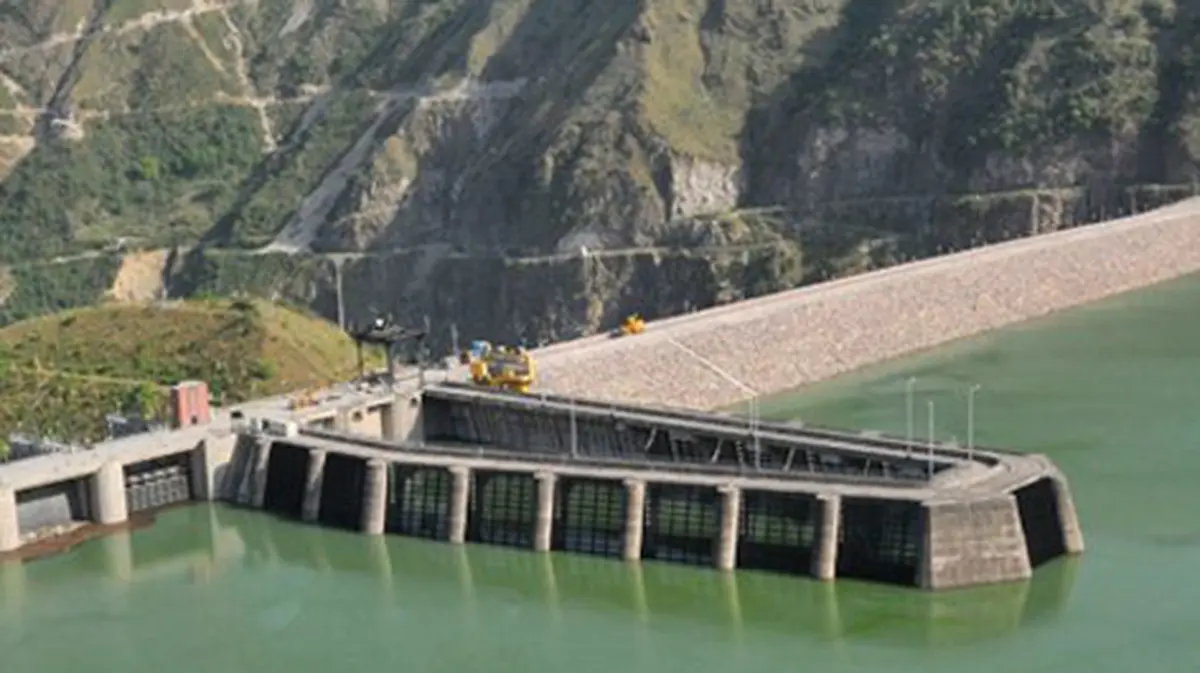
Koldam generated 3,512 million units during financial year 2025–26. This was its highest annual output since commissioning. The 800-megawatt station lies on the Satluj River in Himachal Pradesh. The record renewed attention on hydropower capacity, energy and river management.
Background
Koldam is the first hydropower station developed by National Thermal Power Corporation Limited, now NTPC Limited.
The public-sector company also operates major thermal, solar and other electricity projects.
The project stands on the Satluj River in Bilaspur district, Himachal Pradesh.
Its four generating units can each produce 200 megawatts, giving 800 megawatts overall.
Project chronology
| Stage | Development |
|---|---|
| Construction period | NTPC built a large rock-and-gravel dam across the Satluj. |
| 2015 | All four generating units entered commercial operation during the year. |
| Design estimate | The station’s expected annual generation was about 3,055 million units. |
| 2025–26 | Output reached a record 3,512 million units. |
Understanding the record
A megawatt measures instantaneous generating capacity, while a unit measures electricity produced over time.
One electricity unit equals one kilowatt-hour for ordinary billing purposes.
One million units equal one gigawatt-hour.
Koldam’s 3,512 million units therefore equal 3,512 gigawatt-hours of annual electricity.
The output was roughly 15 per cent above its stated design energy.
It represented an annual capacity factor near 50 per cent.
Why can annual hydropower output change?
- River inflows depend on rainfall, snowmelt and changing upstream water conditions.
- Reservoir operations decide when stored water can pass efficiently through turbines.
- Machine availability changes with maintenance schedules, unexpected faults and planned outages.
- Regional grid demand influences when the operator schedules available generation.
- Environmental, structural and safety rules can restrict permissible operating levels.
A single high-output year cannot alone establish a permanent increase in available river water.
How does the station generate electricity?
- The dam stores and raises river water, creating a usable hydraulic head.
- Intake structures direct controlled water through large high-pressure conduits.
- Fast water flow rotates Francis turbines suited to medium-head operating conditions.
- Connected generators convert continuous turbine rotation into usable electrical energy.
- Power transformers raise voltage before efficient transmission to the northern regional grid.
The dam uses rock and gravel with an impervious central clay core.
This core limits seepage, while the surrounding material provides structural stability.
The Satluj River
The Satluj is the easternmost major tributary within the Indus river system.
It rises near the Kailash region on the Tibetan Plateau and enters India through Himachal Pradesh.
The Beas first joins the Satluj at Harike in Punjab.
Farther downstream, the combined river meets the Chenab, forming the Panjnad before entering the Indus.
Important Indian projects include Nathpa Jhakri, Karcham Wangtoo, Bhakra and Koldam.
Grid evacuation
Koldam connects through high-voltage transmission infrastructure associated with the northern regional grid.
Technical documents describe 400-kilovolt double-circuit lines for moving large power blocks reliably.
Benefits and trade-offs
| Potential benefit | Management concern |
|---|---|
| Low operational carbon emissions | Reservoir construction changes land and aquatic habitats. |
| Fast generation response | Flow changes can affect downstream river ecology. |
| Peak-demand support | Sediment accumulation can reduce long-term storage performance. |
| Domestic renewable electricity | Large projects can require displacement and rehabilitation. |
Himalayan projects also require strong seismic, slope and sediment monitoring.
Koldam lies within Seismic Zone V, India’s highest broad hazard category.
Conclusion
Koldam’s record shows strong operations, while long-term value still depends on careful river management.