
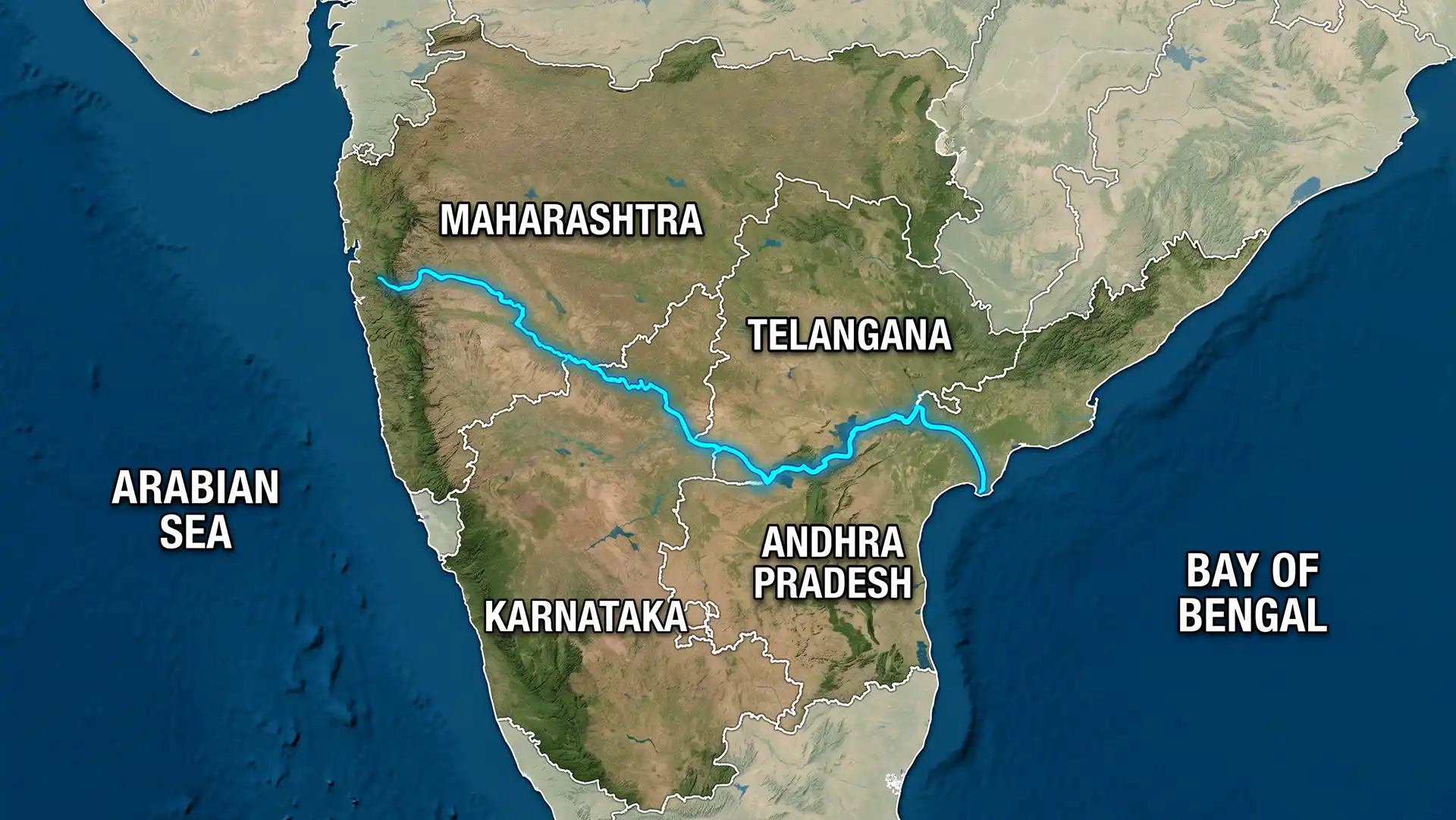
Why in news?
A week-long dry spell reduced inflows into the upper Krishna system. The affected headwaters lie in Karnataka and Maharashtra. Authorities withheld irrigation releases while assessing available water. The situation shows how rainfall quickly influences reservoir decisions.
Background
The Krishna is a major east-flowing peninsular river, and it begins near Mahabaleshwar in Maharashtra’s Western Ghats.
The source lies at roughly 1,337 metres above sea level, and the river travels about 1,400 kilometres.
It flows through Maharashtra, Karnataka, Telangana and Andhra Pradesh, and it enters the Bay of Bengal near Hamsaladeevi.
The drainage basin covers about 258,948 square kilometres, and this area is nearly eight per cent of India.
Ranking caution: River rankings change with the chosen measure. It is safer to use the official basin area and length.
What is a river basin?
A river basin is the land drained by one river and its tributaries. High ridges form its outer watershed boundary.
Rain falling inside that boundary eventually reaches the shared river system, and some water first enters soil or underground aquifers.
The Krishna basin is shared by Maharashtra, Karnataka, Telangana and Andhra Pradesh.
Which are the important tributaries?
- The Koyna drains heavy-rainfall areas of Maharashtra.
- The Panchganga joins the upper Krishna in Maharashtra.
- The Ghataprabha and Malaprabha flow through Karnataka.
- The Bhima is one of the longest tributaries.
- The Tungabhadra forms after the Tunga and Bhadra meet.
- The Dindi, Musi and Munneru join farther downstream.
Tributaries spread rainfall effects across a large basin, and low rain in one sub-basin may not affect every reservoir equally.
Which major projects use Krishna water?
Large reservoirs store monsoon water for later use, and they also support electricity generation, drinking supply and flood management.
- Almatti and Narayanpur are important upper-basin projects.
- Srisailam is a major multipurpose reservoir farther downstream.
- Nagarjuna Sagar supports irrigation and power generation.
- Prakasam Barrage distributes water across the delta.
- Major tributaries also contain several large dams.
A dam’s location matters during shortage. An upstream release can support users downstream but reduce stored water at the first reservoir.
Why did a short dry spell matter?
The Western Ghats force moisture-laden monsoon winds upward, and this process produces heavy rain around the upper catchment.
Steep slopes quickly send part of that rainfall into streams, and reservoir inflow can therefore fall soon after rainfall weakens.
A dry spell is a short rain-free or low-rain period, but it is not automatically a meteorological drought.
Drought describes a longer and broader shortage, and it is measured against expected rainfall, water or soil-moisture conditions.
Do not confuse: Inflow is water entering a reservoir. Storage is water already held, while release is water leaving it.
How do authorities decide an irrigation release?
- Current reservoir storage provides the starting position.
- Recent inflow shows how quickly storage is changing.
- Weather forecasts indicate possible future replenishment.
- Drinking water normally receives high priority.
- Crop stage determines the urgency of irrigation demand.
- Hydropower and ecological needs also require consideration.
- Flood season may require empty space for incoming water.
Withholding water temporarily can preserve a limited reserve, and prolonged delay can still damage crops at sensitive growth stages.
Managers must therefore revise decisions as rain and inflow change, and one week’s decision does not settle the entire season.
How did the water-sharing dispute develop?
- The first Krishna Water Disputes Tribunal was constituted in 1969.
- Its award was officially notified on 31 May 1976.
- A second tribunal was constituted in April 2004.
- It issued decisions during 2010 and 2013.
- Telangana became a separate state in June 2014.
- Reorganisation created new questions between Telangana and Andhra Pradesh.
- The Krishna River Management Board now manages specified interstate projects.
The Board was created under the Andhra Pradesh Reorganisation Act, 2014. Tribunal and court proceedings continue to shape water administration.
Water disputes become sharper during low-flow years, and upstream storage, downstream needs and changing crop patterns can create competing claims.
What can improve basin management?
- Reservoir data should be timely and publicly accessible.
- States need shared rainfall and inflow forecasts.
- Crop planning should reflect dependable water availability.
- Efficient irrigation can reduce avoidable losses.
- Groundwater use must remain within recharge limits.
- Environmental flows should support the river ecosystem.
Conclusion
Krishna management depends upon changing monsoon inflows and interstate cooperation, and transparent data can support fairer and faster release decisions.