

Why in news?
Around World Environment Day 2026, a camera‑trap survey in Madhya Pradesh’s Kuno National Park recorded a wild Caracal—also known as the “flying cat”—for the first time in decades. The sighting is significant because Caracals are among India’s most elusive wild cats, and their presence signals improving grassland health.
Background
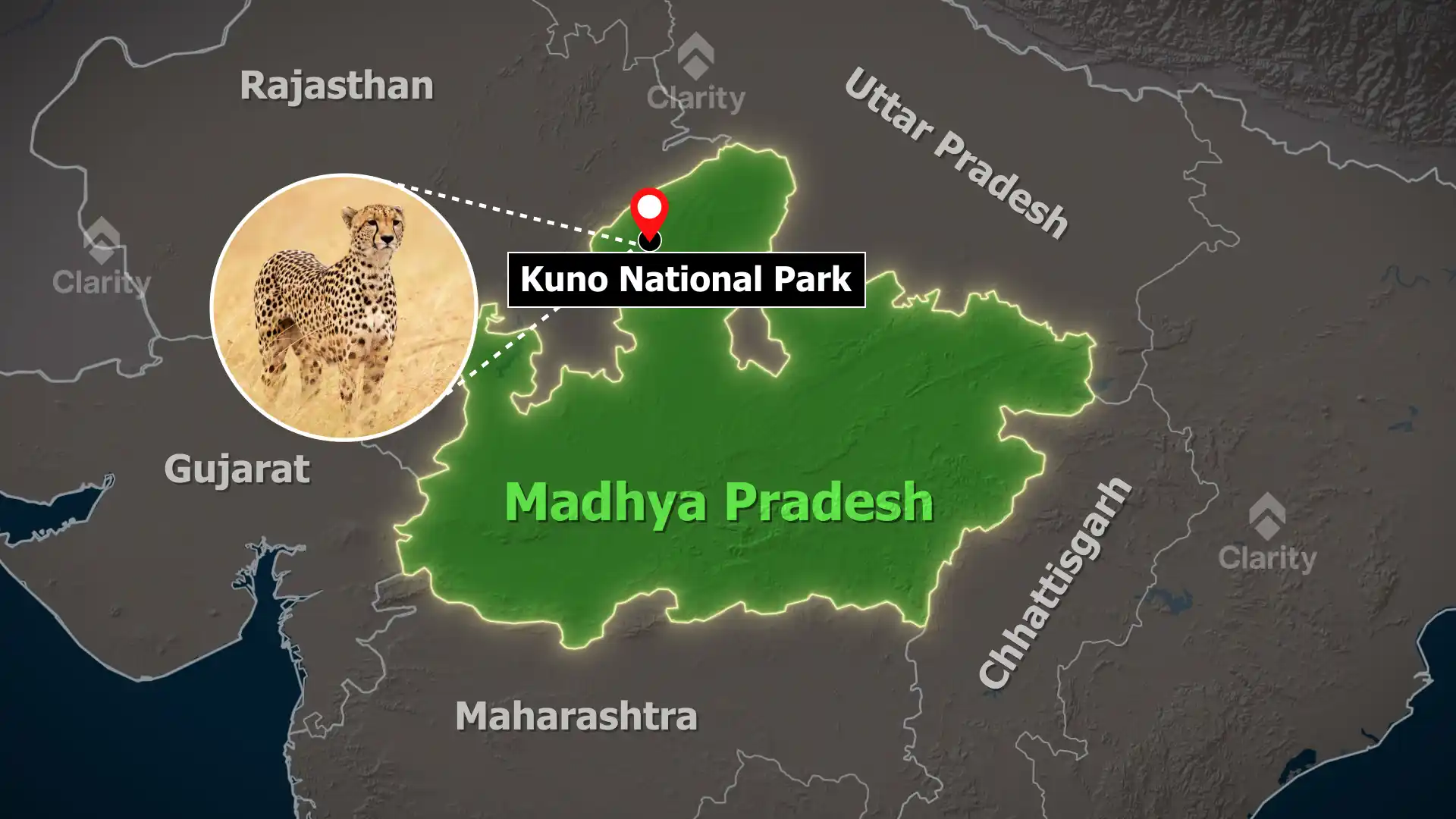
Kuno National Park lies in the Gwalior–Chambal region of Madhya Pradesh, covering about 748.76 square kilometres. It was established as a wildlife sanctuary in 1981 and upgraded to a national park in 2018. The park derives its name from the Kuno River, which flows northward through the Vindhyan hills and divides the protected area. Historically, Kuno was proposed as a site for reintroducing the Asiatic lion to create a second wild population outside Gujarat’s Gir sanctuary; villages were relocated to make space for this project. More recently, the park gained attention as the release site for African cheetahs under Project Cheetah.
Habitat and biodiversity
- Landscape: The terrain includes plateaus, valleys and seasonal streams, with tropical dry deciduous forests and extensive grasslands. The dominant trees are khair (Acacia catechu), salai (Boswellia serrata) and kardhai (Anogeissus pendula). There are more than 120 species of trees, along with diverse shrubs, grasses and bamboo.
- Herbivores: Common mammals include chital, sambar, nilgai, chinkara, blackbuck, four‑horned antelope (chousingha), wild boar, porcupine and Indian hare. Large grasslands support ungulates in sizeable numbers.
- Predators: Kuno hosts Indian leopard, jungle cat, sloth bear, dhole (Indian wild dog), striped hyena and Indian wolf. The elusive Caracal now adds to this list. More than 120 bird species and numerous reptiles also inhabit the park.
Conservation initiatives
- Asiatic lion project: Since the 1990s Kuno has been identified as the second home for Asiatic lions to reduce the risk of a single‑population extinction. Although lions have not yet been moved due to political resistance, habitat restoration and village relocation were undertaken in preparation.
- Project Cheetah: In September 2022 eight cheetahs from Namibia were released into Kuno; in February 2023 another 12 cheetahs from South Africa joined them. These translocations aim to reintroduce the species after it vanished from India in the 1950s. Managed enclosures and prey augmentation help acclimatise the cats before release.
- Habitat management: Forest authorities have undertaken grassland restoration, invasive species removal and scientific monitoring to improve the park’s ecological balance. The recent Caracal sighting is viewed as proof that these efforts are enhancing biodiversity.
Significance of the Caracal sighting
The Caracal is often called the “ghost of the grasslands” because of its secretive habits. Once widespread across western and central India, it is now among the country’s rarest predators. Wildlife experts note that the return of a top predator indicates healthy prey populations and well‑managed grasslands. The sighting has therefore been welcomed as a positive sign for conservation not only in Kuno but also in other dryland habitats.
Conclusion
Kuno National Park exemplifies India’s evolving approach to conservation—moving from single‑species protection to landscape‑level restoration. The park’s diverse habitats support a range of fauna, from ungulates to big cats, and recent initiatives like Project Cheetah and habitat management are bearing fruit. The Caracal’s reappearance adds a hopeful chapter to this story and underscores the importance of preserving grasslands alongside forests.