

Why in news?
Geologists from the Wadia Institute of Himalayan Geology have reconstructed the history of the Ladakh Magmatic Arc (LMA), a belt of igneous rocks in the Trans‑Himalaya. Their research documents how subduction and plate collision formed the arc and shaped the Himalaya.
Background
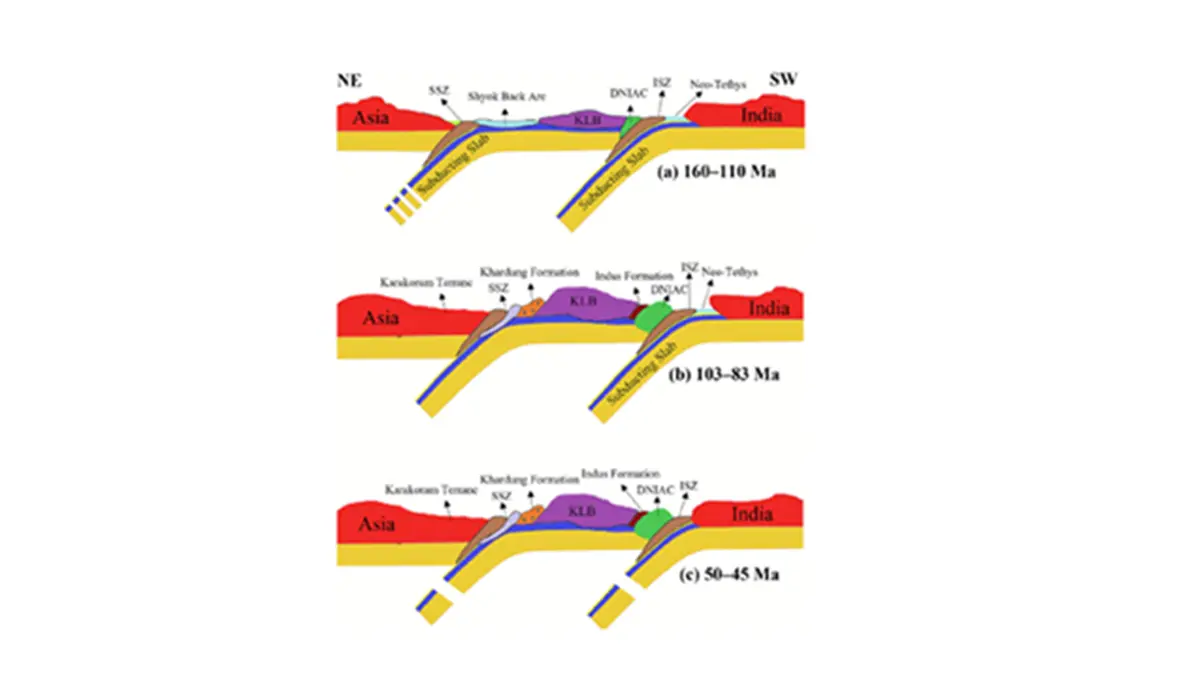
The LMA stretches through the Trans‑Himalayan region and records geological events from about 201 million to 34 million years ago. It formed above the Neo‑Tethys Ocean, where an oceanic plate plunged beneath the Eurasian margin. As the Indian and Eurasian plates converged, magmatic activity progressed through distinct phases, eventually culminating in the uplift of the Himalaya.
Three phases of formation
- Island arc stage (160–110 Ma): Early in the Jurassic period, the region resembled a chain of volcanic islands. Rocks from the Dras–Nidar Island Arc Complex preserve evidence of magma derived mainly from the mantle, with little contribution from sediments.
- Batholith formation (103–45 Ma): As convergence intensified, large granitic bodies called the Ladakh Batholith formed. Chemical signatures show increased input from continental crust and recycled sediments as the impending India–Eurasia collision enriched the magma.
- Post‑collision magmatism (< 45 Ma): After the Neo‑Tethys Ocean closed and the plates collided, molten rock continued to rise through cracks, forming mafic dykes. These rocks indicate lingering tectonic and magmatic activity fed by an already enriched mantle source.
Significance
- Understanding mountain building: The study provides a detailed timeline of volcanic and tectonic events leading up to the formation of the Himalaya, enhancing our knowledge of plate tectonics.
- Geochemical insights: By analysing rare elements and isotopes, scientists traced how mantle and crustal materials mixed over time, shedding light on the processes that shaped the LMA.
- Educational value: The LMA serves as a natural laboratory for students and researchers interested in earth history, showcasing how oceans close and continents collide.
Conclusion
Decoding the Ladakh Magmatic Arc helps geologists piece together the story of the Himalaya’s birth. The research not only reconstructs ancient volcanic events but also underscores India’s growing expertise in geoscience.
Source: Press Information Bureau