
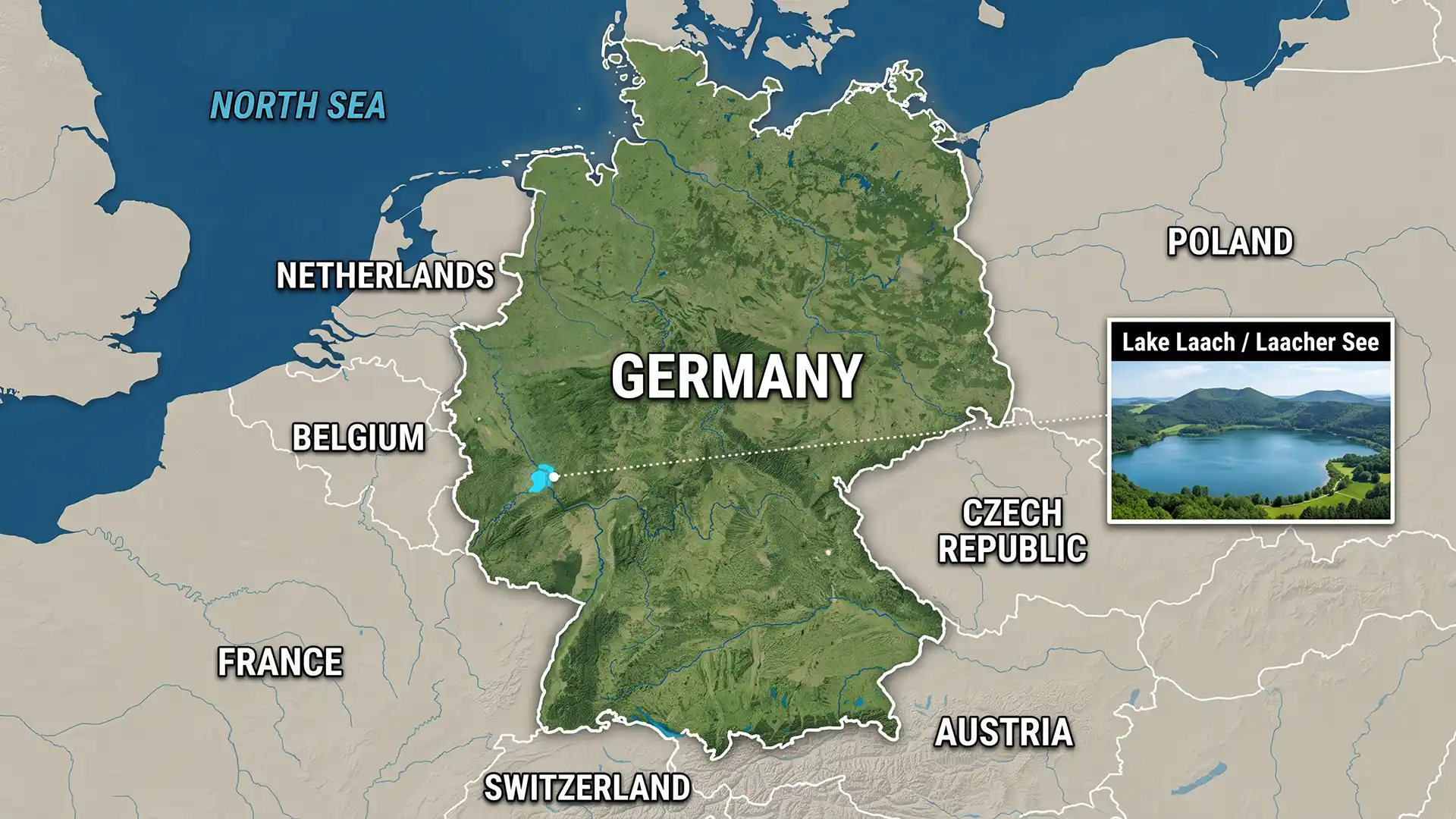
Why in news?
Scientists from Germany’s geoscience institutes reported new findings from a dense seismic experiment around Lake Laach (Laacher See) in June 2026. More than one thousand tiny earthquakes were mapped, revealing a slanted magma reservoir beneath the volcano. These results reassure residents that no immediate eruption is expected but show that the system is still active.
Background
Lake Laach is a caldera lake in the Eifel region of western Germany. About 13 thousand years ago a huge eruption formed the present crater, ejecting ash across Europe. The volcano has been considered dormant, but gas emissions and occasional tremors indicate that magma remains at depth. The region is part of the Eifel volcanic field, where small eruptions have occurred over millions of years. Understanding its behaviour helps assess risks for populated areas along the Rhine Valley.
What the study found
- Large‑N experiment: Researchers placed over 500 seismic sensors and a 64‑kilometre fibre‑optic cable around the lake and nearby villages. They recorded micro‑earthquakes at depths of 10–16 kilometres.
- Slanted reservoir: Data show that the magma storage region is deeper and tilts towards the Neuwied Basin rather than sitting directly below the crater. This contrasts with earlier models of a vertical conduit.
- Fluids and cracks: Unusual seismic reflections suggest that magmatic fluids are pooling between layers of rock and widening cracks. These fluids may maintain the current swarm of micro‑quakes.
- No imminent eruption: Volcanologists stress that the observed activity indicates a living system but does not point to an upcoming eruption. Future eruptions could occur at a different vent within the volcanic field rather than at Lake Laach itself.
Conclusion
Regular monitoring and improved imaging techniques help scientists understand dormant volcanoes. While Lake Laach poses no immediate threat, the research provides valuable data for hazard planning in Europe’s most populated region.