
Why in news?
Pilgrims undertaking the 2026 Kailash Manasarovar Yatra could not bathe inside Lake Manasarovar. Chinese authorities continued their prohibition on entering the lake for a holy dip. The restriction disappointed pilgrims who consider the water sacred. It also renewed attention towards the lake’s geography and fragile environment.
Background
Lake Manasarovar is also commonly written as Mansarovar, especially in Indian news and general usage.
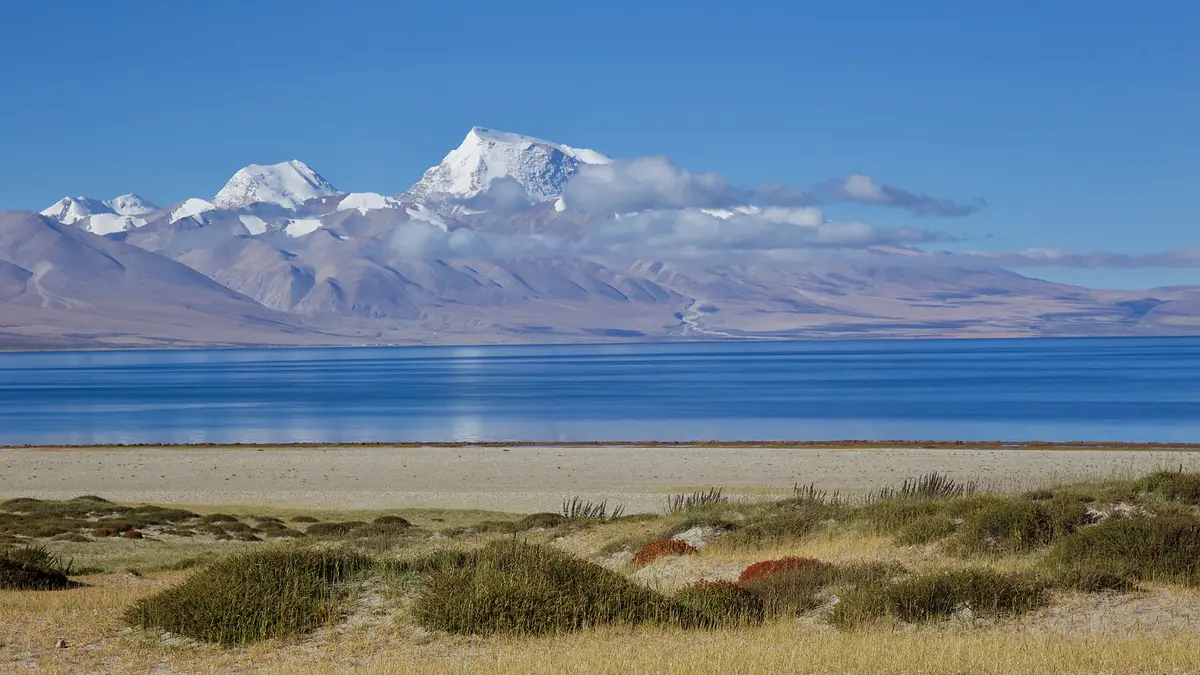
It is a high-altitude freshwater lake in Burang County within China’s Tibet Autonomous Region.
Mount Kailash rises north of the lake, while Gurla Mandhata rises towards its south.
The lake is sacred within Hindu, Buddhist, Jain and Bon traditions.
Different traditions explain its sacredness through their own texts and beliefs.
Physical features
| Feature | Important detail |
|---|---|
| Location | It lies in south-western Tibet, near Mount Kailash. |
| Elevation | Its surface lies about 4,590 metres above sea level. |
| Water type | It is a freshwater lake within a cold, dry plateau. |
| Global distinction | It is among the world’s highest large freshwater lakes. |
| Northern landmark | Mount Kailash stands north of the lake. |
| Southern landmark | Gurla Mandhata, or Naimona’nyi, rises southwards. |
Published lake-area estimates differ with mapping methods and water levels, so every quoted area remains approximate.
Manasarovar and Rakshastal
Lake Rakshastal lies immediately west of Manasarovar, but it contains saline rather than fresh water.
A natural channel called Ganga Chhu connects them and may carry Manasarovar’s overflow towards Rakshastal.
The neighbouring lakes therefore have different water chemistry despite their proximity.
Are four major rivers born from the lake?
The broader Kailash region lies near the headwaters of the Indus, Sutlej, Yarlung Tsangpo and Karnali systems.
The Yarlung Tsangpo later enters India as the Siang and becomes Brahmaputra.
The Karnali flows into the Ghaghara, which later joins the Ganga.
Why is the lake environmentally fragile?
The plateau has cold temperatures, strong sunlight and a short growing season.
Biological recovery can therefore remain slow after physical disturbance.
Waste decomposes slowly under these cold conditions, while sudden visitor pressure can damage sensitive shore habitats.
Bathing products, litter and repeated trampling can degrade sensitive lake edges.
Climate change may also alter glaciers, snowmelt and the regional water balance.
Kailash Manasarovar Yatra
The Ministry of External Affairs coordinates India’s official pilgrimage arrangements with Indian agencies and relevant Chinese authorities.
The journey involves international travel, high altitude and difficult weather.
Participants undergo medical assessment, while the Indo-Tibetan Border Police conducts additional fitness checks along Indian routes.
Official routes during 2026
| Route | 2026 batches | Approximate duration | Estimated cost |
|---|---|---|---|
| Lipulekh Pass through Uttarakhand | Ten batches | About 22 days | About ₹2.09 lakh per pilgrim |
| Nathu La through Sikkim | Ten batches | About 21 days | About ₹3.31 lakh per pilgrim |
The online application deadline for both official 2026 yatra routes was 19 May 2026.
The official programme does not provide a general travel subsidy.
Why does high altitude require special care?
Air pressure and available oxygen fall significantly as pilgrims ascend towards the lake’s very high elevation.
Rapid ascent can cause headache, nausea, tiredness and disturbed sleep.
Severe altitude illness can affect the brain or lungs.
Gradual acclimatisation and medical screening therefore protect pilgrims.
Understanding the bathing restriction
The current restriction prevents pilgrims from physically entering the lake for a traditional holy dip.
A religious wish does not create an automatic international travel entitlement.
Pilgrims must follow local rules, visa conditions and official group instructions.
Environmental protection can also require limits within culturally important landscapes.
Conclusion
Lake Manasarovar unites faith and geography, while responsible pilgrimage must respect health, borders and ecological limits.