
Why in News?
Latvia’s Prime Minister Evika Siliņa resigned amid controversy over how her government handled a series of stray drones, believed to be Ukrainian, that crossed into Latvian airspace. The incident exposed weaknesses in Latvia’s air‑defence system and caused her coalition to collapse ahead of parliamentary elections.
Background of the Resignation
Latvia borders Russia and Belarus and is a member of both the European Union and NATO. Since Russia’s invasion of Ukraine in 2022, the Baltic states have heightened vigilance against aerial threats. Between March and May 2026, several drones launched by Ukraine against Russia were reportedly deflected by Russian electronic warfare and strayed into Latvia, Lithuania and Estonia. On 7 May two stray drones exploded at an oil storage facility in Latvia, prompting public concern.
Prime Minister Evika Siliņa, leader of the centre‑right New Unity party, responded by sacking Defence Minister Andris Sprūds of the Progressive Party, accusing him of failing to develop adequate anti‑drone defences. The Progressives withdrew their support from the coalition, leaving the government without a majority in the 100‑seat parliament. Facing a no‑confidence vote, Siliņa resigned on 14 May 2026. Latvia’s president began consultations with parties to form a new government.
Geography and Features of Latvia
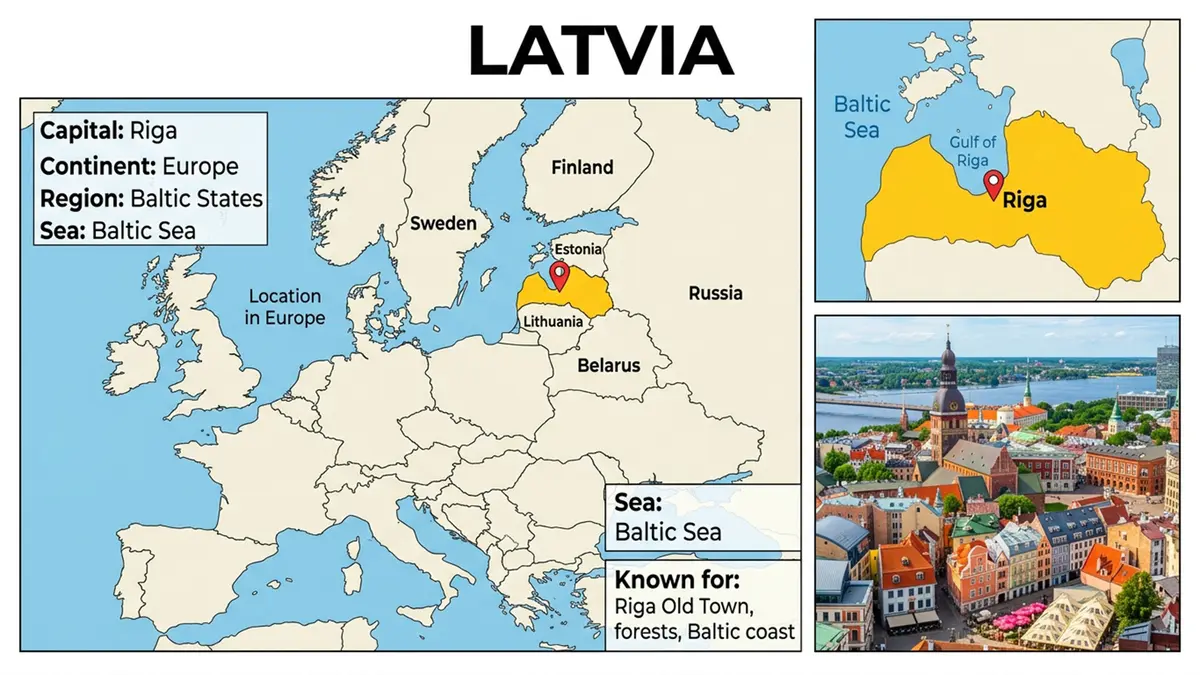
- Location: Latvia is a Baltic country in northeastern Europe, bordered by Estonia to the north, Lithuania to the south, Belarus to the southeast and Russia to the east. It has a coastline along the Baltic Sea and the Gulf of Riga.
- Climate: The country experiences a temperate continental climate moderated by the Baltic Sea. Winters are cold and snowy, while summers are mild and humid. Average January temperatures range from −1.7 °C in coastal cities to −6.6 °C inland, and July temperatures hover around 17 °C.
- Topography: About 98 % of Latvia lies below 200 m elevation. The highest point is Gaiziņkalns, which rises to 312 m above sea level. The landscape is characterised by low uplands, moraine hills and broad lowlands formed by glacial activity.
- Rivers and lakes: Latvia has over 12,000 rivers; only 17 exceed 100 km in length. The major rivers are the Daugava, Gauja, Lielupe, Venta and Salaca. Lake Lubāns is the largest lake. Many rivers drain into the Gulf of Riga, providing hydropower and transport routes.
- Natural resources: While Latvia lacks major mineral wealth, it has abundant limestone, gypsum, clay, dolomite and peat, which are used for construction and fuel. Amber, washed up from the Baltic Sea, is a traditional export. Forests cover more than half the country, supporting timber and biodiversity.
- Capital city: Riga, located on the Daugava River near its mouth on the Gulf of Riga, is the capital and largest city.
Significance
- The resignation underscores the security challenges facing Baltic states as the conflict in Ukraine spills over into neighbouring airspace.
- Latvia’s geography – a small, low‑lying nation with extensive forests and rivers – shapes its economic activities, particularly forestry and agriculture.
- Understanding Latvia’s topography and resources is important for regional planning, particularly for developing air‑defence infrastructure and cross‑border cooperation.
Conclusion
Evika Siliņa’s resignation highlights both the political fragility of coalition governments and the broader impact of the Russia‑Ukraine war on neighbouring countries. Latvia’s geography makes it strategically important and necessitates constant vigilance to protect its airspace and natural resources.
Source: TH

