

Why in news?
The Masroor rock‑cut temple complex in Himachal Pradesh is drawing renewed attention from heritage lovers and tourists. Often called the “Ellora of the Himalayas,” the site showcases early medieval Indian rock‑cut architecture and is being highlighted for potential inclusion on UNESCO’s World Heritage list.
Background
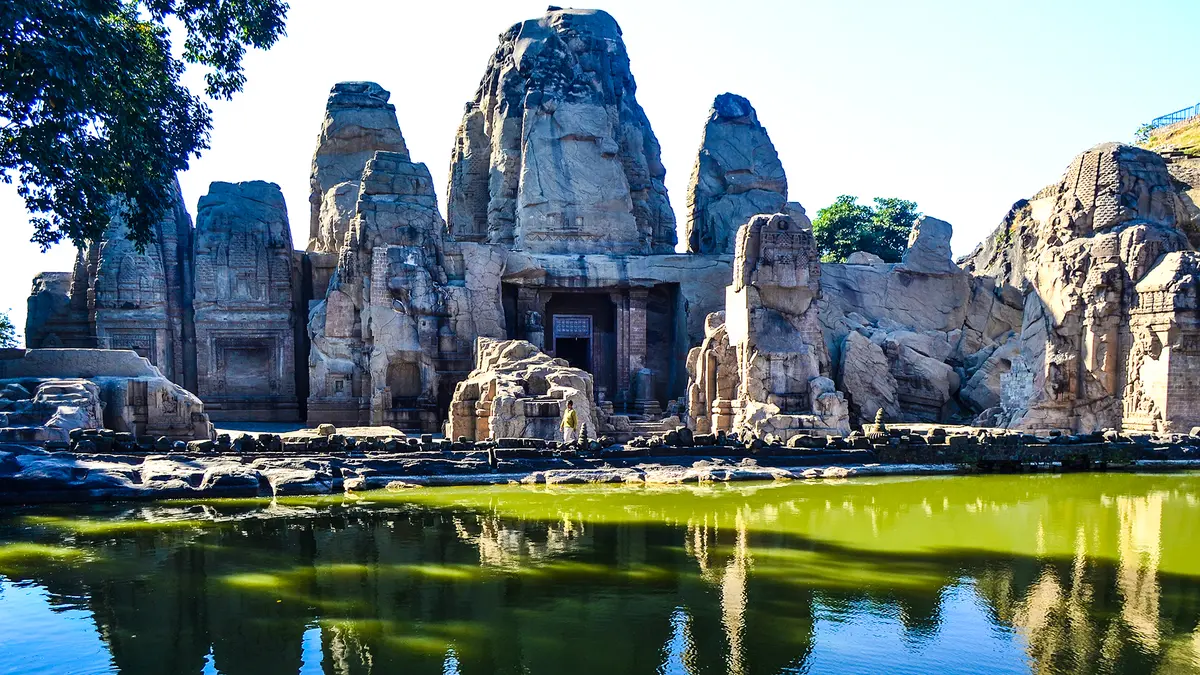
Located in the Kangra Valley near the Beas River, the Masroor complex was carved from a single sandstone outcrop around the 8th century. It faces northeast towards the snow‑covered Dhauladhar range and follows the North Indian Nagara style of temple architecture. The main shrine, dedicated to Shiva, is surrounded by smaller shrines in a symmetric square plan with a sacred pool in front. Historical records suggest that the site was first reported by British engineer Henry Shuttleworth in 1913 and later surveyed by archaeologist Harold Hargreaves in 1915.
Artistic features
- Monolithic design: The entire complex was chiseled from a single rock, making it one of India’s few free‑standing rock‑cut temple groups. Each shrine has a square base topped by a curvilinear shikhara (tower).
- Iconography: Reliefs depict deities from the Vedic and Puranic traditions, including forms of Shiva, Vishnu and Devi. Many carvings were damaged by earthquakes, yet surviving panels still show intricate workmanship.
- Unfinished entrances: Three entrances—northeast, southeast and northwest—are complete, while evidence of a fourth entrance suggests the complex was never finished.
Significance
Masroor is a rare example of early medieval temple architecture in the western Himalayas. Its blend of artistic styles and bold engineering reflects the cosmopolitan culture of the period. Restoration and conservation efforts are ongoing. Tourism to the site must be managed carefully to protect the delicate carvings and surrounding environment.
Conclusion
The Masroor rock‑cut temples provide a glimpse into the architectural and religious heritage of early medieval India. As interest grows, local authorities and the Archaeological Survey of India face the challenge of balancing conservation with visitor access. Increased awareness may support the temple complex’s inclusion on global heritage lists.