
Why in news?
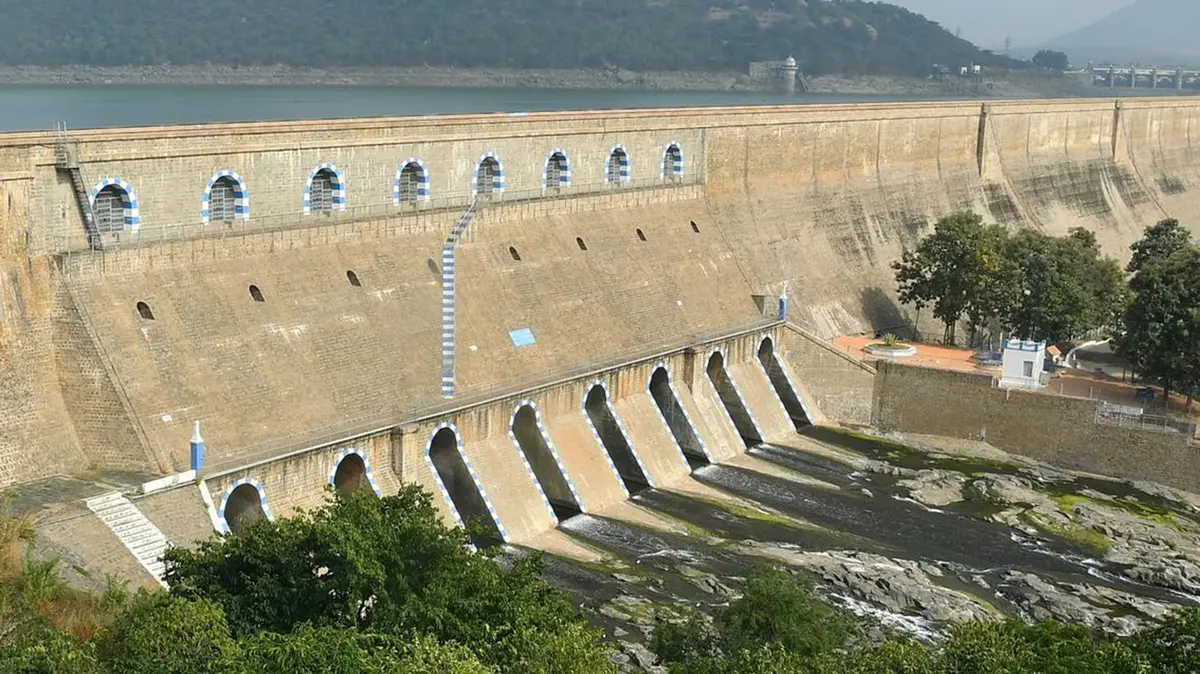
Built during British rule and opened in June 1934, the Mettur Dam remains a vital source of irrigation and drinking water for central Tamil Nadu. Each year authorities announce the date for opening the dam’s sluice gates to release water downstream, making headlines in early June. A look back at its history explains why the structure is so important.
Background
The Mettur Dam spans the Kaveri River where it leaves the mountains and enters the plains. Construction began in the 1920s under the supervision of Irish engineer Colonel W.M.E. Vincent Hart. The project employed nearly 17,000 workers and required relocating villages such as Nayambadi. After nine years of work it was inaugurated on 12 June 1934. With a length of about 1,700 metres and a height of roughly 120 feet, it was then one of Asia’s longest masonry dams.
The dam creates the Stanley Reservoir, named after the Governor of Madras. It receives water from its own catchment and from upstream dams like Krishna Raja Sagara and Kabini in Karnataka. Mettur’s storage capacity of about 93 billion cubic feet feeds a network of canals that irrigate more than a million acres across Salem, Erode, Tiruchirapalli and Thanjavur districts. The reservoir is also one of South India’s major fishing grounds.
Key points
- Annual water release: The dam’s gates are usually opened in mid‑June for the first crop season (kuruvai) and again in September for the second season (samba). Opening dates depend on monsoon inflows and coordination with upstream states.
- Multi‑purpose use: Besides irrigation, Mettur supplies drinking water to more than 12 districts and supports hydroelectric generation through the Mettur Hydroelectric project.
- Socio‑economic impact: The dam has transformed arid regions into fertile rice bowls. Farmers’ livelihoods and industries such as paper mills and textiles depend on its timely releases.
- Challenges: Silting reduces storage capacity, while interstate disputes over Cauvery waters sometimes delay water releases. Periodic strengthening of the dam wall and modern flood‑management strategies are required to ensure safety.
Conclusion
More than ninety years after its completion, the Mettur Dam remains the lifeline of central Tamil Nadu. Prudent reservoir management and cooperation among riparian states will be crucial to sustaining agriculture and drinking water supply in the years ahead.