
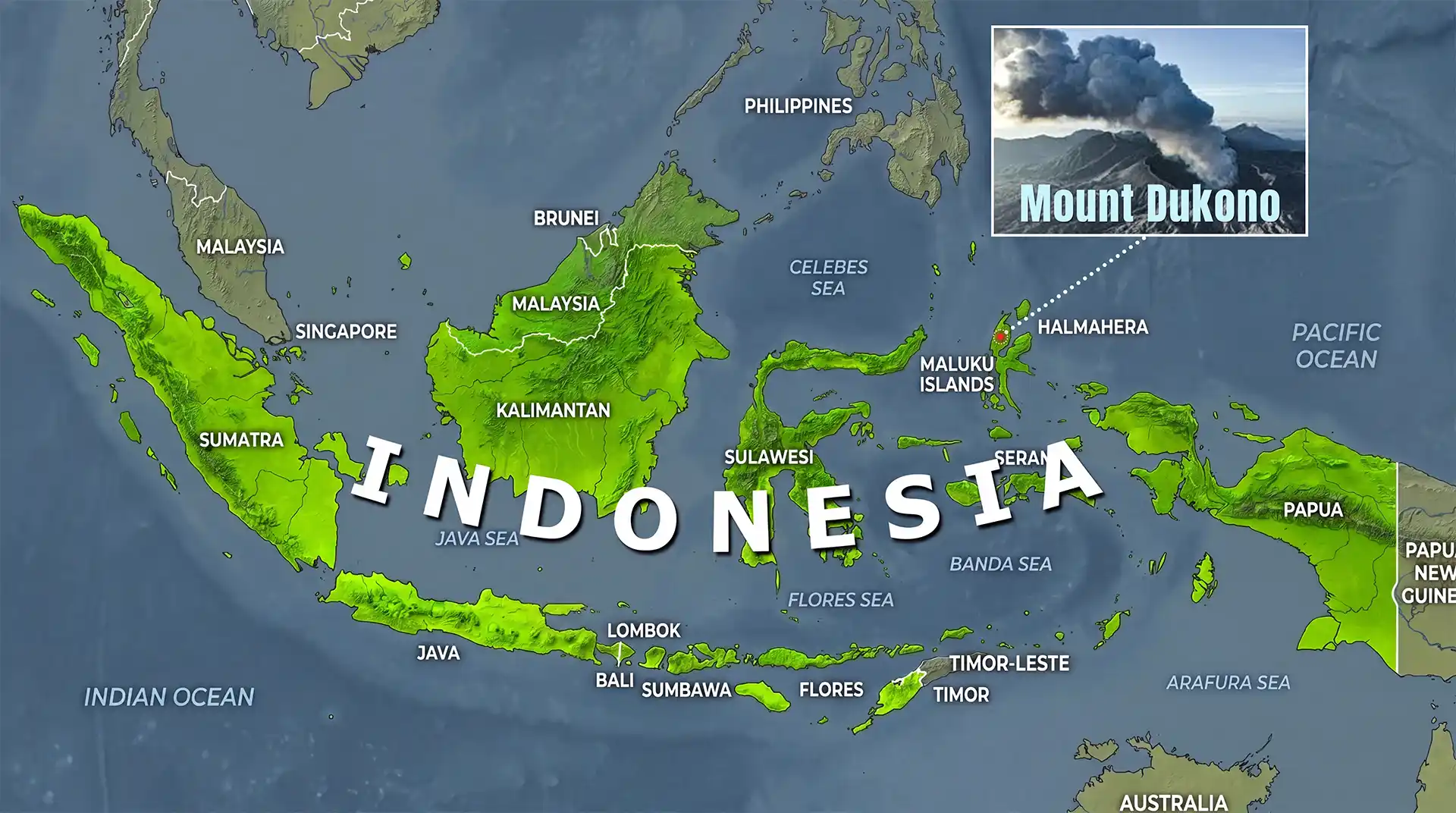
Why in news?
Mount Dukono, an active volcano on Halmahera Island in Indonesia’s North Maluku province, erupted again in April 2026. Authorities reported a column of ash rising about 1.4 kilometres above the summit and advised people to stay at least 4 kilometres from the crater as a precaution against ashfall and breathing difficulties.
Background
Dukono is one of Indonesia’s most active volcanoes. It sits on the northern tip of Halmahera and has a broad, low profile with multiple overlapping craters. The volcano rises to about 1,087 metres above sea level and forms part of the Pacific “Ring of Fire.” Historical records indicate that the first documented eruption occurred in 1550, when a major explosion filled a nearby strait with lava and ash. Since 1933 the volcano has been in a nearly continuous state of activity, producing frequent ash plumes and sulphur‑dioxide emissions.
Key features
- Geology: Complex volcano with several vents and the Malupang Warirang crater located about 1 kilometre south‑west of the summit. This crater contains a 700 × 570 metre depression that has its own vents.
- Activity: Continuous explosive eruptions since 1933. Ash columns often reach several kilometres high; minor lava flows are occasional.
- Alert level: Indonesia’s volcanology agency keeps the volcano at Level II, indicating caution but not immediate danger. Residents are advised to wear masks and avoid the danger zone.
- Hazards: Ash can cause respiratory problems and contaminate water sources. The volcano’s remoteness reduces risk to large populations, but its eruptions occasionally disrupt air travel.
Significance
Indonesia lies along a convergent tectonic boundary where the Australian and Pacific plates meet the Eurasian plate. Frequent eruptions such as that of Dukono remind authorities of the need for continuous monitoring, emergency preparedness and public awareness in a region where millions of people live within sight of active volcanoes.

