Why in news?
The Narmada River, one of India’s major waterways, often features in discussions on river systems because it flows westwards, unlike most peninsular rivers that flow east. Recent initiatives to harness its water for irrigation, hydroelectricity and tourism, including the completed Sardar Sarovar Dam and the nearby Statue of Unity, keep the river in public discourse.
Background
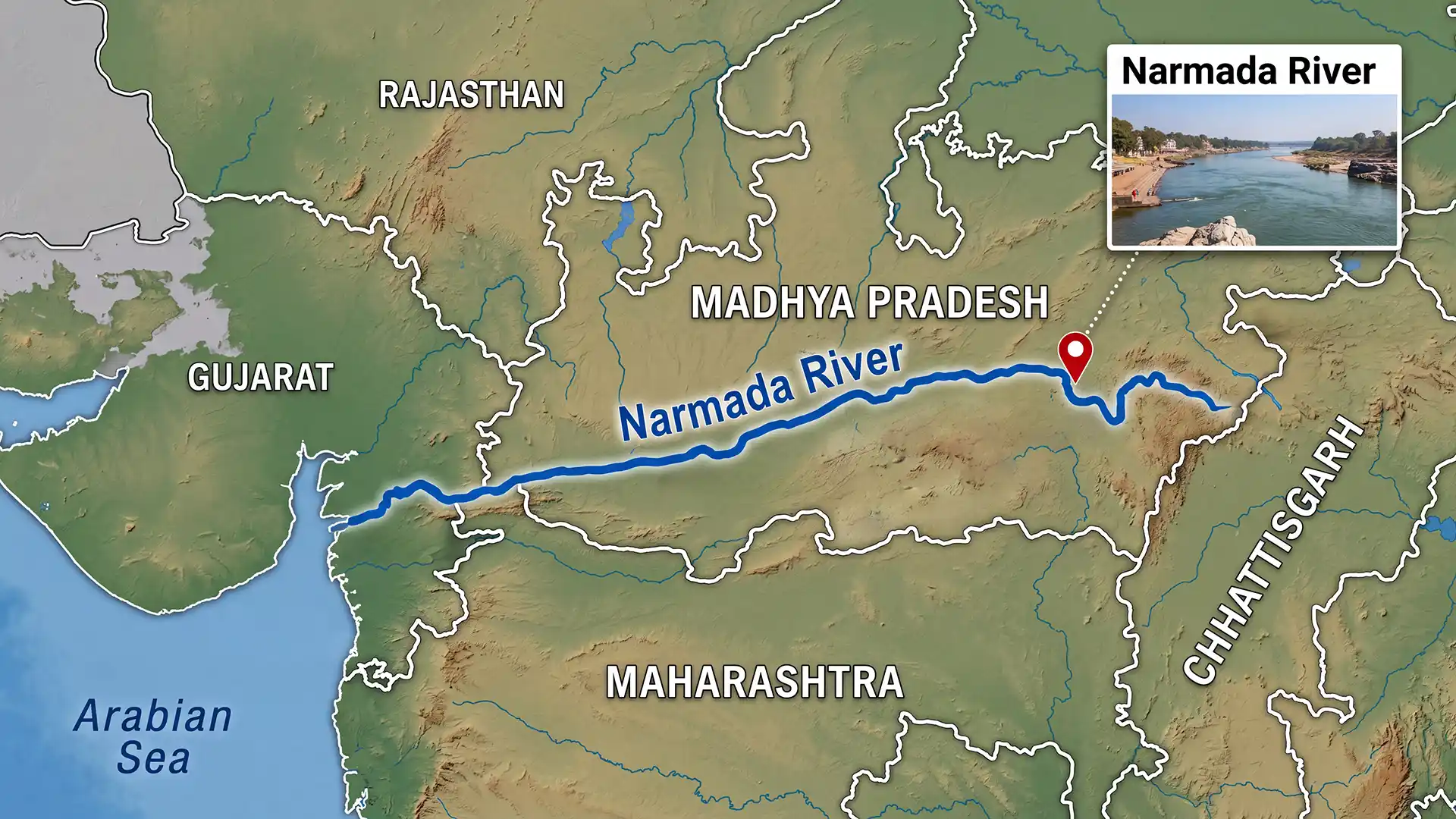
The Narmada rises in the Maikala Range in eastern Madhya Pradesh, near the town of Amarkantak, at an elevation of about 1,080 m. It is fed by 41 tributaries and flows westward for roughly 1,300 km through Madhya Pradesh, Maharashtra and Gujarat. Draining the northern slopes of the Satpura Range, the river meanders through plains, uplands and gorges before entering the Gulf of Khambhat (Cambay) via a wide estuary near Bharuch. The Narmada basin covers about 98,800 km² and provides a historic route between the Arabian Sea and the Ganges valley. The river is sacred to Hindus, who believe it sprang from the body of Shiva, and is considered almost as holy as the Ganges. The pradakshina pilgrimage involves walking along both banks from source to sea and back.
Key points
- Course and features: After rising near Amarkantak, the Narmada flows northwest towards Jabalpur, then southwest through the marble gorge near Bhedaghat. It continues across central India before entering Gujarat. The river has waterfalls such as the Dhuandhar Falls near Jabalpur and passes through narrow gorges at Mandhata and Murkata.
- Water resource projects: Major dams on the river include the Indira Sagar, Omkareshwar, Bargi and Maheshwar dams and the Sardar Sarovar Dam. The Sardar Sarovar project, completed in 2017, generates around 1,450 MW of power and supplies water to parts of Gujarat, Madhya Pradesh and Maharashtra. The project was controversial because of displacement of local communities and gave rise to the Narmada Bachao Andolan protest movement.
- Religious significance: Narmada Kund at Amarkantak is regarded as the source of the river and is a pilgrimage site. Towns along the river — Hoshangabad, Maheshwar, Omkareshwar and Mandla — have temples and ghats for rituals. Many Hindus perform pradakshina, a circumambulation of the river, to seek blessings.
Significance
The Narmada provides irrigation, drinking water and electricity to millions of people. Its west‑flowing course makes it a unique part of India’s river network. Development projects must balance the river’s economic importance with ecological health and the rights of indigenous communities.
Sources: Republic World