

Why in news?
A cluster of shallow tremors in northern Nashik led officials to plan four continuous seismic stations.
What happened
Reviewed National Centre for Seismology listings recorded several late-July events near Nashik. Their reported magnitudes ranged from 2.8 to 3.9.
Many hypocentres were shallow, including one recorded at five kilometres. Residents therefore felt some events despite their modest magnitude.
Officials selected sites in Surgana, Peth, Dindori and Kalwan talukas. Continuous instruments can improve locations and identify small events.
The National Centre for Seismology is India’s nodal earthquake-monitoring agency. It operates under the Ministry of Earth Sciences.
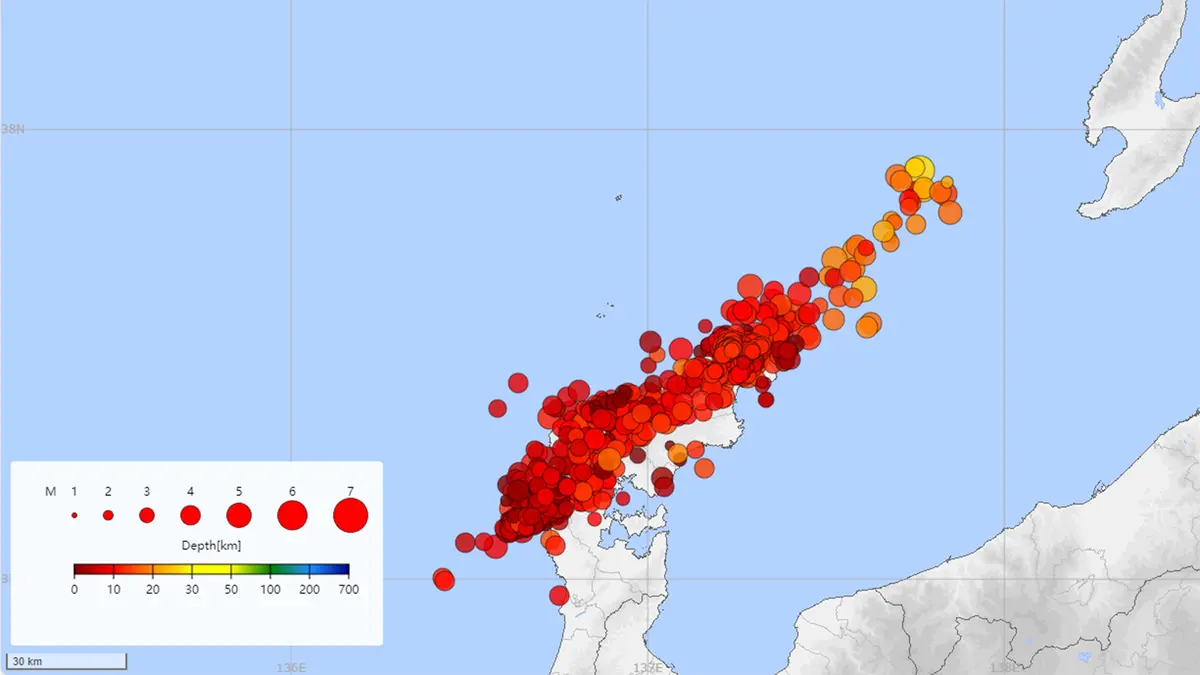
What makes a swarm
A swarm contains many nearby earthquakes without one clearly dominant mainshock. Activity can rise and fall over an uncertain period.
The local geography
Nashik district stretches across northern Maharashtra and the Sahyadri ranges. Gujarat adjoins its northern and north-western side.
Surgana and Peth lie close to that inter-state boundary. The wider landscape includes steep uplands, valleys, settlements and reservoirs.
These features affect exposure but do not establish an earthquake cause. Causation requires hypocentre patterns, geology and time-series evidence.
A denser network can reduce uncertainty in depth and epicentre estimates. That helps researchers distinguish clustered sources from location error.
What monitoring can and cannot do
More stations can reveal fault orientation and changes in event frequency. They can also support quicker public information after felt tremors.
No monitoring network can reliably predict an exact earthquake time. A swarm alone neither proves nor rules out a larger event.
Preparedness should therefore remain proportional and practical. Authorities need resilient buildings, response plans and clear advice on safe behaviour.
Open publication of reviewed data would reduce rumours. It would also let independent specialists test possible explanations.
Observe without predicting
The appropriate response combines closer measurement with routine safety. Speculation should not outrun the seismic record.
Conclusion
Nashik’s swarm deserves sustained scientific attention, not alarmist forecasting. The new stations can turn scattered tremors into better evidence.