

Why in news?
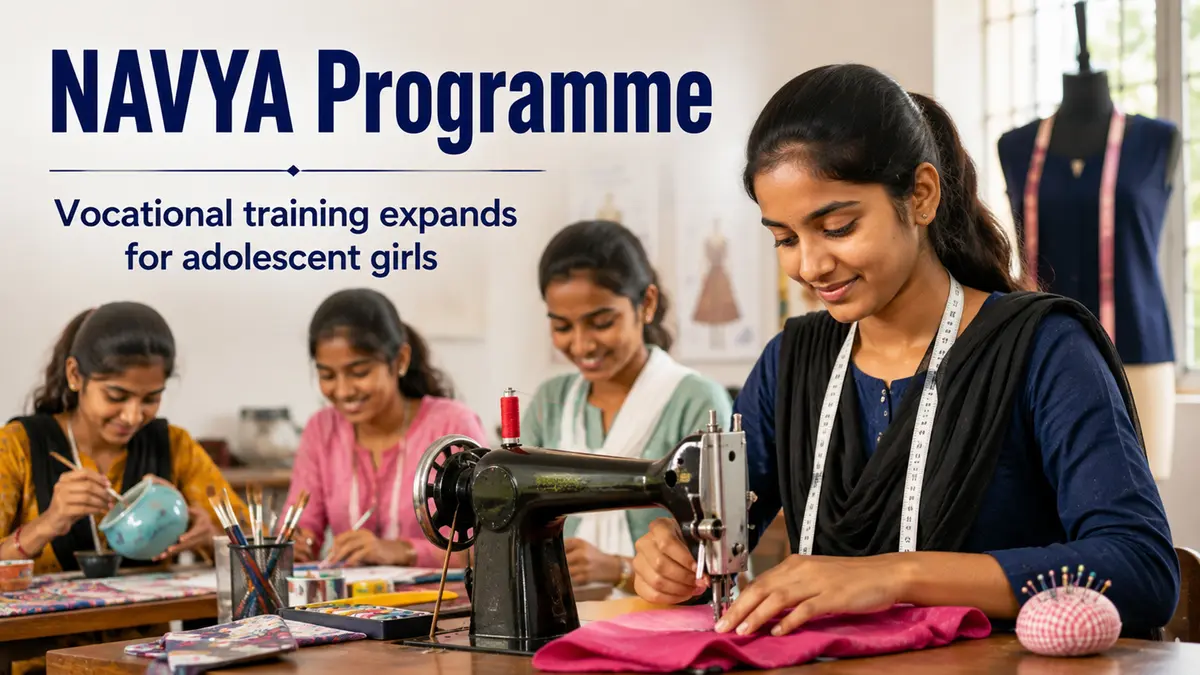
The government reported new results for Nurturing Aspirations through Vocational Training for Young Adolescent Girls (NAVYA). By 30 June 2026, it had trained 1,060 girls. The programme now covers 100 aspirational districts.
Programme design
NAVYA is a joint programme of two Union ministries. It connects vocational training with support for adolescent girls.
The Ministry of Skill Development and Entrepreneurship works with the Ministry of Women and Child Development. They launched NAVYA in Sonbhadra on 24 June 2025.
It targets girls aged 16 to 18 who have completed Class 10. Training operates under Pradhan Mantri Kaushal Vikas Yojana 4.0.
Expansion and course choices
The pilot aimed to train 3,850 girls across 27 districts in 19 states. Its occupations included digital, technical and service-sector roles.
From 27 May 2026, coverage expanded to 100 aspirational districts. The Skill India Digital Hub supports enrolment and monitoring.
State skill missions are expected to facilitate apprenticeships and employment. This role matters because a certificate alone may not overcome local labour barriers.
What inclusion requires
Course selection should reflect both demand and informed choice. Girls should not be channelled into a narrow set of traditionally female occupations.
Safe transport, hostels and family engagement can determine participation. Training schedules must also recognise schooling and unpaid care duties.
The reported trainee count measures reach, not sustained employment. Public evaluation should track completion, placement, earnings and retention over time.
Quality and local labour markets
Aspirational districts differ greatly in industry and connectivity. Each course needs a credible pathway to local work, migration or remote employment.
Training providers should publish trainer qualifications and assessment methods. Independent checks can reduce certificate-focused delivery and unsafe workshop conditions.
Apprenticeships provide workplace exposure but need fair terms and supervision. Placement claims should separate paid employment from unpaid or brief engagement.
Former trainees can help review course relevance and safety. Their experience should inform expansion before weak models become harder to correct.
Outcome reports should explain withdrawals as well as placements. Dropout reasons may expose transport, safety or course-design failures.
Tracking must protect minors’ personal information. Aggregated outcome data can support accountability without publishing identities or sensitive household details. Consent and access controls remain essential.
Expansion needs outcome evidence
A wider map is useful only when training remains safe, relevant and connected to dignified work.
Conclusion
NAVYA targets an important transition between schooling and work. Its credibility will rest on choice, safety and durable economic outcomes.