
Why in news?
A Union expert panel recommended environmental clearance for the Naying project. The proposed plant has a 1,000-megawatt capacity. It will use the Siyom River in Arunachal Pradesh. Several other legal approvals are still required before physical construction can begin.
Background
Hydroelectricity uses moving water to rotate turbines and generate electricity.
Mountain rivers offer steep gradients, which can provide strong water pressure.
Arunachal Pradesh therefore has a large assessed hydropower potential; however, Himalayan projects also affect forests, rivers, slopes and settlements.
They need engineering, environmental, forest and social scrutiny before construction.
What is the Naying project?
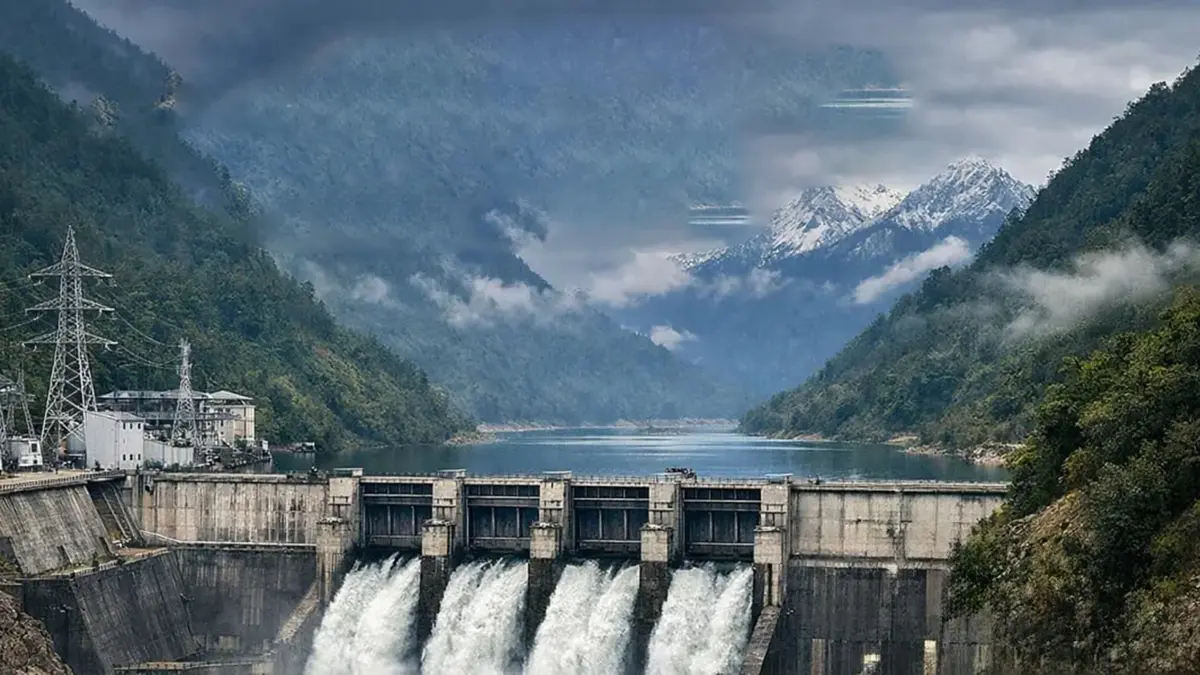
Naying is a proposed 1,000-megawatt hydroelectric project in Arunachal Pradesh.
It is planned across the Siyom River, which is also called Yomgo locally.
Project components extend across Siang and Shi-Yomi districts; the North Eastern Electric Power Corporation will develop it.
This corporation is shortened to NEEPCO; the design provides four generating units of 250 megawatts each.
Planned annual generation is about 4,966.77 gigawatt-hours; a gigawatt-hour measures generated electrical energy over time.
It is not the same as the project’s instantaneous megawatt capacity.
Prelims numbers: Capacity is 1,000 megawatts; planned annual generation is 4,966.77 gigawatt-hours.
What does run-of-the-river mean?
Naying is described as a run-of-the-river project; such a project uses the river’s flowing water with limited long-term storage.
Water may enter an intake and travel through tunnels or channels; it then drives turbines before returning downstream.
This design usually stores less water than a large storage project.
Important clarification: Run-of-the-river does not mean dam-free or impact-free.
Naying still includes a concrete dam, tunnels and an underground powerhouse.
River flow, sediment, fish movement and downstream conditions can still change.
How did the project reach this stage?
- The Central Electricity Authority gave technical concurrence during 2013.
- Construction did not begin on the original schedule.
- Environmental and social assessments continued during later years.
- Shi-Yomi published a Social Impact Assessment during September 2025.
- A public environmental hearing was scheduled for November 2025.
- The expert panel examined the proposal during 29–30 June 2026.
- The panel recommended clearance with several environmental conditions.
The appraisal is therefore part of a long approval process; project schedules suggesting construction from 2028 remain planning estimates.
They are planning targets, not guaranteed dates for completing the entire project.
What exactly did the expert panel do?
The Expert Appraisal Committee is shortened to EAC; it advises the Union Environment Ministry on covered project proposals.
The EAC examined Naying during its 57th meeting; it recommended environmental clearance subject to mandatory conditions.
Clearance stage: An EAC recommendation is not permission to begin every construction activity immediately.
The project may still need forest diversion approval and other permissions; wildlife clearance would also apply if legally required.
Land acquisition, rehabilitation and state permissions remain separate processes.
What did the appraisal record?
- The estimated project cost exceeds ₹11,835 crore.
- The project footprint covers more than 470 hectares.
- Land acquisition affects twelve villages, according to the appraisal record.
- The panel accepted the submitted relief and rehabilitation plan.
- Land compensation must follow the applicable 2013 acquisition law.
- The project must follow pollution-control and state conditions.
The 2013 law gives affected families rules for compensation and rehabilitation.
Its full title begins with the Right to Fair Compensation and Transparency.
Actual outcomes depend upon lawful implementation, consultation and payment.
What environmental conditions were attached?
- Compensatory afforestation must address every approved diversion of recorded forest land.
- A wildlife conservation plan must protect affected fauna and habitats.
- Air and noise levels require regular monitoring during construction.
- Construction waste and excavated material need safe disposal.
- Disaster plans must consider earthquakes, landslides and sudden water releases.
- Authorities must maintain required environmental flows within the downstream river channel.
Environmental flow means water deliberately left in the natural river channel; this water supports aquatic life and downstream human needs.
The meeting record reported no notified protected area within ten kilometres.
It also reported no listed wildlife corridor within that distance; that finding does not remove duties outside notified protected boundaries.
What is the Siyom River?
The Siyom rises in the eastern Himalayan region of Arunachal Pradesh; it flows through the state’s central mountain landscape.
The river joins the Siang, which forms the Brahmaputra farther downstream; communities also use the name Yomgo for the river.
River valleys here support settlements, forests and transport routes.
Students should connect Naying with Siyom, not directly with the main Brahmaputra channel.
What is NEEPCO?
NEEPCO was incorporated in 1976 for power development in India’s North-East; it operates hydroelectric, thermal and renewable power assets.
It is a Schedule A, Miniratna Category I public sector enterprise.
NEEPCO is now a wholly owned subsidiary of NTPC Limited.
A subsidiary remains a separate company controlled by its parent company.
Therefore, calling NEEPCO directly independent of NTPC would be incomplete.
Why can the project be important?
- Hydropower can provide low-carbon electricity throughout its long operating life.
- Reservoir and peaking flexibility can help balance variable solar power.
- Construction can create roads, employment and local public revenue.
- The project may strengthen electricity supply in the North-East.
What concerns require attention?
- Land acquisition can disrupt livelihoods and customary community relationships.
- Forest diversion can fragment habitat and increase slope disturbance.
- Tunnelling and blasting can affect springs and local geology.
- Changed flows may affect fish, sediment and downstream users.
- Himalayan earthquakes and landslides increase long-term disaster-management and monitoring needs.
- Several projects in one basin can create cumulative impacts.
A cumulative assessment studies combined effects from several projects; it can reveal risks missed by evaluating each project separately.
Conclusion
Naying crossed a major appraisal stage, but responsible development requires every remaining safeguard.