
Why in news?
The government of the Democratic Republic of Congo (DRC) has announced plans to create a 20,000‑strong paramilitary Mining Guard. This new force will secure critical mineral sites, transport routes and border crossings amid a surge in global demand for cobalt, copper and other strategic minerals used in electric vehicles.
Background
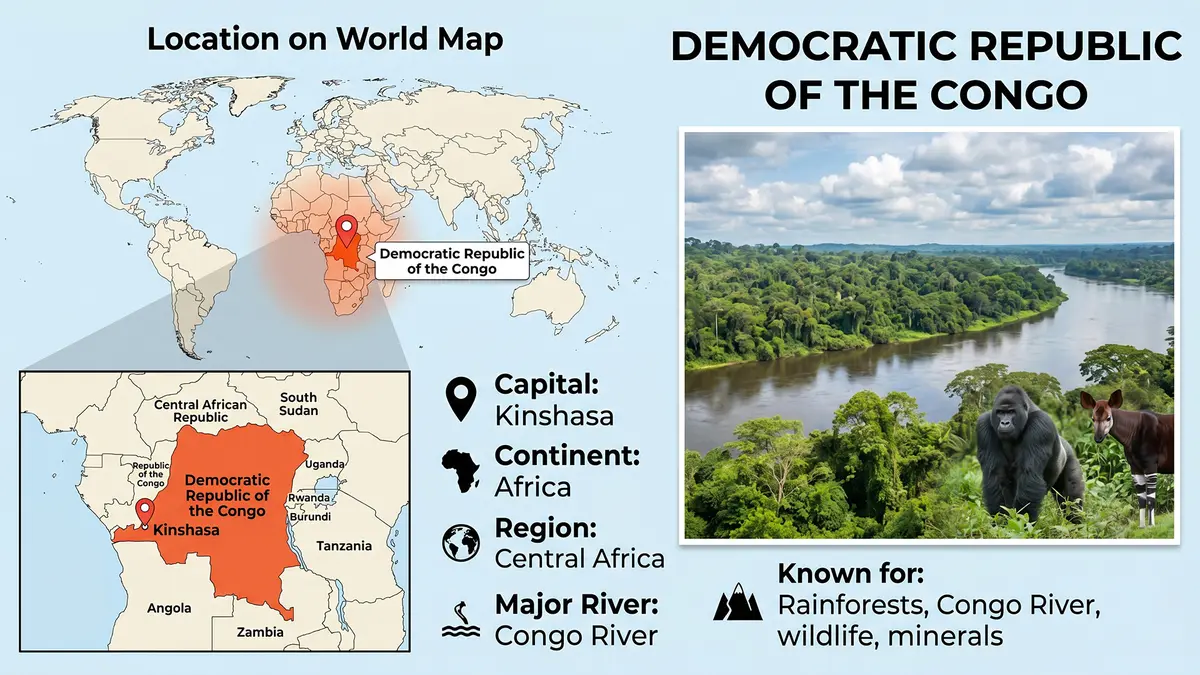
The DRC is the second‑largest country in Africa and sits in the heart of the continent. It shares borders with nine countries and is home to vast rainforests, high plateaus and the Congo River system. The nation holds more than half of the world’s cobalt reserves along with large deposits of copper, gold, coltan and diamonds.
These resources have long attracted foreign companies and armed groups. Informal mining, smuggling and conflict have plagued the sector. In 2018 the DRC introduced a new Mining Code to increase taxes and improve regulations, but enforcement has been inconsistent. Illegal militias and corrupt security units continue to control many mines.
Purpose and challenges of the Mining Guard
- The Mining Guard aims to professionalise security around mining concessions. Its mandate includes protecting workers, monitoring shipments and reducing theft and smuggling.
- Officials hope the force will ensure that more revenue from cobalt and copper remains in the national treasury and that communities around mines benefit from development projects.
- Analysts caution that security alone cannot solve underlying governance problems. The Mining Guard must operate transparently and respect human rights to gain trust from local communities and international partners.
- Existing security forces in the DRC have been accused of corruption and abuses. Without reforms in policing, taxation and environmental governance, the new guard risks replicating past problems.
Significance for global supply chains
- Global demand for electric vehicles has increased the strategic importance of cobalt, of which the DRC supplies about three‑quarters of world output.
- China currently dominates investment in Congolese mines. Western governments want to diversify supply chains to reduce reliance on one source.
- Responsible sourcing standards require companies to ensure that minerals are extracted without child labour or financing armed groups. Strengthening security and governance in the DRC is thus crucial for ethical supply chains.
Conclusion
The proposed Mining Guard could improve safety and accountability in the DRC’s mining sector, but it is not a panacea. It must be accompanied by reforms in governance, community consultation and environmental protection to ensure that mineral wealth leads to sustainable development for Congolese citizens.

