
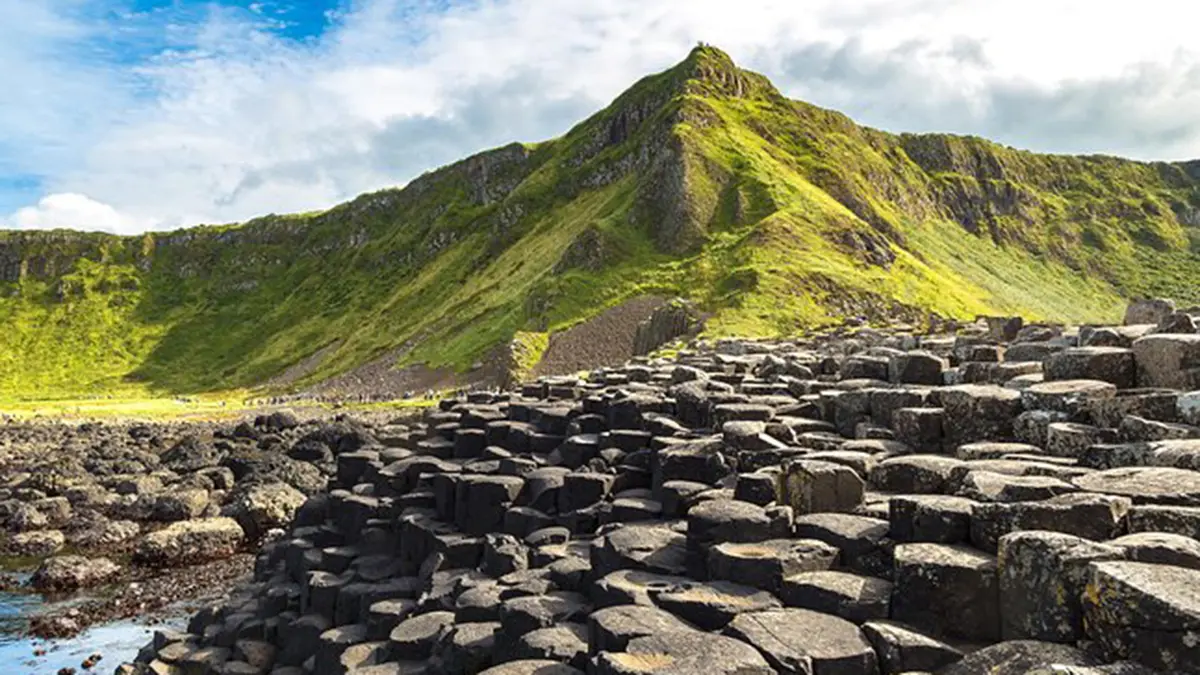
Why in news?
Scientists from the Geological Survey of Northern Ireland and the British Geological Survey have reported that the basalt columns of the Giant’s Causeway formed over about 5.5 million years. This finding shortens the previously accepted formation time by roughly eight million years.
Background
The Giant’s Causeway in Northern Ireland is a UNESCO World Heritage site known for its 40,000 interlocking basalt columns. These hexagonal columns formed as molten lava cooled and contracted. Previous studies suggested that the volcanic activity spanned 13 million years. New geochronological techniques using radioactive decay reveal that the eruptions occurred over a shorter period roughly 60 million years ago. The lava flows were part of the wider North Atlantic Igneous Province associated with the opening of the North Atlantic Ocean.
Key points
- The new study indicates the Antrim lava plateau formed in a series of eruptions over about 5.5 million years.
- The shorter timeline aligns Northern Ireland’s volcanic history with volcanic events in Greenland and Scotland.
- Understanding the precise timing helps geologists connect the site’s formation to global tectonic processes.
- The research suggests the famous columns formed rapidly as thick lava flows cooled and fractured.
- Improved dating techniques refine our understanding of how large volcanic provinces evolve.
Conclusion
The Giant’s Causeway is not only a scenic wonder but also a geological archive. The new timeline provides insights into the earth’s volcanic past and links Northern Ireland’s basalt formations to global tectonic events. Such research enriches our appreciation of the site and its scientific value.