

Why in news?
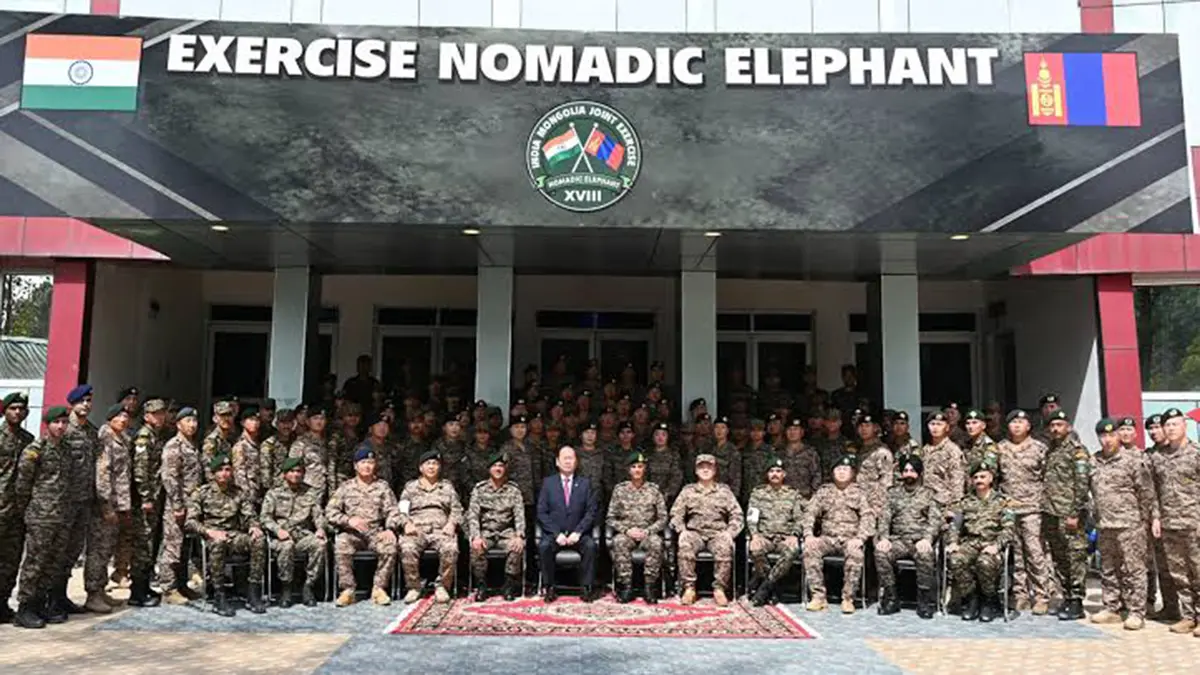
The eighteenth India–Mongolia military exercise, Nomadic Elephant, began at Pithoragarh in Uttarakhand on 21 September 2026. The Defence Ministry announced a programme running until 3 October, with 45 personnel from each country. The annual exercise trains the two armies to work together in selected operational scenarios, including mountain and semi-urban settings. Its stated focus includes counter-insurgency tasks under a United Nations mandate. That makes coordination, shared procedures and understanding of responsibilities central to the training. This is a bilateral exercise, not an announcement of a new United Nations deployment. Its planned activities do not yet demonstrate that the intended improvements have been achieved.
A recurring exercise rather than a new alliance
Nomadic Elephant alternates between India and Mongolia. The previous edition concluded in Ulaanbaatar in June 2025, while the 2026 edition brings the participants to India. This alternating arrangement gives each side experience of hosting and operating in the other's training environment. It also provides a recurring point of contact rather than a one-off ceremonial visit. The existence of an exercise, however, should not be described as a mutual-defence treaty or a promise of automatic military assistance.
The Defence Ministry describes the current activity as platoon-level training. That is a relatively small-unit setting in which personnel can practise coordination directly. A small group offers opportunities to compare procedures and discuss specific difficulties during shared activities. The scale helps explain the exercise's practical purpose: developing working relationships among participants rather than demonstrating a large force deployment. Each edition builds another opportunity for contact within the recurring bilateral programme.
Place the participants on the map
Pithoragarh is in the Himalayan state of Uttarakhand, in a district adjoining Nepal along the Kali river setting. The district administration describes the town as lying in a valley enclosed by hills. This provides relevant geographical context for an exercise that includes mountain scenarios. It does not mean every activity occurs at an extreme altitude, or that the programme reproduces conditions across the entire Himalaya. Training location and the precise terrain of individual activities are related but different facts.
Mongolia is a landlocked Asian country with only two land neighbours: Russia to the north and China to the south. It does not share a border with India. Its capital, Ulaanbaatar, hosted the preceding edition. This geographical separation gives organised exchanges particular value. Cooperation requires arrangements for personnel, equipment and communication rather than routine contact across a shared frontier. The relationship is diplomatic and strategic, not the product of adjoining territory.
What working together actually involves
Interoperability means being able to work together effectively despite differences in organisation, equipment or procedures. In an exercise, this can involve establishing how information is shared, how responsibilities are understood and how coordinated actions are reviewed. Simply placing two contingents at the same location does not prove interoperability. Its value lies in identifying mismatches during training, when participants can examine them and improve their understanding before any real operational requirement arises.
The announced programme includes joint drills in built-up and mountain environments, helicopter-related activities, and exposure to drone and counter-drone operations. Cyber-related elements also form part of the stated schedule. These are training areas identified by the ministry, not a report of combat use during the exercise. Their inclusion reflects the need to coordinate across different capabilities while keeping the event's limited scale and training purpose in view.
The United Nations reference needs context
The ministry places the exercise's scenarios within a United Nations mandate. In an actual peacekeeping operation, a mandate sets out the tasks authorised for that mission. The United Nations identifies consent, impartiality and limits on force as central peacekeeping principles. Force may be used in self-defence and defence of the mandate under the applicable authority. These principles are not interchangeable with an unrestricted permission to conduct military operations wherever participants choose.
The distinction matters when reporting an exercise. Practising for a mandated scenario does not create a mandate, establish a mission or authorise a real deployment. Nor does the phrase remove the importance of protecting civilians and understanding the local political setting. The United Nations distinguishes impartiality from inactivity: carrying out authorised responsibilities can require action, but it must remain consistent with the mission's purpose. Training has to develop judgement as well as coordination.
A broader relationship behind the military contact
India and Mongolia established diplomatic relations in December 1955. Their relationship was elevated to a strategic partnership during the Indian prime minister's May 2015 visit. The Ministry of External Affairs places defence exchanges alongside wider political, cultural and development ties. This history helps explain why a small military exercise receives diplomatic attention. It is one part of an established relationship, rather than sufficient evidence on its own of a new regional bloc.
Conclusion
Nomadic Elephant offers India and Mongolia a practical setting for developing shared understanding at a small-unit level. Its significance lies in sustained contact, relevant training and clear responsibilities, supported by a wider bilateral relationship. The September opening establishes the programme and its aims; a judgment about achieved improvements would require evidence from the completed exercise.