

Why in news?
Punjab politicians recently invoked the baaj during rival campaign speeches. One claim linked a circling bird with protection after an August attack. Another leader pointed to a bird above his public meeting. Neither episode established that the bird was Punjab’s state bird, the Northern Goshawk.
The bird behind the name
The state-bird name remains widely recorded as Northern Goshawk. Modern lists call the Eurasian species Astur gentilis. It was formerly placed in Accipiter as Accipiter gentilis. The newer genus reflects genetic evidence that the older grouping was not a natural lineage.
The American population is now treated as a separate species. This is why some current references use Eurasian Goshawk instead. Bird Count India notes that the Eurasian species occurs in South Asia. Older Indian notifications understandably retain the earlier common and scientific usage.
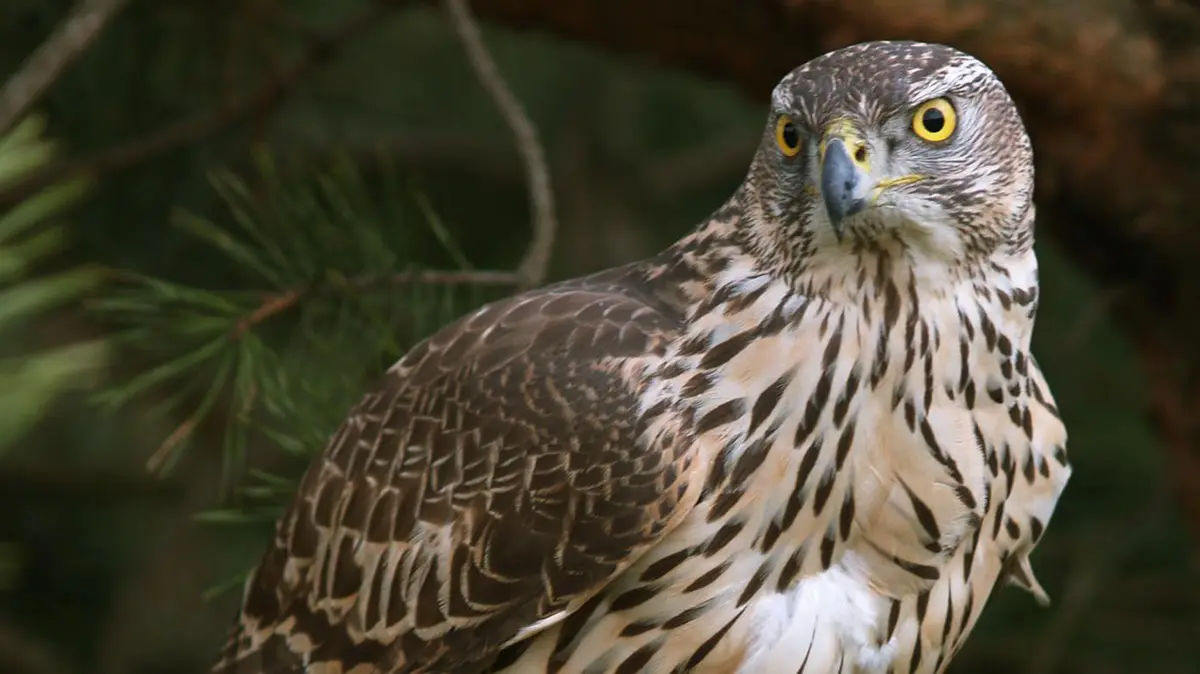
The goshawk is a powerful forest raptor in the hawk family, Accipitridae. Broad wings and a long tail support rapid movement among trees. Adults show a strong pale eyebrow above the eye. Females are larger than males, a common pattern among many raptors.
Distribution and habitat
The Eurasian Goshawk ranges across northern forests from Europe through Asia. In India, records are concentrated around Himalayan and adjoining regions. Some birds move to lower elevations during winter. Reports from the plains and peninsula are sparse and require careful identification.
Dense woodland provides nesting cover and hunting space. The bird takes medium-sized birds and mammals. It can remain difficult to observe even where present. Brief views are easily confused with shikras, sparrowhawks, kites or other large birds.
Punjab’s plains lie south of the main Himalayan forest range. A genuine state record would therefore be notable. Photographs, location details and review by experienced observers would strengthen identification. Cultural meaning alone cannot establish a biological record.
How it became Punjab’s state bird
Punjab originally named an “Eastern Goshawk” as state bird in 1989. That name did not correspond to the intended Indian bird in modern taxonomy. The government corrected the designation to Northern Goshawk in 2015. The Bombay Natural History Society records the declaration date as 18 September.
The selection reflects the baaj’s importance in Sikh history and art. It is strongly associated with Guru Gobind Singh, the tenth Sikh Guru. The bird represents sovereignty, courage and resistance to injustice. Falconry also formed part of an older historical connection involving several Sikh Gurus.
A state symbol does not prove that the species is currently common within state boundaries. According to records reviewed by The Indian Express, Punjab organised searches in 2018 and 2025. Those efforts did not locate the bird within the state. This makes verified field evidence particularly important.
Reading the political claims carefully
Harsimrat Kaur Badal said a baaj circled near a hospital treating Sukhbir Singh Badal. Chief Minister Bhagwant Mann later used the story in campaign speeches. He also gestured towards a large bird above a meeting. These were political and symbolic claims, not scientific identifications.
A distant flying shape rarely permits reliable species-level identification. Plumage, size, flight pattern and photographs should be examined together. The sex-specific historical use of baaj adds another layer of interpretation. A report should therefore separate faith, symbolism and ornithological evidence.
The debate can still support useful public interest in Punjab’s birds. Authorities could publish survey methods and verified records openly. Citizen observers can contribute photographs without approaching nests or disturbing wildlife. Expert review would help correct mistakes before they become repeated claims.
Conservation significance
A culturally valued state bird can connect heritage with habitat protection. Yet conservation cannot focus on one emblem alone. Woodlands, wetlands and agricultural mosaics support many resident and visiting species. Monitoring those habitats would provide better evidence than occasional campaign sightings.
Taxonomic updates should also be reflected in official educational material. The update need not erase the familiar Northern Goshawk name. It should explain that current authorities call the Eurasian species Astur gentilis. Clear naming reduces confusion with unrelated goshawks and common urban raptors.
Conclusion
Punjab’s baaj carries deep historical and spiritual significance. The recent campaign references show that this symbolism remains powerful. They do not confirm a Northern Goshawk sighting. Verified records require photographs, field details and expert assessment. Public interest should now support transparent surveys and wider habitat conservation across Punjab.