

Why in news?
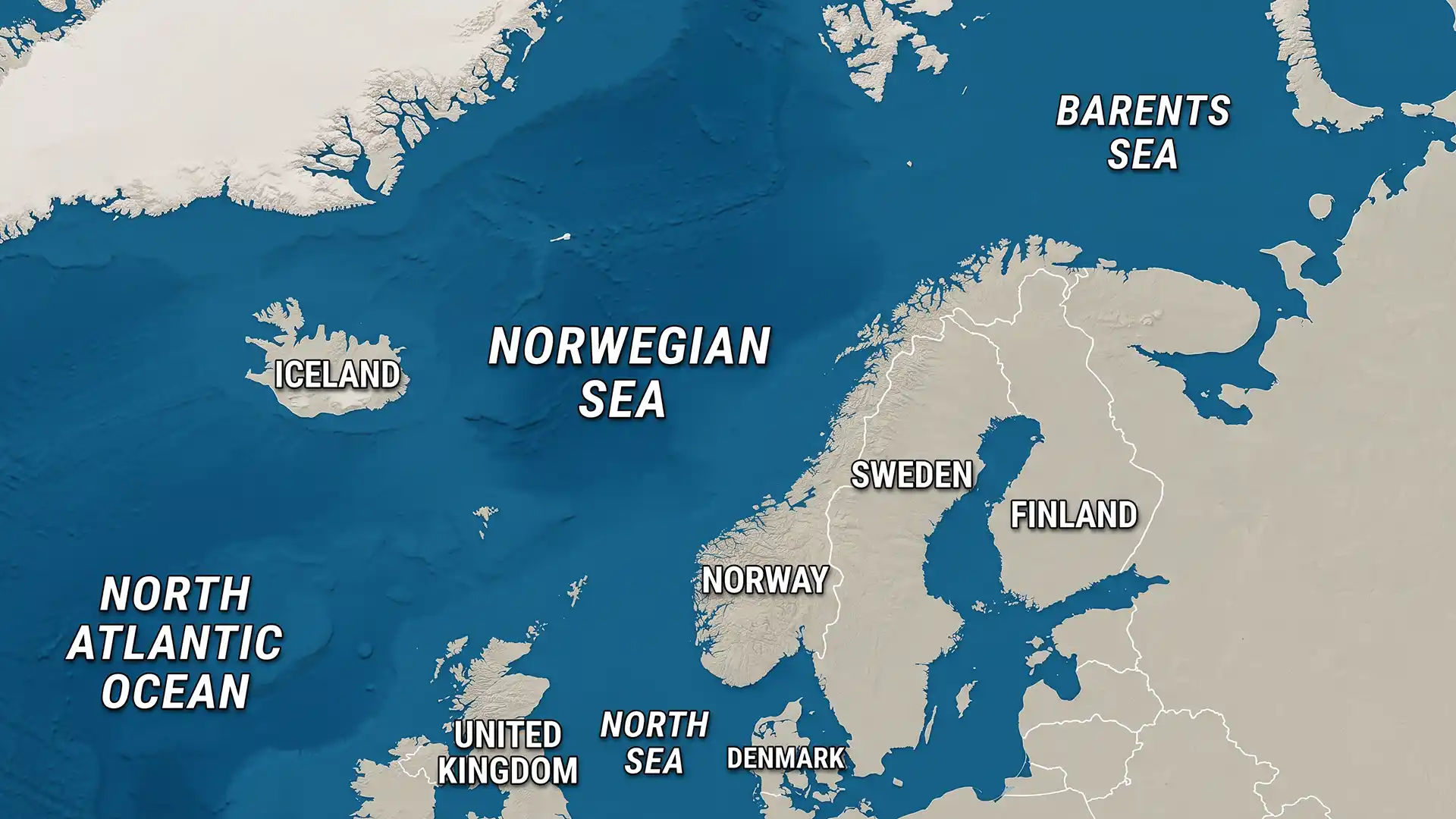
On 7 July 2026 United Kingdom F‑35 jets intercepted a Russian reconnaissance aircraft over the Norwegian Sea. The Russian plane was seen dropping sonobuoys near the British carrier HMS Prince of Wales, prompting London to call the action unsafe. The incident drew attention to this strategically important sea.
Background
The Norwegian Sea is a marginal sea of the North Atlantic and Arctic Oceans. It lies between Norway to the east, Iceland to the west and the island of Jan Mayen to the north. The sea was formed when the Eurasian and North American tectonic plates began to separate about 55 million years ago. It covers around 1.38 million square kilometres and has an average depth of 2 km, with the deepest point reaching almost 4 km.
Key features
- Climate and currents: Warm waters from the North Atlantic current meet colder waters from the East Iceland current, keeping the sea largely ice‑free year‑round. Sea temperatures vary between 2–7 °C in winter and 8–12 °C in summer.
- Marine resources: The sea hosts Europe’s richest cod fishery near the Lofoten Islands and supports large populations of herring and mackerel. Cold‑water coral reefs, especially those built by Lophelia pertusa, provide important habitats.
- Energy reserves: Since the 1990s petroleum and natural gas fields have been developed in the Norwegian Sea, contributing significantly to Norway’s economy.
- Hazards: The Moskstraumen whirlpool and frequent storms make navigation challenging. The area also lies along the North Atlantic approaches to Arctic shipping routes linking Europe and Asia.
Significance of the recent incident
The interception underscores rising military tensions in the North Atlantic. The Norwegian Sea sits near NATO’s northern flank, and any confrontation could threaten vital shipping lanes and energy infrastructure. The episode also highlights the need for clear rules to avoid miscalculations in busy international waters.
Conclusion
The Norwegian Sea combines rich marine resources with strategic importance. Events such as the July 2026 intercept remind us that geopolitical flashpoints are not confined to land; they can occur over remote seas that support global trade and fisheries.