

Why in news?
The Nyishi community featured in a new botanical discovery from Arunachal Pradesh; researchers named Begonia neelamorum after its Neelam clan. The discovery also recorded local knowledge and assistance. It renewed attention to ethical collaboration in biodiversity research.
People and homeland
The Nyishi are one of Arunachal Pradesh’s major indigenous communities. Their settlements extend across a broad central belt of the State. The Constitution recognises Nyishi as a Scheduled Tribe in Arunachal Pradesh. Article 342 governs specification of Scheduled Tribes for each State.
The 2011 individual Scheduled Tribe tables recorded 2,49,824 Nyishi people. That figure is a census count, not a current estimate.
Official tables recorded 1,28,349 women and 1,21,475 men. The resulting sex ratio was 1,057 women per thousand men.
Recorded literacy stood at 63.1 per cent. Male literacy was 70.5 per cent, while female literacy was 56.2 per cent.
Language, belief and festival
Nyishi belongs to the Tani group of languages; Indian census records separately enumerate Nyishi language returns. Oral traditions have carried history, ecological knowledge and social memory across generations. Writing and digital documentation now complement those traditions.
Many Nyishi families follow a Donyi-Polo religious worldview. Christianity and other faiths are also present within the community.
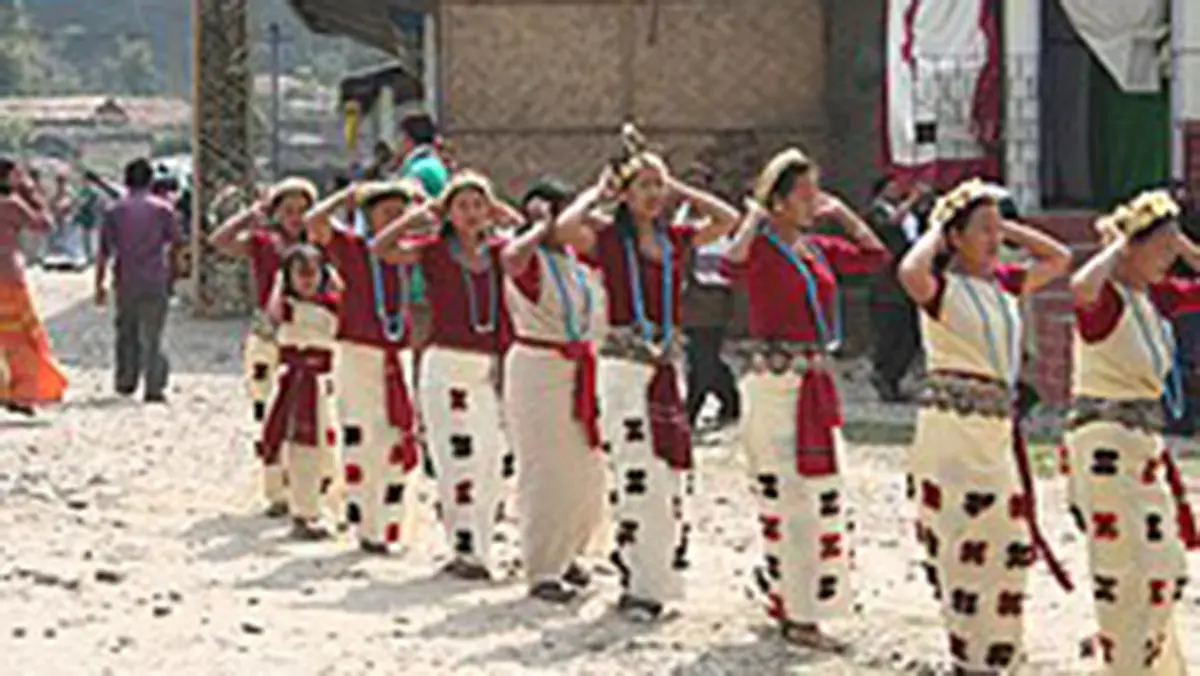
Nyokum is the best-known annual festival; it expresses relationships among people, land, crops and protective spiritual forces.
Public presentations often reduce a living culture to costume and dance. Everyday institutions, language change and modern occupations deserve equal attention.
Knowledge and biodiversity research
Community members often know local habitats, seasons and plant names in fine detail; that knowledge can guide scientific field surveys. Such assistance is not merely logistical. It can shape where researchers search and how they interpret a species’ ecology.
The new begonia paper records the Nyishi name “Kobiirhopu Baabrai”; it also acknowledges the field contribution behind the discovery.
Scientific naming can honour a community, but naming alone does not ensure fair partnership. Consent, attribution and benefit sharing remain important.
Researchers should discuss how specimens, photographs and knowledge will be used. Results should return in accessible form to participating communities.
Change, development and representation
Roads, education and communications have expanded opportunities across Arunachal Pradesh; they also accelerate language shift and land-use change. Customary institutions continue to matter, yet they adapt to elected government and formal law. Neither system is completely static.
Development projects can affect forests used for farming, hunting or cultural practice. Consultation must begin before decisions become irreversible.
Young Nyishi people increasingly work in administration, education and urban professions. Describing the community only through tradition creates a misleading picture.
Women sustain knowledge and livelihoods, but public cultural narratives may understate their roles. Sex-disaggregated education data can reveal continuing gaps.
Avoiding two common errors
The Nyishi are not a museum community separated from modern life. Cultural continuity and social change occur together. Arunachal Pradesh is also outside the Constitution’s Sixth Schedule. Scheduled Tribe status does not itself create an autonomous council.
Conclusion
The Nyishi connection to Begonia neelamorum shows how community knowledge can strengthen formal science. Ethical recognition must extend beyond a species name. Language, land and informed participation are central to cultural resilience. Policy should treat Nyishi people as partners in contemporary development.