

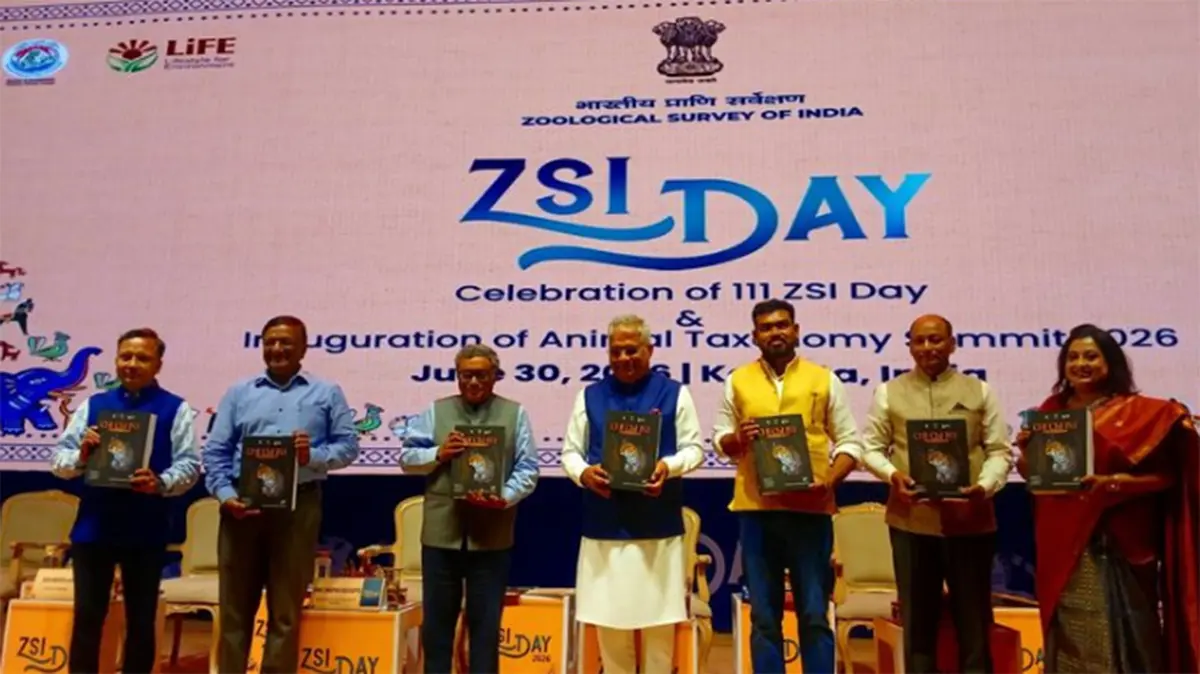
Why in news? At the Zoological Survey of India’s (ZSI) 111th foundation day celebrations, the Union Environment Minister unveiled the PaleoIndia Portal. This digital platform documents fossil records from across India, providing scientists and citizens easy access to the nation’s paleontological treasures.
Background
India’s fossil record stretches back hundreds of millions of years, yet information about fossil discoveries has remained scattered in scientific papers and museum archives. Recognising the need for an accessible database, the ZSI collaborated with the National Centre for Sustainable Coastal Management (NCSCM) and used geological maps from the Geological Survey of India (GSI) to build an online portal. The initiative supports the government’s push for open science and citizen participation in biodiversity conservation.
Key features of the portal
- Comprehensive coverage: The portal stores information on more than 5,000 fossil specimens spanning mammals, reptiles, birds, fish, amphibians, molluscs, arthropods, foraminifera, echinoderms and trace fossils. It aims to cover fossil sites in all 28 states and eight Union Territories.
- Dynamic mapping: Data are layered over interactive geological maps, allowing users to visualise where fossils were found. The portal integrates geological datasets from the GSI with taxonomic information from ZSI and NCSCM.
- Real‑time data upload: Researchers and trained citizens can upload new discoveries in real time, enabling the database to grow continuously and encouraging citizen science.
- Educational resource: Each entry includes photographs, descriptions and age estimations, making the portal a valuable tool for students, researchers and educators interested in India’s deep past.
About the National Centre for Sustainable Coastal Management
NCSCM is an autonomous institute under the Ministry of Environment, Forest and Climate Change. Established in 2011 in Chennai, it supports integrated management of India’s coastal zones. Its work ranges from mapping ecologically sensitive areas and assessing coastal vulnerability to advising on policy for coastal communities. The centre’s six research divisions cover geospatial sciences, social economics, environmental impact assessment, conservation of coastal and marine resources, governance and policy, and island management.
Conclusion
The PaleoIndia Portal represents a milestone in digitising India’s fossil heritage. By bringing together diverse datasets and allowing real‑time uploads, it will foster collaboration between scientists and citizens and help protect sites that hold clues to the subcontinent’s ancient life.
Sources: TI