

Why in news?
A 76.4-square-kilometre ice island broke from Petermann Glacier on 4 August. Researchers described it as the glacier’s largest calving since 2012.
What scientists observed
University of Stirling scientists tracked the event through European Space Agency Sentinel-1 radar images. The images showed rapid weakening on 3 August.
The detached block was roughly comparable with Manhattan in area. Researchers estimated that parts of it were up to 150 metres thick.
The team called it the Arctic’s largest reported calving event since 2020. That comparison concerns the event’s area, not global ice loss.
Geographical setting
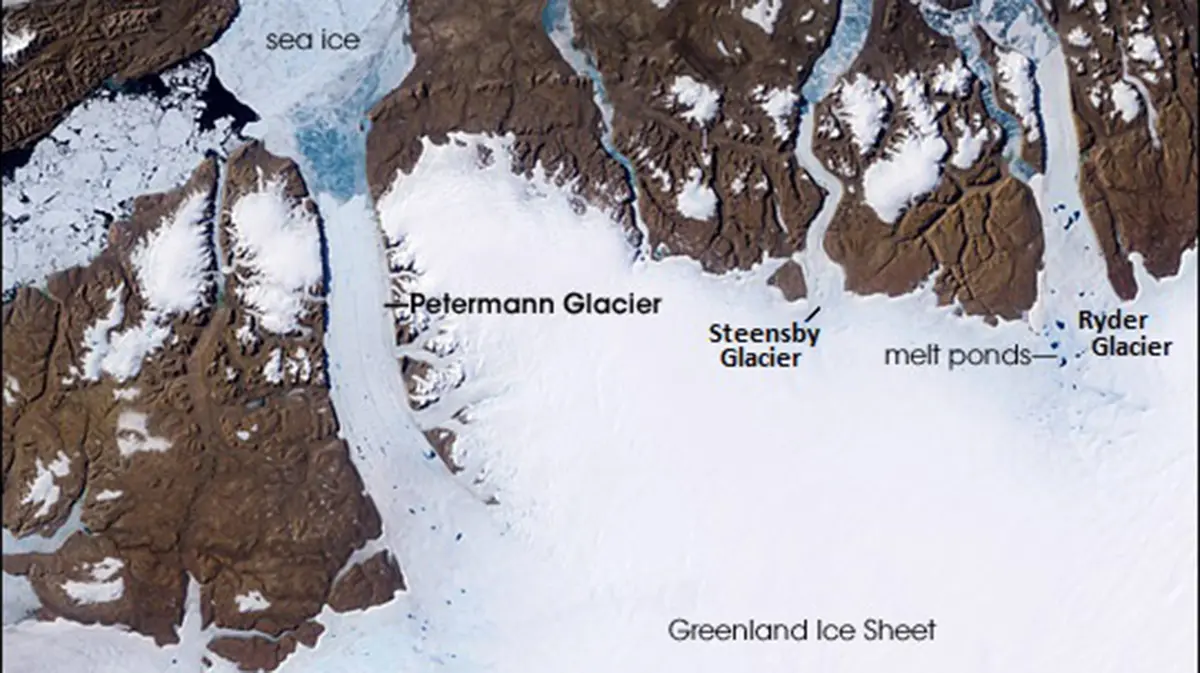
Petermann Glacier drains the north-western Greenland Ice Sheet. Its long floating tongue extends through Petermann Fjord towards Nares Strait.
Nares Strait separates Greenland from Canada’s Ellesmere Island. It links the Lincoln Sea and Arctic Ocean with northern Baffin Bay.
This narrow passage also carries sea ice southward from the high Arctic. Large ice islands may enter the same route.
Calving is not the same as melting
The lost section was already floating. Its separation therefore causes little direct sea-level rise.
Why the event still matters
A floating ice tongue can restrain the grounded glacier behind it. Further retreat may weaken that support and alter inland ice flow.
That effect is not automatic. Scientists need later velocity, thickness and grounding-line measurements before judging the response.
Radar data show two additional fractures farther inland. Researchers estimate their enclosed areas at about 94 and 84 square kilometres.
Those areas remain attached. They are potential future losses, not completed calving events.
Large, thick ice islands can also threaten Arctic shipping and coastal activity. Their paths depend on winds, currents and break-up.
Petermann previously produced major ice islands in 2010 and 2012. The sequence makes long-term monitoring especially important.
Read the event in sequence
A single calving does not measure climate change alone. Repeated retreat and changing glacier flow provide the stronger evidence.
Conclusion
The August break removed a major part of Petermann’s floating tongue. Its lasting importance depends on the glacier’s measured response.