

Why in news?
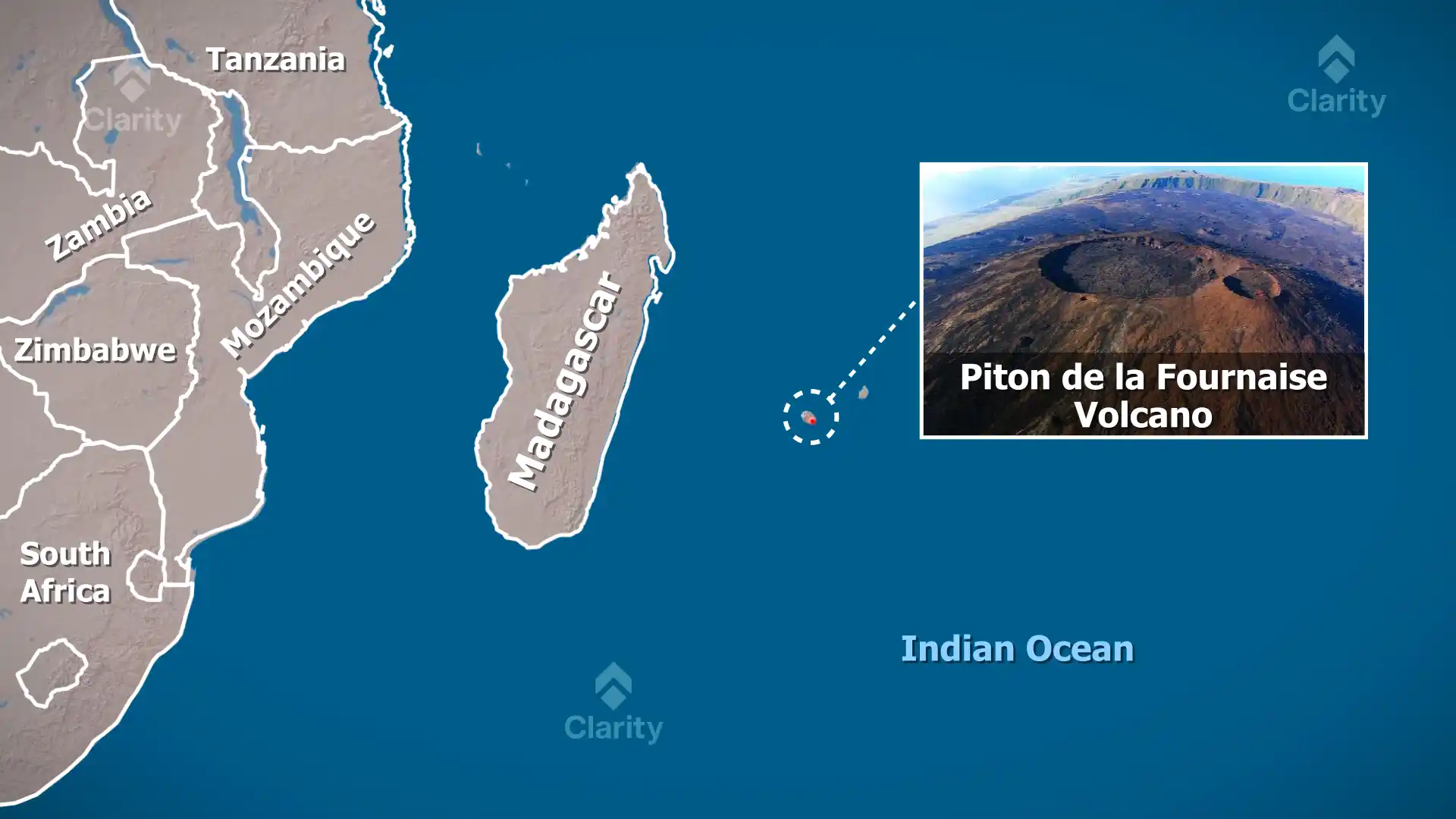
Piton de la Fournaise, a highly active shield volcano on Réunion Island in the Indian Ocean, erupted again on 13 February 2026. This was its second major eruption in less than a month. Authorities closed access to hiking trails as lava fountains and flows emerged from new fissures. The eruption drew attention because it underlined the volcano’s persistent activity and the need for vigilant monitoring.
Background
Piton de la Fournaise (meaning “peak of the furnace” in French) rises 2,632 metres on the eastern side of Réunion Island, a French overseas department. It is one of the world’s most active shield volcanoes. Unlike steep stratovolcanoes, shield volcanoes have broad gentle slopes formed by fluid basaltic lava. Their eruptions tend to be effusive rather than explosive, producing lava flows that travel long distances.
Recent eruption activity
- The latest eruption began on 13 February 2026 around 5:05 am local time. Two fissures opened on the upper flank inside the Enclos Fouqué caldera, releasing lava fountains that reached around 20 metres and creating lava flows confined within the caldera.
- Authorities from the Volcano Observatory closed public access to the summit area and the main hiking trail as a safety precaution. No inhabited areas were threatened.
- This eruption followed an earlier episode on 18 January 2026 when four fissures opened and lava fountains erupted. After that event, hundreds of small earthquakes and ground deformation indicated that magma was rising again, leading to the February eruption.
- Scientists monitor the volcano using seismic instruments and Global Navigation Satellite System (GNSS) sensors that measure ground deformation. These tools detect magma movement and help authorities issue timely warnings.
Significance
The repeated eruptions of Piton de la Fournaise offer valuable insights into shield volcano dynamics. They demonstrate how magma recharge and pressure build-up can lead to consecutive eruptions within weeks. The events also highlight the importance of hazard preparedness on inhabited volcanic islands. By studying such eruptions, volcanologists can improve forecasting models and contribute to safer tourism and local livelihoods.
Source: Watchers