

Why in news?
Two Przewalski’s horse foals were born in central Kazakhstan in late August 2026. Mongabay reported their births on 9 September, following an announcement by conservation partner Fauna & Flora. They belong to a programme rebuilding a population on the steppe. The births occurred in a reintroduction enclosure, an important detail behind the encouraging headlines.
What happened at Alibi
The male foals were born on 22 and 31 August. Their mothers, Tessa and Umbra, are among the horses moved to Kazakhstan through the recovery programme. The Alibi Wild Ungulates Reintroduction Centre provides an acclimatisation base. Its setting is the Altyn Dala steppe landscape, rather than an ordinary urban zoo.
Mongabay places the births inside a 56-hectare enclosure within the Altyn Dala reserve. This does not diminish their conservation value. It does distinguish a managed reintroduction setting from unrestricted wilderness. Animals can reproduce after transfer while still receiving protection, veterinary supervision and assistance during their adjustment.
Project partners describe the first foal as Kazakhstan’s first “wild-born” Przewalski’s horse in approximately 200 years. That is their historical claim about the country, not a statement about the entire species. Przewalski’s horses have reproduced in other recovery programmes. The Kazakh milestone concerns the return of breeding to part of their former range.
The horse and its habitat
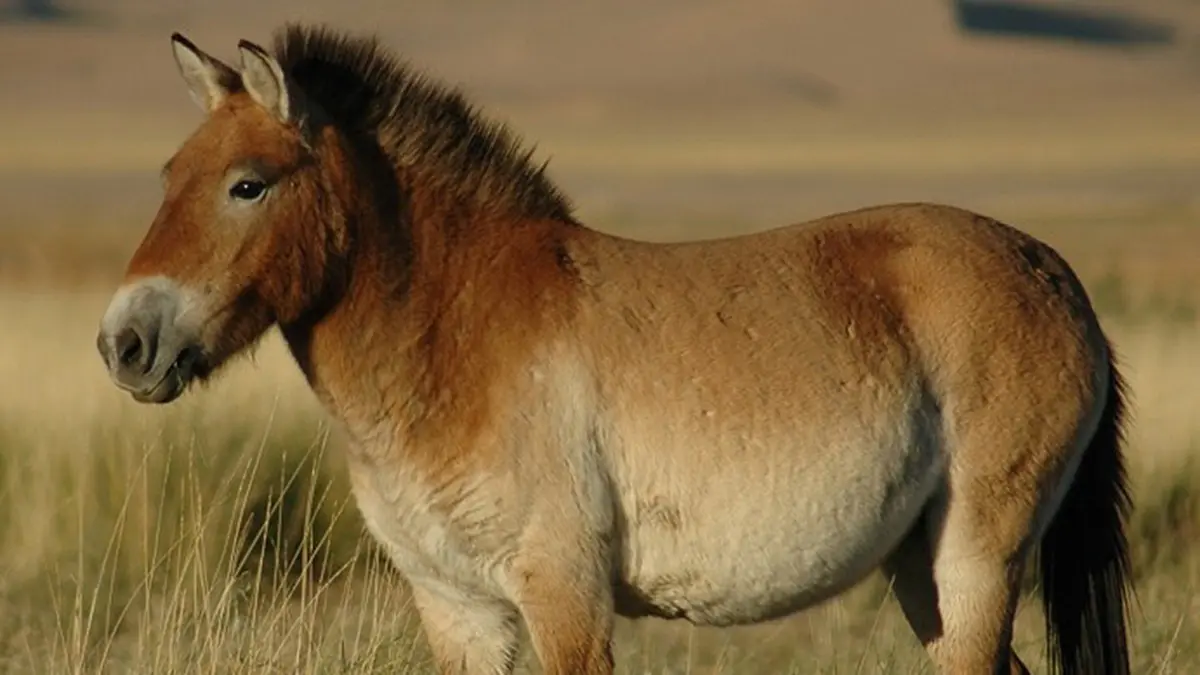
Przewalski’s horse is a stocky equid with a large head, upright mane and short legs. Its coat is usually sandy brown, with darker markings along the back and legs. Smithsonian uses the name Equus ferus przewalskii. Other accounts treat it at species level, reflecting differences in taxonomic treatment.
These animals graze and also browse some woody vegetation. Their social groups commonly include mares, offspring and a breeding stallion. Access to forage, water and space therefore matters alongside the number released. A suitable-looking grassland must support animals through seasonal changes, not merely during favourable summer conditions.
The word “wild” needs care. Mustangs and many free-ranging Australian horses descend from domestic animals and are described as feral. Przewalski’s horses represent a distinct surviving lineage. Genetic links with ancient Botai horses have complicated claims that their ancestors were never managed by people. Their conservation importance does not depend on simplifying that debate.
Why Kazakhstan’s geography matters
Kazakhstan lies mainly in Central Asia; land west of the Ural River is conventionally placed in Europe. It borders Russia, China, Kyrgyzstan, Uzbekistan and Turkmenistan. Although it has a Caspian coastline, it lacks direct access to the world ocean. The Caspian is an inland waterbody, not an open-ocean coast.
The Altyn Dala landscape contains steppe, semi-desert and wetlands. Steppe is predominantly open grassland, unlike tropical savanna or dense temperate forest. Restoring large herbivores here is consequently a landscape project. It requires connected feeding areas, seasonal water access and cooperation with people using neighbouring land.
Kazakhstan should not be confused with Mongolia, another important country in the horse’s recovery. Mongolia lies between Russia and China and does not border Kazakhstan. The small separation between the two countries is a useful geographical distinction. Reintroduction sites in different countries remain separate populations with their own management needs.
From survival in captivity to recovery outside it
Wild populations disappeared during the twentieth century, with the last sightings in Mongolia during the 1960s. Captive breeding prevented total extinction. Later reintroductions returned horses to parts of Asia. Extinction in the wild was therefore not extinction everywhere: animals survived under human care.
The International Union for Conservation of Nature, or IUCN, classifies the horse as Endangered, according to San Diego Zoo. This category concerns extinction risk, not whether an individual lives inside a reserve. Recovery from disappearance in the wild is significant. It does not mean the species has become secure.
The Kazakh programme began bringing horses back in 2024. Fauna & Flora describes an acclimatisation period before wider release. Transport is only the opening stage. Animals must adjust to local food, weather and social conditions. Managers monitor health and assess whether the receiving landscape can support them.
Partners hope to bring at least 40 horses by 2029. That is a programme target, not a universal threshold for population security. Long-term recovery also depends on the animals’ relatedness, successful breeding and survival. A population can grow numerically while retaining a narrow genetic base inherited from a small founder group.
What would establish lasting success?
The next test is whether locally born animals survive, mature and eventually reproduce. Monitoring should distinguish births, deaths, transfers and releases rather than reporting one combined total. That would show whether growth increasingly comes from the population itself. Continued dependence on repeated imports would tell a different recovery story.
Management must also address contact with domestic horses, disease and habitat pressures. These risks connect conservation with surrounding livelihoods. Protecting a herd without maintaining its grazing landscape would be incomplete. The broader aim is a functioning population within a living steppe ecosystem, rather than a successful transport operation alone.
Conclusion
The two foals provide encouraging evidence that Kazakhstan’s reintroduction effort is progressing beyond relocation. Their precise birthplace and the attributed historical claim should remain clear. Lasting recovery will be demonstrated through survival, breeding and habitat security over time. The births are a meaningful milestone, not the end of that work.