

Why in news?
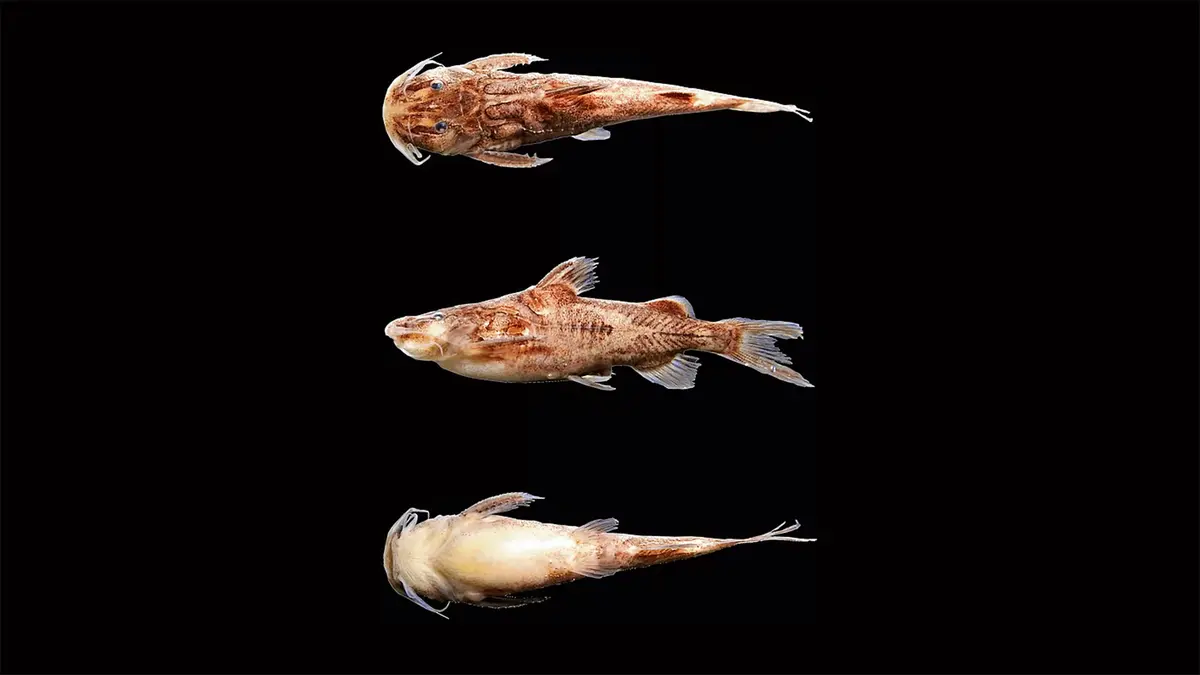
Researchers formally described a new freshwater catfish from Odisha's Budhabalanga River.
They named the species Pseudolaguvia khairii after the celebrated tigress Khairi.
The peer-reviewed description appeared in Zootaxa on 23 July 2026.
A fleshy structure along the dorsal-fin base separates it from every known congener.
Background
Pseudolaguvia khairii belongs to the catfish order Siluriformes and family Sisoridae.
Sisorids are mostly Asian freshwater catfishes adapted to flowing rivers and hill streams.
The genus Pseudolaguvia contains small-bodied fishes distributed across parts of South and Southeast Asia.
Taxonomists describe these fishes as diminutive because adults remain only a few centimetres long.
How was the species identified?
A new species must possess a stable combination of features separating it from known relatives.
The strongest diagnostic feature is a prominent, fleshy protuberance along the dorsal-fin base.
The fish also has an ovoid thoracic adhesive apparatus on its underside.
Such adhesive structures help many hill-stream catfishes hold position against fast currents.
Other characters include cream body bands and measured proportions of several fins.
The dorsal-fin spine has a serrated front margin, providing another useful identification feature.
Where was it found?
The type material came from the Budhabalanga River in eastern Odisha.
This river rises in the Similipal hills and flows through Mayurbhanj and Balasore districts.
It ultimately reaches the Bay of Bengal along Odisha's northern coast.
River gradients, rocky beds and flowing reaches create varied habitats for specialised fishes.
Freshwater discoveries also show why river health matters beyond large and familiar animals.
Why the name khairii?
The specific name honours Khairi, a tigress associated with Odisha's Similipal landscape.
Khairi became known through her unusual bond with forest officer Saroj Raj Choudhury.
The name therefore connects scientific taxonomy with Odisha's conservation history and public memory.
What does formal description mean?
Finding an unusual specimen does not by itself establish a new species.
Researchers compare morphology, measurements and earlier descriptions before publishing a diagnosis.
Type specimens then provide permanent reference material for later scientific comparison.
The 2026 paper establishes the scientific name and distinguishing features for future research.
Conclusion
This small catfish expands known river biodiversity and highlights the scientific value of Odisha's freshwater habitats.