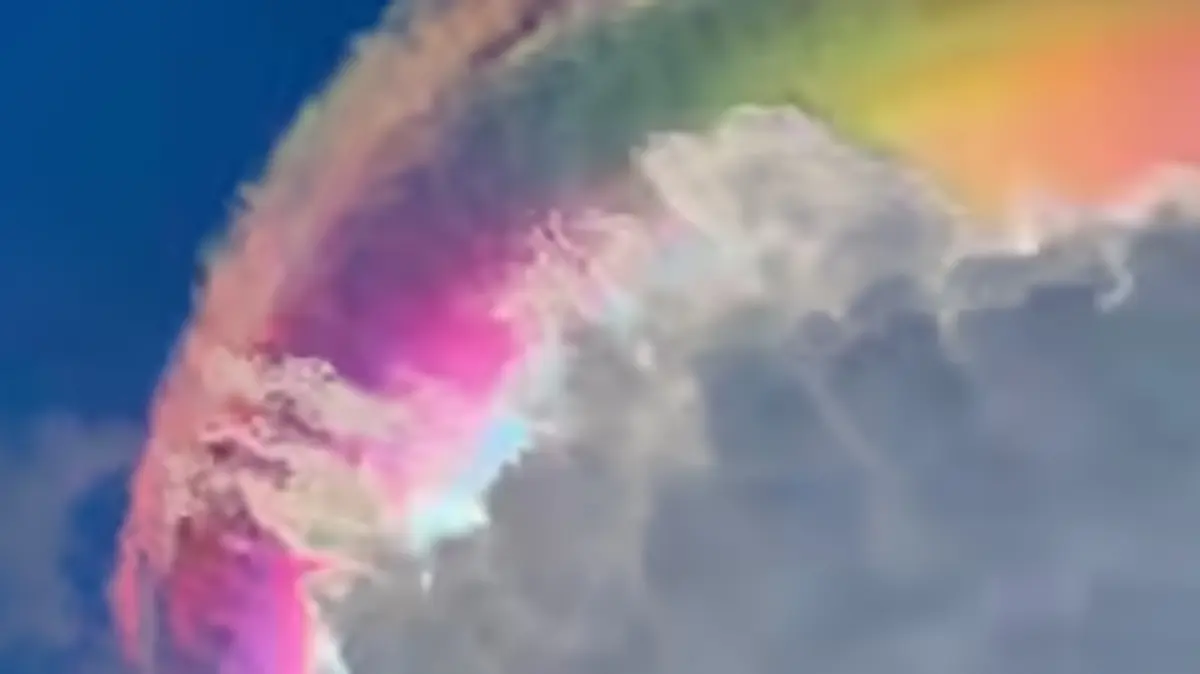
Why in news?
Social media users recently shared videos of pastel‑coloured “rainbow clouds” seen in the skies over Indonesia. The spectacle sparked curiosity and speculation about what causes such vivid colours near the sun.
Background
The phenomenon is called cloud iridescence. It occurs when sunlight passes through thin clouds made of tiny, uniformly sized water droplets or ice crystals. The particles diffract (bend) light, causing the different wavelengths to interfere and produce bright bands of colour. Iridescent clouds usually form in altocumulus, cirrocumulus or lenticular clouds when they are in the right position relative to the sun.
Key facts
- Appearance: Cloud iridescence produces soft pastel shades that blend into one another. Unlike a rainbow, which forms in a bow opposite the sun, iridescent clouds appear close to the sun’s disc.
- Conditions: For vivid iridescence, the cloud must be thin and consist of droplets or ice crystals of nearly the same size. Such conditions are relatively rare, so iridescent clouds are not seen often.
- Safety: Observing these clouds requires caution. Never stare directly at the sun; use your hand or a building to block the sun while viewing the cloud colours.
- Difference from rainbows: A conventional rainbow is created by refraction and reflection of light inside raindrops, producing a spectrum of colours opposite the sun. Iridescent clouds result from diffraction in tiny droplets and appear near the sun.