

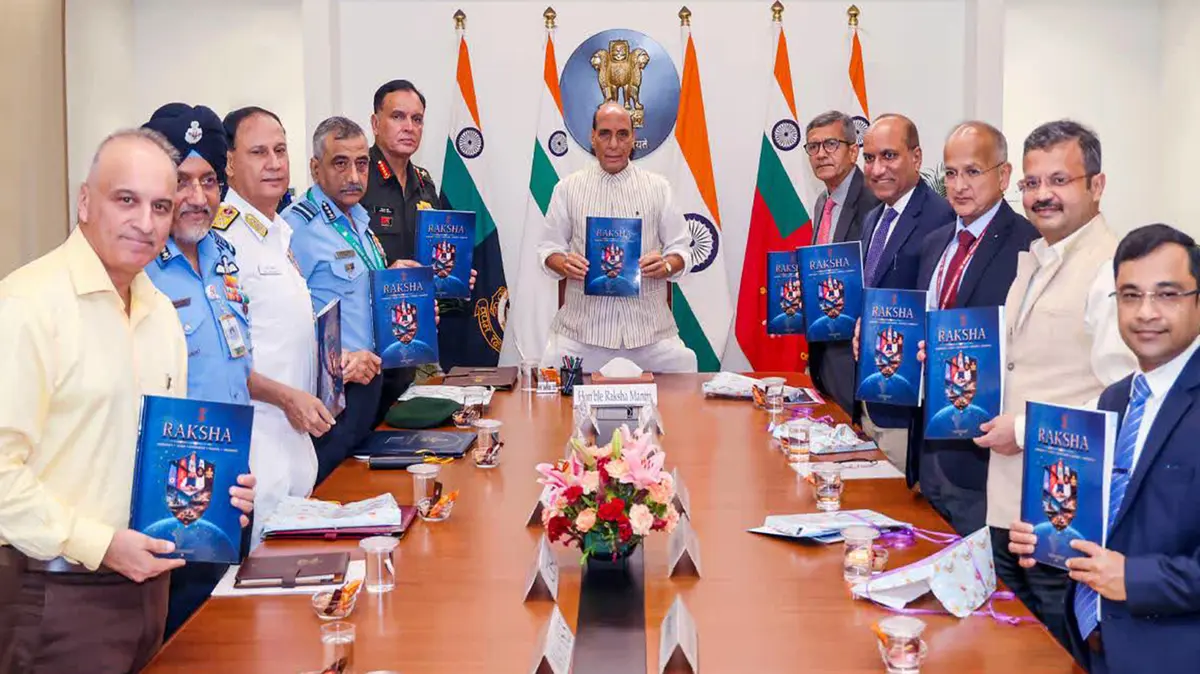
Why in news?
Defence Minister Rajnath Singh released the ‘RAKSHA’ document in New Delhi on 3 September 2026. It sets a ten-year direction for India’s defence diplomacy. The public summary identifies partnerships, capacity-building, exports and maritime security as pillars. It is a strategic framework, not a defence treaty with another country.
What defence diplomacy means
Defence diplomacy uses military and security engagement to support foreign policy. It includes official dialogues, training, exercises and ship visits. It can also cover equipment cooperation and humanitarian assistance. These activities build working relationships before a crisis occurs.
Diplomacy does not remove the armed forces’ defence responsibilities. Instead, it creates channels for communication and cooperation. Regular contact can improve mutual understanding and reduce avoidable miscalculation. It can also help countries respond together to shared threats.
The released document is named ‘RAKSHA’ in the official announcement. That announcement gives no expanded acronym. A responsible account should therefore retain the published name. Inventing a full form would create a fact that the government did not provide.
The framework’s four public pillars
The first pillar is deeper strategic partnership. It covers bilateral and multilateral security cooperation. Different partners will require different arrangements and levels of trust. A common roadmap can still make India’s objectives and responsibilities more consistent.
The second pillar concerns capacity-building. The government lists joint exercises, training and shared good practices. Such activity can improve interoperability during disaster relief or maritime operations. It can also strengthen smaller partners without creating a formal alliance.
The third pillar promotes indigenous defence exports. Equipment sales can create long-term training, maintenance and supply relationships. They can also support domestic production at larger scale. Export growth must remain consistent with law, end-use controls and responsible risk assessment.
The fourth pillar is maritime security. The document casts India as the region’s first responder and a net security provider. It places this role within the Indian Ocean Region. That geographic focus reflects India’s central position and dependence on surrounding sea routes.
Why the Indian Ocean matters
The Indian peninsula projects between the Arabian Sea and Bay of Bengal. India also has island territories near important eastern and western approaches. Sea routes carry most of India’s trade by volume. Maritime disruption can therefore affect energy, goods and economic security.
The region stretches from eastern Africa and West Asia towards Southeast Asia and Australia. It contains narrow passages used by international shipping. Piracy, trafficking, disasters and unsafe navigation cross national jurisdictions. Information-sharing and coordinated presence can improve collective response.
India already works through several regional mechanisms. The Information Fusion Centre–Indian Ocean Region supports shared maritime awareness. The Indian Ocean Naval Symposium connects regional navies. Ship deployments, hydrographic support and training add practical cooperation.
Connecting diplomacy, industry and readiness
Exports can support strategic relationships only when equipment remains dependable. Buyers need training, spares, repair and predictable upgrades. Delayed support can damage both commercial credibility and diplomatic trust. Production capacity must therefore grow with export commitments.
Joint exercises should have clear objectives and lessons. More exercises do not automatically create useful interoperability. After-action reviews can identify communication or logistics gaps. Civilian authorities should also participate where disaster response is involved.
Defence and foreign ministries must coordinate country priorities. Armed forces, embassies and manufacturers hold different information. A ten-year framework can align them without making every partnership identical. Parliamentary oversight and financial transparency remain important for public accountability.
Limits of the announcement
The public release outlines broad directions but few measurable milestones. It does not itself announce a new alliance or operational command. Nor does it list a separate budget for every pillar. Later programmes will require their own agreements, approvals and resources.
Results should be measured through capability and trust. Useful indicators include trained personnel, sustained equipment support and faster disaster coordination. Export value alone cannot capture these outcomes. Partner feedback and respect for sovereignty should remain central.
Conclusion
‘RAKSHA’ gives India’s defence diplomacy a longer planning horizon. Its four pillars connect security cooperation with capability and industry. Maritime geography makes regional partnerships especially important. Delivery now requires clear priorities, resources and responsible export practices. Durable trust, rather than activity counts, should define the framework’s success.