

Why in news?
Prime Minister Narendra Modi welcomed visiting leaders against a Ramanathaswamy Temple backdrop in New Delhi on 12 September 2026. The Times of India’s account placed the welcome at Bharat Mandapam during the BRICS summit. BRICS takes its name from Brazil, Russia, India, China and South Africa, although its membership has since expanded. The featured shrine is a major Shiva temple in Rameswaram, Tamil Nadu, not the summit venue itself. Its long pillared corridors and Ramayana associations connect regional architecture with a wider pilgrimage tradition. The backdrop brought that heritage into an international diplomatic setting. Understanding the temple requires distinguishing its sacred traditions from the history of its built structures. It also requires locating Rameswaram on Pamban Island, close to the shallow waters separating India and Sri Lanka.
The island and its surrounding waters
Rameswaram lies in Ramanathapuram district, off the southeastern coast of mainland Tamil Nadu. Pamban Island is connected to the mainland by bridges across the intervening channel. This coastal setting places the pilgrimage town close to Sri Lanka. The shallow seas and island connections are therefore essential to understanding its location.
The Palk waters lie towards the north of the island-and-shoal chain, while the Gulf of Mannar lies to its south. Adam’s Bridge, also known as Ram Setu, extends between the Indian and Sri Lankan sides. Satellite observations show a chain of shallow limestone shoals. A shoal is an area where submerged material makes the water relatively shallow.
The physical feature and its religious associations answer different questions. Satellite images can show the chain’s location and form. They do not, by themselves, date an epic event or establish who constructed a sacred bridge. The Ramayana connection belongs to the region’s living tradition and should be described on those terms.
Why a Shiva temple is associated with Rama
The principal deity is Shiva, worshipped as Ramanathaswamy. Local tradition links the shrine with Rama’s worship of Shiva after the events in Lanka. The temple’s official account also recounts Sita, Hanuman and the establishment of the lingam. These are sacred narratives explaining the place’s meaning to worshippers, rather than modern records of a dated construction project.
A lingam is a form through which Shiva is worshipped. Ramanathaswamy is counted among the twelve Jyotirlinga shrines, associated with Shiva’s manifestation as light. Its connection with Rama also links the site with the Vaishnava devotional tradition. The district administration consequently describes the shrine as significant to both Shaiva and Vaishnava worshippers.
Rameswaram also belongs to the four-site Char Dham pilgrimage circuit, together with Badrinath, Dwarka and Puri. These sites are spread across India: Badrinath in the north, Dwarka in the west, Puri in the east and Rameswaram in the south. This differs from Uttarakhand’s Himalayan circuit, comprising Yamunotri, Gangotri, Kedarnath and Badrinath.
A complex built and enlarged over time
The district’s historical account places substantial temple construction from the twelfth century onwards and identifies the contribution of the Sethupathi rulers. The present complex should therefore not be attributed to one moment simply because its sacred story refers to a much earlier age. Patronage, enlargement and renovation can produce several historical layers within one place of worship.
The long corridors are among its most recognisable features. Repeated carved pillars guide movement through the complex and frame long lines of sight. A corridor is not merely a decorative façade: it provides passage and space around the shrine. This helps explain why its architectural image is identifiable even when shown separately from the whole temple.
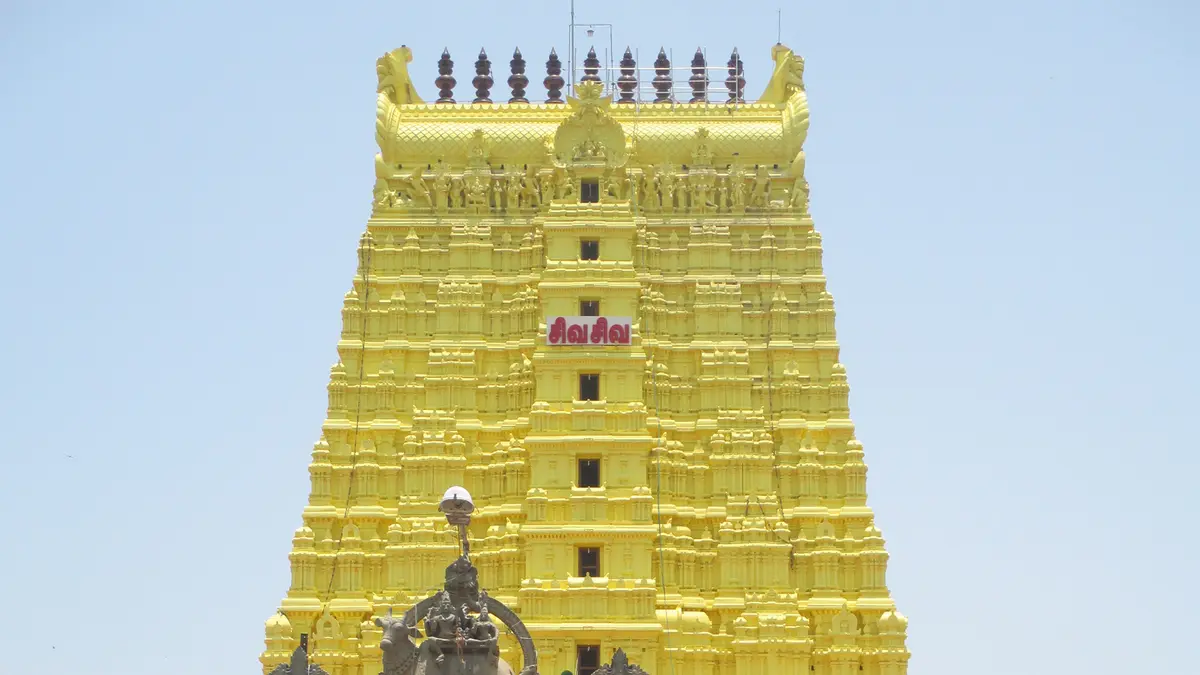
The towering gateways are known as gopurams. They mark entrances into the temple enclosure, while the sanctum contains the principal object of worship. Confusing the entrance tower with the central shrine obscures the building’s arrangement. The temple is better understood as a connected complex of entrances, passages and sacred spaces than as one isolated monument.
Water, worship and the meaning of the backdrop
The district administration records 22 theerthams associated with ritual bathing in the temple. A theertham is a sacred water source or bathing place. The practice forms part of pilgrimage, connecting movement through the complex with worship. Its religious significance should not be presented as evidence of a scientifically established medical benefit.
Showing the temple at a leaders’ welcome communicates a cultural reference without moving the diplomatic event to Rameswaram. The distinction matters because a photograph’s background can otherwise create a mistaken location. The news concerns the selection of a heritage image; it does not announce a new temple designation, restoration project or archaeological discovery.
Conclusion
The Ramanathaswamy backdrop drew attention to a shrine shaped by coastal geography, devotional traditions and generations of construction. Its significance is clearer when these strands remain connected but distinct. The temple’s pilgrimage role explains its cultural reach, while its corridors and gateways explain the architectural identity presented to the visiting leaders.