
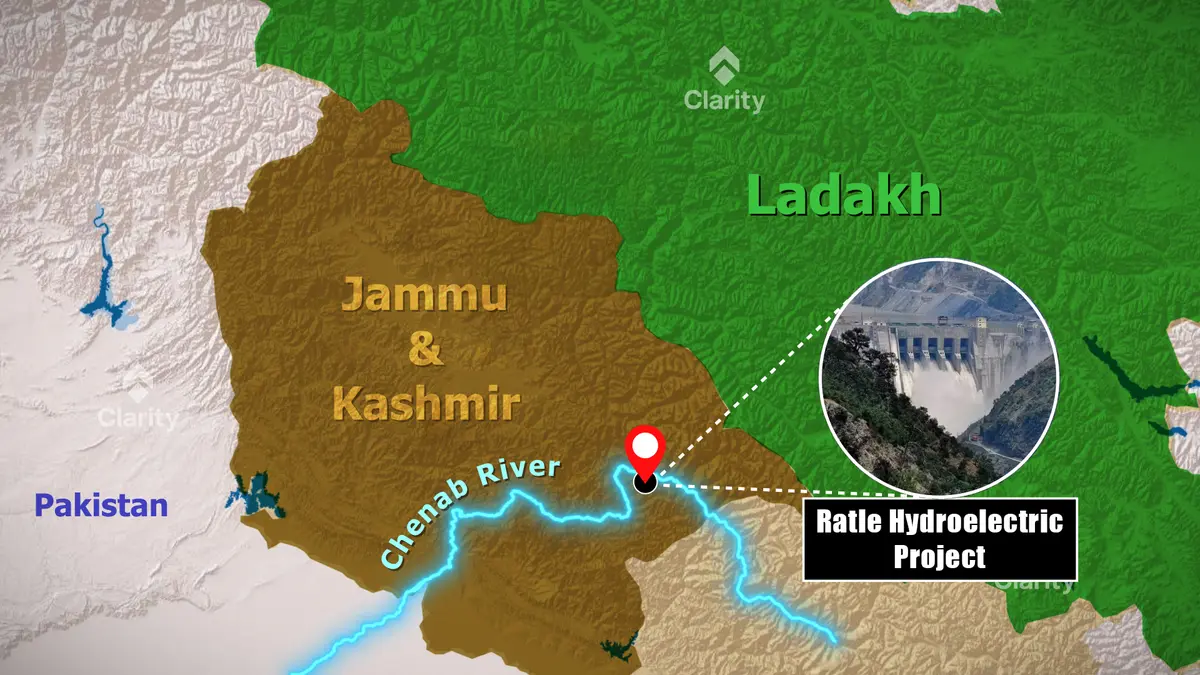
Why in news?
Heavy rainfall sharply raised the Chenab River near the Ratle project. The high flow damaged a temporary cofferdam at the construction site. Workers were moved to safety, and no casualties were reported. The damaged barrier was not the project’s permanent main dam.
Background
The Ratle Hydroelectric Project is being built on the Chenab River in Kishtwar district of Jammu and Kashmir.
The site lies downstream of Dulhasti and upstream of Baglihar, a useful sequence for map-based questions.
Ratle is an 850-megawatt run-of-river project that mainly uses natural flow and the available height difference.
Cofferdam and main dam are different
A cofferdam is a temporary barrier that excludes or diverts water while construction continues inside its work area.
Workers may later remove or abandon it, so cofferdam damage does not prove failure of the permanent dam.
Ratle’s main structure will be a 133-metre gravity dam, whose concrete weight resists water pressure.
Key verified project facts
| Feature | Official detail |
|---|---|
| River and location | It is on the Chenab in Kishtwar district. |
| Project type | It is a run-of-river hydroelectric scheme. |
| Installed capacity | Its total planned capacity is 850 megawatts. |
| Generating units | It has four 205-megawatt units and one 30-megawatt unit. |
| Main dam | The planned concrete gravity dam is 133 metres high. |
| Powerhouse | The main powerhouse will be underground and use Francis turbines. |
| Design energy | Official design energy is 3,136.76 million units annually. |
| Cost estimate | The estimate is ₹5,281.94 crore at November 2018 prices. |
| Expected operation | NHPC anticipates commercial operation during November 2028. |
A “90 per cent dependable year” meets the design flow in nine years out of ten.
Since one electricity unit equals one kilowatt-hour, 3,136.76 million units equal 3,136.76 gigawatt-hours.
Who is implementing the project?
Ratle Hydroelectric Power Corporation Limited implements the project.
The National Hydroelectric Power Corporation, now called NHPC Limited, holds 51 per cent equity.
The Jammu and Kashmir State Power Development Corporation holds 49 per cent. Therefore, NHPC Limited is the majority partner.
Project chronology
- 3 February 2019: The partners signed a tripartite memorandum for developing Ratle.
- June 2021: The present joint-venture company was incorporated with 51:49 ownership.
- 18 January 2022: The company awarded the turnkey construction contract.
- 27 January 2024: Engineers achieved diversion of the Chenab River.
- July 2026: Monsoon flow damaged a temporary construction cofferdam.
- 28 November 2028: The India Investment Grid lists this project completion date.
How will electricity be generated?
- The dam will create the water level needed for controlled diversion.
- Intake structures will send water towards underground pressure shafts.
- Falling water will rotate Francis turbines inside the powerhouse.
- Generators will convert the turbines’ mechanical energy into electricity.
- Tailrace tunnels will return used water to the Chenab River.
Indus Waters Treaty context
India and Pakistan signed the Indus Waters Treaty in 1960 after World Bank-supported negotiations.
The treaty grouped the Indus, Jhelum and Chenab as western rivers while permitting India constrained uses.
Pakistan objected to Ratle and Kishenganga designs, while India preferred the treaty’s Neutral Expert process.
India placed the treaty in abeyance during April 2025 and reiterated this unchanged position in July 2026.
Why monsoon management matters
Mountain rivers rise quickly after intense rain, while construction sites also face sediment, debris and sudden flow changes.
Temporary structures serve narrower purposes than completed works, but their damage still requires inspection before construction resumes.
Conclusion
The July incident concerned a temporary barrier, whose safe recovery needs inspection, flow monitoring and careful monsoon planning.