

Why in news?
Heat and limited rainfall sharply lowered the Rhine during July 2026. Cargo vessels reduced loads because their safe draught had decreased. German steel and chemical supply chains faced higher transport costs. The episode approached, but did not beat, the 2018 record low.
Background
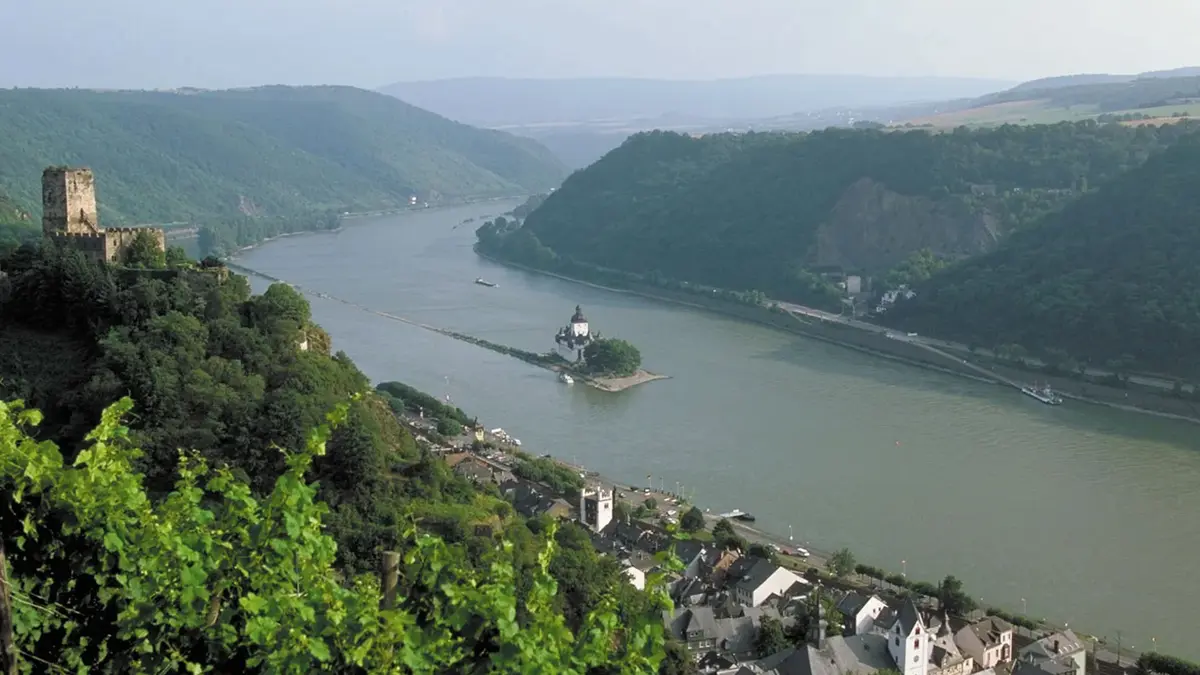
The Rhine rises in the Swiss Alps and flows northwards. Headwaters pass through Lake Constance before continuing along important national boundaries. The river eventually enters the Netherlands and reaches the North Sea.
Its length is about 1,230 kilometres, with major tributaries including the Aare, Neckar, Main, Moselle and Ruhr. The Rhine drains a densely populated and highly industrialised European region.
Navigation connects Basel with ports in Germany, France, the Netherlands and the sea. Barges carry fuel, coal, chemicals, grain, containers and construction materials. Inland water transport moves heavy cargo with comparatively low energy use.
European states have coordinated navigation through long-standing international arrangements. Environmental cooperation also operates through the International Commission for the Protection of the Rhine. River management therefore crosses national and sectoral boundaries.
What happened during July 2026
A western European heatwave combined with deficient rainfall to reduce river flow. Industry analysts warned that the Kaub gauge could fall below fifty centimetres. Kaub is a critical shallow section near Koblenz.
Many cargo vessels travelled with roughly one-fifth of their normal loads. Carrying less cargo keeps a vessel higher in the water. This reduced draught allows passage where the navigable channel has become shallower.
Thyssenkrupp suspended some company barges, reduced blast-furnace output and used vessels designed for shallow conditions. Other businesses faced higher freight charges because more journeys carried the same quantity.
Official monitoring showed the Kaub gauge recovering to eighty-eight centimetres on 20 July. River conditions can change quickly after rainfall or upstream releases. A forecast low should not be reported as a measured record.
Why a gauge reading is not water depth
A river gauge measures water height against a locally defined reference zero. The zero does not correspond to the riverbed everywhere. A reading of fifty centimetres therefore never means the whole channel is fifty centimetres deep.
Navigation authorities combine the gauge with charted channel information and vessel characteristics. Operators calculate safe loading draught, with margins accounting for changing bed conditions and vessel movement.
Low gauge readings usually restrict cargo before stopping every vessel, while shallow-draught ships may continue after larger vessels become uneconomic. Headlines saying the Rhine has “closed” can therefore exaggerate conditions.
Economic consequences
Transport cost rises sharply when a barge carries only a small fraction of capacity. Companies may switch cargo to rail or road, but both alternatives have limits. Thousands of extra lorries would increase congestion and emissions.
Steel plants need steady supplies of coal, ore and other inputs. Chemical facilities move bulky raw materials and finished products along the river. Interrupted deliveries can force output reductions even before stocks disappear completely.
Low water affects fuel distribution and port handling, while freight surcharges can spread through prices and industrial contracts. Repeated disruptions encourage firms to hold more inventory, increasing working-capital costs.
The 2018 episode showed broader economic consequences for Germany, although each event differs in duration, location and preparedness. Directly copying earlier loss estimates into 2026 would be misleading.
Climate and adaptation
High temperature raises evaporation and can intensify dry conditions. Reduced snow and changing Alpine runoff may alter seasonal Rhine flows. Climate change increases several such risks, although one event has multiple immediate causes.
Companies are investing in shallow-draught vessels and more flexible supply chains. Seasonal forecasts aid scheduling, while rail capacity, storage and alternative ports provide redundancy.
Engineering alone cannot remove every constraint from a natural river. Continuous dredging can damage habitats and remains limited by geology. Adaptation should balance navigation, water quality, ecology and downstream needs.
International sharing of flow, temperature and forecast data is essential because upstream decisions affect downstream users within days. Joint planning can reduce national responses that merely transfer risk elsewhere.
Conclusion
The 2026 low water exposed the Rhine's importance far beyond shipping. Resilient industry will need reliable forecasts, diversified logistics and basin-wide climate adaptation.