

Why in news?
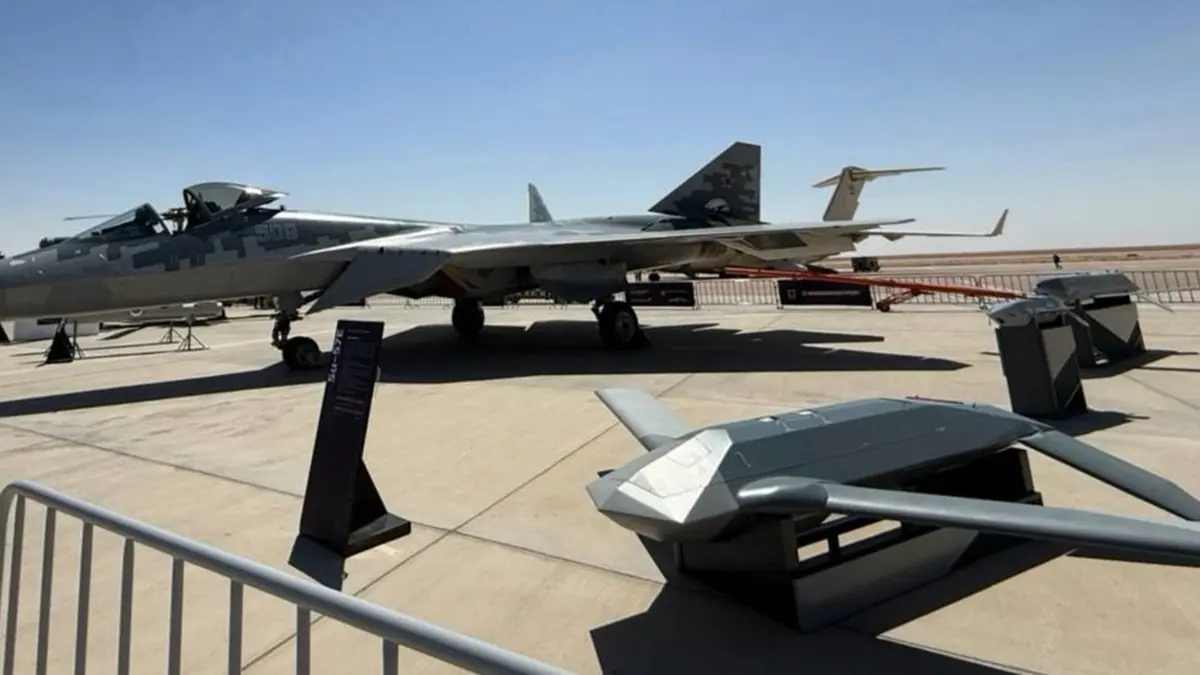
Reporting on 11 September highlighted Russia’s display of the S-71K Kovyor at an airshow in Egypt. The missile is associated with the Su-57 aircraft programme. Rostec had announced new weapons for the export Su-57E display. Public exhibition, however, must be distinguished from first development, first combat use and an actual export agreement.
The exhibition and its setting
The El Alamein International Airshow took place from 8 to 10 September 2026. El Alamein lies on Egypt’s Mediterranean coast, west of Alexandria. The event provided a setting for aircraft demonstrations and defence marketing. Exhibitors’ statements describe their products, but do not independently establish every advertised operational capability.
Rostec’s advance announcement described an export-configured Su-57E with previously undisplayed weapons. The Times of India subsequently identified the S-71K among the showcased systems. These reports explain the September news hook. They do not mean that the missile was developed during the airshow. Earlier intelligence reporting had already discussed it.
What kind of missile is it?
The S-71K is described as an air-launched cruise missile intended for attacking ground targets. An aircraft carries and releases it. Powered flight then takes it towards its target. This separates it from an unpowered bomb and from an air-to-air missile designed primarily to engage another aircraft.
A cruise missile flies aerodynamically through the atmosphere, using propulsion for much of its journey. A ballistic missile follows a different flight pattern, including a substantial ballistic phase after powered acceleration. “Cruise” is therefore a description of flight behaviour. It is not, by itself, a statement about range, accuracy or stealth.
The public record describes the Kovyor as a subsonic weapon, not a hypersonic one. Subsonic means travelling below the local speed of sound. Range and speed are separate characteristics. A missile can travel hundreds of kilometres without being unusually fast, and high speed alone does not establish precision.
What the Ukrainian examination reports
Ukraine’s military intelligence published an account of the missile on 27 April 2026. It identified the United Aircraft Corporation as the developer and associated the weapon with the Su-57. It also reported use in late 2025. This is an attributed assessment by a party to the war, not a neutral certification.
The Ukrainian account describes turbojet propulsion and an estimated range of up to 300 kilometres. It identifies an inertial navigation system and a conventional fragmentation payload derived from an aircraft bomb. These are reported characteristics of the examined system. They should not be expanded into unsupported claims about every production version.
Inertial navigation estimates movement using onboard sensors. It is different from a terminal seeker that recognises or tracks a target near impact. The published description does not establish every advanced guidance feature circulated online. Nor does a nominal range tell us the conditions under which that performance was achieved.
Stealth is not invisibility
Reporting emphasises the weapon’s angular shape and reduced-observability design. Such features may aim to make detection or tracking more difficult. They do not make a weapon invisible. Actual detectability depends on the sensor, viewing direction, operating conditions and the complete system, not one photograph of its exterior.
That distinction is especially important when an exhibition is linked with export promotion. Public images can establish that an object was displayed. They cannot demonstrate a precise radar signature or guaranteed penetration of air defences. Those conclusions would require evidence beyond a manufacturer’s description or a press photograph.
The S-71K is also discussed alongside the S-71M Monokhrom. Similar programme labels can conceal different roles and equipment. Features attributed to one should not automatically be transferred to the other. In particular, claims about autonomous searching or advanced terminal recognition require variant-specific evidence before inclusion.
Why the story matters for India
The Su-57E’s export prospects make the display relevant to Indian defence discussions. The aircraft and its available weapons would form parts of a larger procurement package. Yet discussion of a possible offer does not establish an Indian purchase. The sources reviewed here do not confirm an Indian contract for this missile.
A procurement assessment would need to examine compatibility, training, maintenance, supply arrangements and life-cycle costs. Claimed performance is only one part of that evaluation. These are questions raised by the display, not findings that a particular purchase would be beneficial. Exhibition publicity cannot settle them on its own.
The wider significance is the connection between aircraft exports and their weapons ecosystem. A fighter’s usefulness depends partly on the equipment it can actually operate and sustain. Demonstrating a new weapon can therefore strengthen a marketing offer. Demonstrating reliable service performance requires a different and longer evidentiary record.
Conclusion
The Kovyor display adds to the public picture of Russia’s aircraft-weapons programme. The strongest account separates the exhibition from earlier reported deployment and keeps variant-specific claims distinct. Manufacturer statements and Ukrainian assessments both require attribution. Neither an advertised capability nor interest from a potential customer should be presented as a verified operational outcome.