
Why in news?
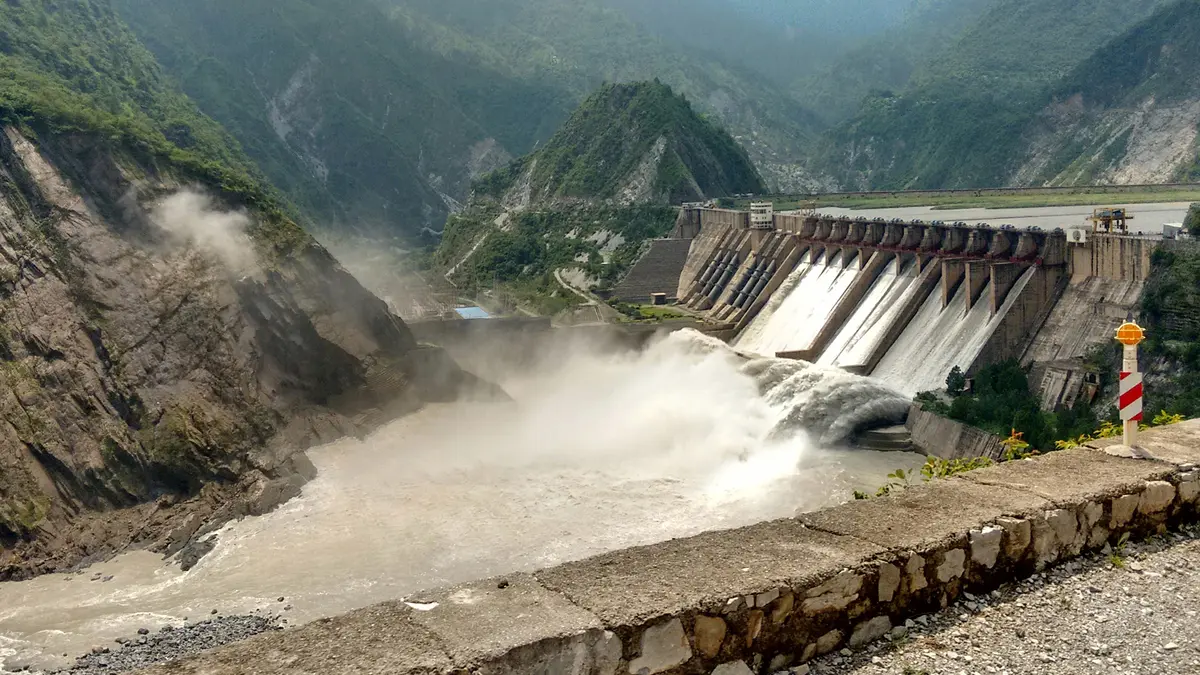
Heavy rain sharply increased inflows into the Chenab River and Salal reservoir. Authorities opened all dam gates on 21 July 2026. Downstream residents received warnings because the river became faster and deeper.
Background
Salal is a 690-megawatt hydroelectric project in Jammu and Kashmir’s Reasi district.
The project uses the Chenab, a major western river of the Indus system.
National Hydroelectric Power Corporation Limited, now branded NHPC Limited, owns and operates the station.
What is a run-of-the-river project?
Salal is officially classified as a run-of-the-river hydroelectric scheme on the Chenab.
Such projects mainly use flowing river water instead of vast seasonal storage.
Water passes through intakes and channels, turning machinery that converts its energy into electricity.
Run-of-the-river never means no dam or reservoir; Salal has both, but remains inflow-dependent.
How does Salal generate electricity?
- The dam creates a useful height difference, called the hydraulic head.
- Large pipes carry controlled water towards six Francis turbines within the surface powerhouse.
- Each 115-megawatt generator supplies the northern transmission network after voltage transformation.
- Released water returns to the Chenab downstream of the station.
Verified project specifications
| Feature | Official NHPC detail |
|---|---|
| Installed capacity | 690 megawatts through six units of 115 megawatts each. |
| Development stages | Stage One and Stage Two each contain three generating units. |
| Turbine type | Six Francis turbines operate with a rated 94.5-metre head. |
| Rockfill section | It is 118 metres high and 630 metres long. |
| Concrete section | It is 113 metres high and 486.75 metres long. |
| Design energy | 3,082 million units in a 90 per cent dependable year, assuming 95 per cent machine availability. |
Structural correction: Salal is not one 100-metre-high, 1,200-metre-long embankment. NHPC lists separate rockfill and concrete dam sections with the measurements above.
Commissioning timeline
- Units one to three began commercial operation on 20 November 1987.
- Unit four followed on 1 July 1993, while unit five followed on 23 May 1994.
- The sixth and final unit began commercial operation on 1 April 1995.
This sequence explains why different sources mention several commissioning years.
Who receives Salal electricity?
NHPC’s northern-network beneficiaries include Jammu and Kashmir, Chandigarh, Delhi, Haryana and Punjab.
Himachal Pradesh, Rajasthan, Uttarakhand and Uttar Pradesh are also listed.
Connection with the Indus Waters Treaty
India and Pakistan signed the World Bank-assisted Indus Waters Treaty during 1960.
It allocated Ravi, Beas and Sutlej mainly to India.
It placed the Indus, Jhelum and Chenab mainly for Pakistan’s use.
India retained specified western-river uses, including hydropower projects complying with treaty design restrictions.
Salal became the treaty’s first major hydropower design dispute.
India and Pakistan settled those objections through a bilateral agreement on 14 April 1978.
India placed the treaty in abeyance on 23 April 2025, citing concerns about cross-border terrorism.
Pakistan rejected India’s unilateral step, leaving the treaty’s current status disputed.
River grouping: Chenab is a western river with the Indus and Jhelum. Ravi, Beas and Sutlej form the eastern group.
Why were all gates opened?
Continuous rain increased flow from Reasi and the upstream catchment.
The gates released excess inflow and kept the reservoir within safe operating limits.
Such releases can rapidly raise downstream water levels and current strength.
Authorities therefore warned riverside and low-lying communities to remain alert.
Opening spillway gates is a safety operation, not electricity generation by itself.
Why is sediment management important?
Himalayan rivers carry heavy sediment, which reduces reservoir space and can damage hydraulic equipment.
Unremoved sediment weakens long-term generation, while management releases must balance infrastructure safety with downstream risks.
Conclusion
Salal combines hydropower, Chenab geography and water politics, while its gates require careful rainfall monitoring.