

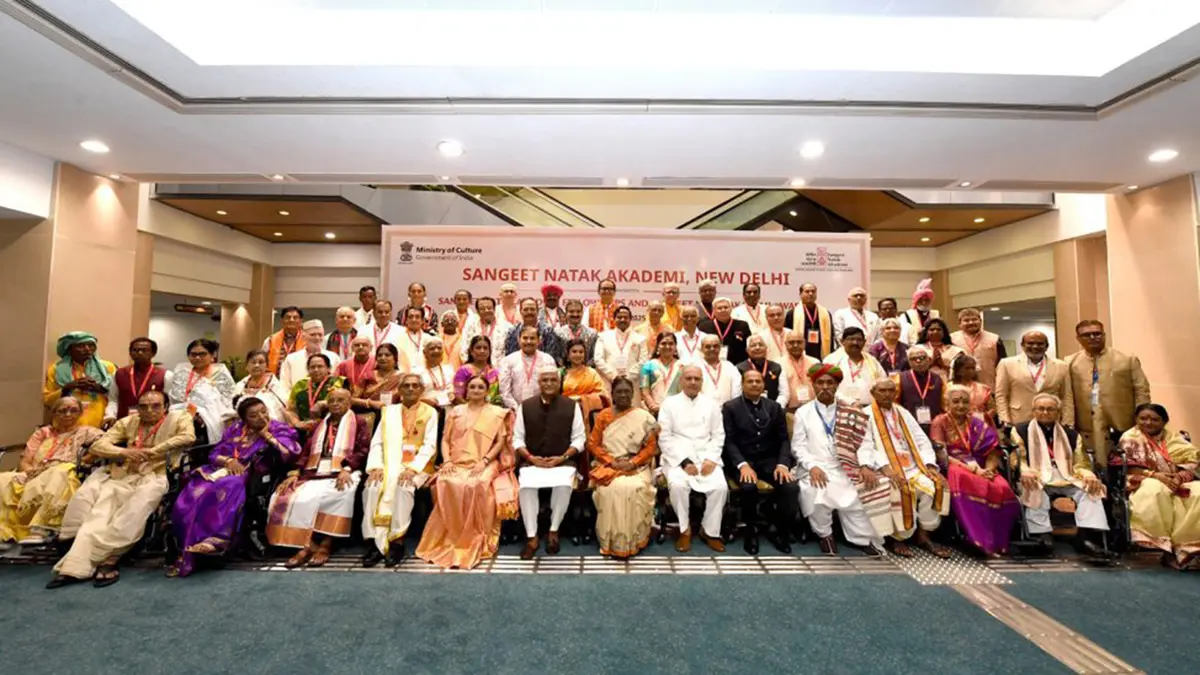
Why in news?
The President was scheduled to confer Sangeet Natak Akademi fellowships and awards on 13 August. The honours cover the years 2024 and 2025.
What the honours cover
The Akademi selected seven Fellows and 108 awardees across music, dance, theatre, folk, tribal and allied performing arts.
Fellowship is the Akademi’s highest honour. It carries ₹3 lakh, while the main award carries ₹1 lakh.
Both honours include a copper plaque, called a Tamrapatra, and an Angavastram. The fellowship is restricted to 40 living recipients at any time.
Two categories, not 115 awards
The group comprises seven fellowships and 108 awards. The Ustad Bismillah Khan Yuva Puraskar is a separate recognition.
Institutional background
Sangeet Natak Akademi is India’s national academy for music, dance and drama. It has presented awards since 1952.
Recognition can strengthen artists working outside commercial markets. It also creates an official record of diverse regional and community traditions.
An award cannot by itself sustain a living art form. Training spaces, documentation, fair payment and intergenerational transmission need continuous support.
Questions of representation
Selection systems should remain transparent about disciplines and procedures. Balanced recognition should not reduce regional traditions to fixed quotas.
Digital archives can widen access when artists give informed consent. Documentation should record context and language, not only short performance clips.
Public honours also create responsibility for preservation. Institutions should connect recognition with research, teaching and accessible performance opportunities.
Living traditions and public support
Many performing arts depend on teachers, accompanists and community spaces. Individual recognition should not hide these wider creative ecosystems.
Younger practitioners need stable opportunities to learn and perform. Short festivals rarely replace sustained apprenticeships or regular local audiences.
Archiving must respect performers’ moral and economic rights. Public access should not become unlicensed commercial reuse of community knowledge.
Periodic diversity reviews could reveal neglected forms without predetermining artistic judgment. Clear documentation would also strengthen institutional trust.
Award ceremonies can introduce artists to new audiences. Follow-up programming determines whether that attention becomes sustained engagement.
Accurate biographies and field classifications matter for the public record. Artists should have an opportunity to correct names, languages and credited traditions. Such corrections protect both attribution and cultural history.
Conclusion
The honours recognise artistic excellence and cultural memory. Their wider impact depends on sustained institutions around artists and their traditions.