
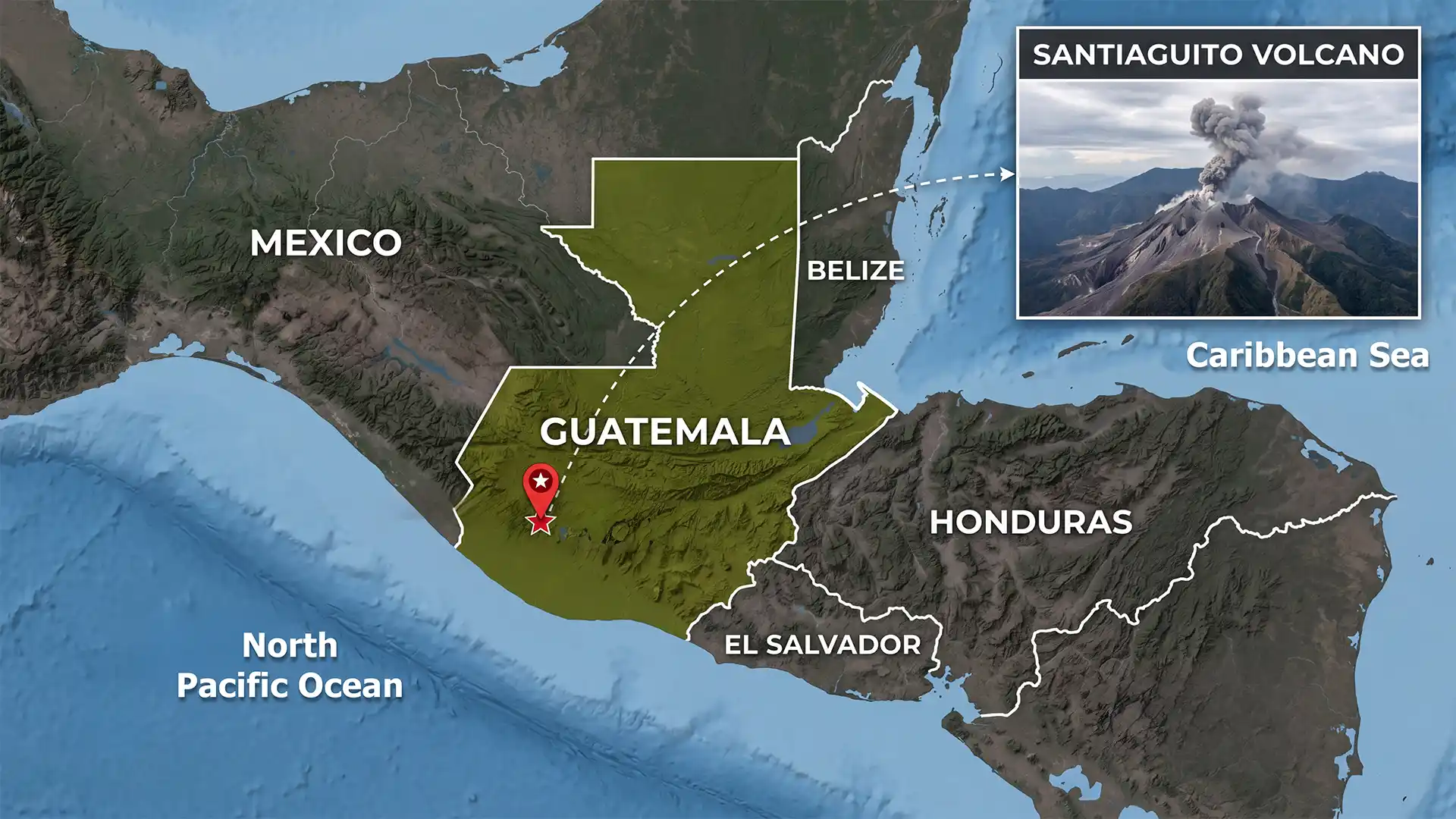
Why in news?
The Santiaguito lava dome complex on the southwest flank of Guatemala’s Santa María volcano has been in the spotlight due to continuing eruptions and small pyroclastic flows. Monitoring agencies report persistent lava extrusion at the Caliente dome and explosions that send ash plumes hundreds of metres into the sky.
Background
Santa María is a 3,772‑metre stratovolcano rising above Guatemala’s Pacific plain. After a dormant period lasting many centuries, it erupted catastrophically in 1902, blasting open a crater 1.5 km wide and depositing volcanic ash across much of Central America. Twenty years later, in 1922, lava started oozing from the base of the crater to form a new dacitic dome named Santiaguito. This complex has four overlapping domes—El Caliente, El Brujo, El Monje and La Mitad—that have grown westwards over time.
Evolution and activity
- Continuous growth: Dome extrusion has been almost unbroken since 1922. Periods of rapid growth alternate with quiet phases, and the active vent has shifted among the different domes. Caliente has been the main source of eruptions in recent decades.
- Explosions and flows: Minor explosions occur frequently, sending ash plumes 200–1,000 metres above the dome. Blocky lava flows move down gullies, and collapses at the dome’s edge generate block‑and‑ash avalanches. During high‑extrusion phases the volcano can produce pyroclastic flows—fast‑moving clouds of hot gas and debris that endanger villages.
- Historic hazard: In 1929 a partial dome collapse sent pyroclastic flows more than 10 km to the south, killing thousands of people in nearby settlements. Subsequent eruptions in 1992 produced ash columns up to 6 kilometres high. Because the volcano threatens populated valleys, the International Association of Volcanology and Chemistry of the Earth’s Interior lists Santa María/Santiaguito as a “Decade Volcano” requiring special study.
- Lahars and flooding: Heavy rains remobilise loose volcanic ash, generating mudflows (lahars) that travel down rivers and destroy infrastructure. These secondary hazards can occur years after an eruption.
Significance
- Ongoing risk: People living near Santiaguito must remain vigilant. Monitoring agencies issue alerts when ash plumes threaten aviation or when pyroclastic flows are possible.
- Scientific importance: Continuous dome growth offers volcanologists a natural laboratory to study eruption cycles, magma extrusion rates and hazard mitigation.
- Tourism and education: Guided tours to viewpoints near the volcano help raise awareness of volcanic hazards and support local economies, but safety protocols are essential.
Sources: Aljazeera

