

Why in news?
A new study examined how people understand the striped hyena in parts of West Bengal. Researchers conducted 104 semi-structured interviews in landscapes where the elusive carnivore occurs. Responses ranged from respect for a harmless scavenger to fear of a dangerous hunter. The findings show why coexistence does not always produce accurate knowledge about wildlife.
What the researchers found
Participants used different local ideas when describing the same animal. Some called it “Gaadha” and associated it with scavenging and avoidance of people. Others used “Kuia” for an aggressive creature described through alarming stories. These categories reflected memory, folklore and occasional encounters.
Many beliefs were not based upon direct observation. Striped hyenas are nocturnal, wide-ranging and difficult to see. Information therefore passes through family stories and community discussion. A rare livestock loss or frightening sound may influence belief for many years.
The researchers argue against labelling every belief as simply positive or negative. One person may value scavenging but still fear an encounter. Perceptions can change with age, livelihood and recent events. Conservation messages must engage with this complexity.
Understanding the animal
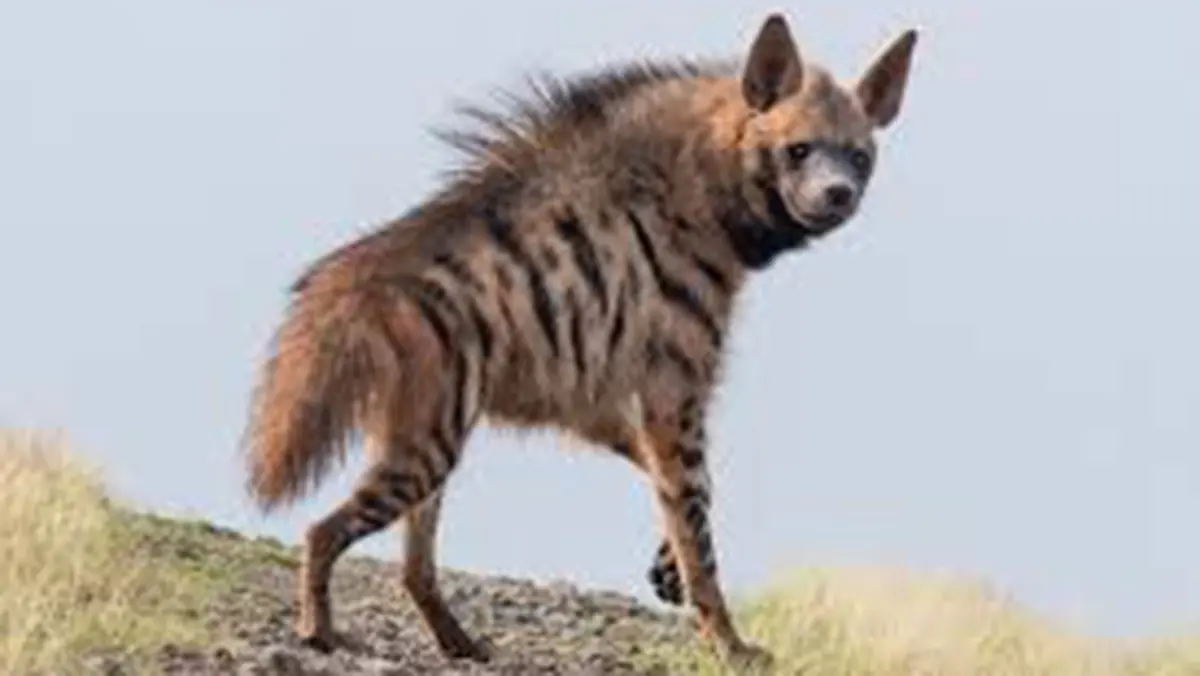
The striped hyena's scientific name is Hyaena hyaena. It belongs to family Hyaenidae and order Carnivora. Adults carry dark vertical stripes across a pale grey or brown coat. A long mane can rise when the animal feels threatened.
Striped hyenas are mainly nocturnal and often forage alone. They consume carrion but can also eat insects, fruit and small animals. Their strong jaws process bones and tough remains left by other predators. This scavenging helps recycle nutrients and remove decaying material.
The species uses scrub, grassland, rocky hills and open woodland. Dens require secure ground with limited disturbance. In India, roads, mines, settlement growth and changing grazing can fragment this habitat. Poisoned carcasses and direct killing add further risk.
Status and geographical range
The species occurs across parts of Africa, West Asia and South Asia. India holds an important portion of its Asian range. It occurs from dry north-western landscapes to suitable areas in central and eastern India. Records in West Bengal represent the wetter eastern part of that broad distribution.
The International Union for Conservation of Nature classifies the striped hyena as Near Threatened. Its global assessment is old and researchers have called for updated evidence. India protects the species under Schedule I of the Wild Life (Protection) Act, 1972. Since March 2026, the species has also received stronger international trade controls.
The Convention on International Trade in Endangered Species of Wild Fauna and Flora (CITES) places it in Appendix II. Appendix II does not prohibit every international transaction. Export permits require checks on legality and the species' survival. This status followed an amended proposal adopted at the twentieth Conference of the Parties.
A legal category cannot substitute for population monitoring. The animal is easily missed during daytime surveys. Camera traps, spoor records and genetic material can improve detection. Comparable methods are needed to distinguish real change from better sampling.
Why perceptions affect conservation
Fear can lead to persecution even when attacks are rare. Misidentification may also assign another animal's damage to a hyena. Conversely, calling every hyena harmless would dismiss genuine local concerns. Outreach should explain behaviour while maintaining practical safety advice.
Carcass disposal deserves particular attention. Open dumping may draw scavengers close to homes and roads. Veterinary drugs or poison in carcasses can harm animals that feed upon them. Safe disposal reduces conflict and protects public health.
Communities can help identify dens, road-crossing points and seasonal activity. Their observations become stronger when combined with field evidence. Conservation programmes should return findings in local languages. Trust weakens when researchers extract information but provide no useful response.
The species' ecological value can support communication. Scavengers clean carcasses and move nutrients through food webs. That role does not make them sanitation workers for unsafe waste. Healthy coexistence requires both habitat and responsible human practices.
Conclusion
The West Bengal study reveals several meanings attached to one secretive carnivore. Folklore can support tolerance or intensify fear when sightings are scarce. Conservation must listen carefully without treating every claim as biological fact. Better field evidence and local communication can correct harmful misunderstandings. Protecting dens and managing carcasses can turn knowledge into practical coexistence.