
Why in news?
In May 2025 severe storms spawned multiple tornadoes across the United States, particularly in Kentucky and Missouri. At least 21 people died and tens of thousands lost power, highlighting the destructive power of these rotating columns of air.
Background
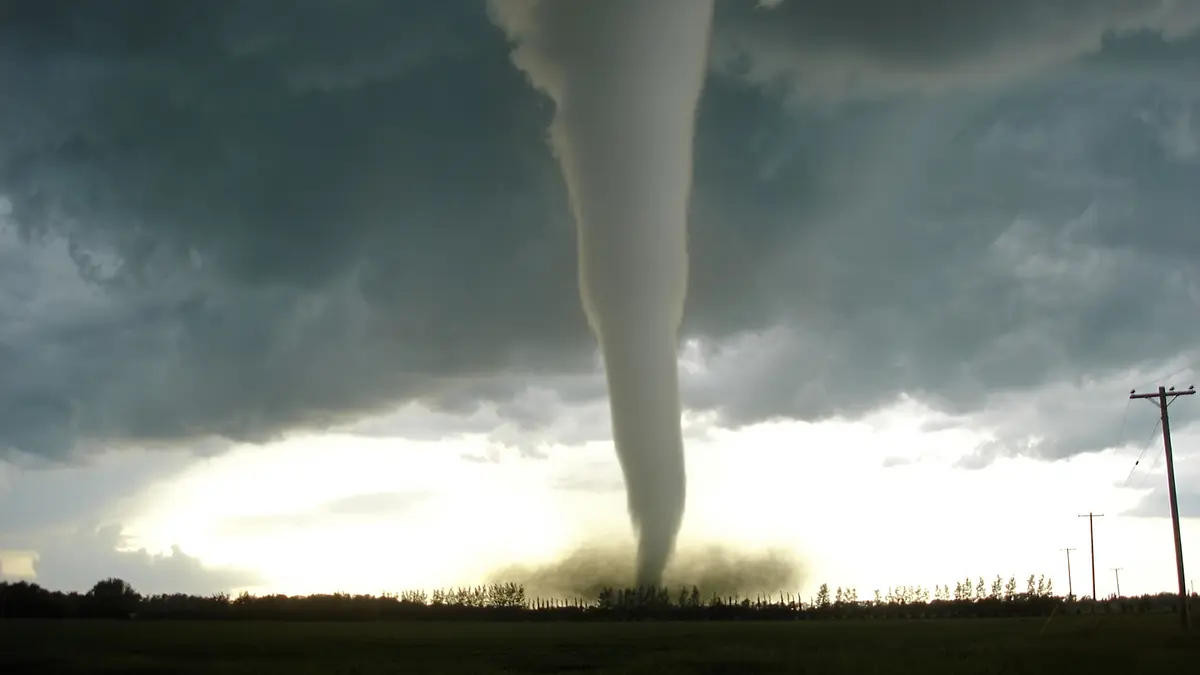
A tornado is a narrow, violently rotating column of air extending from the base of a thunderstorm to the ground. Because air is invisible, a tornado often appears as a funnel cloud made up of condensed water droplets, dust and debris. Tornadoes can occur almost anywhere but are most frequent in regions where warm, moist air collides with cool, dry air under unstable atmospheric conditions.
How tornadoes form
- Most destructive tornadoes originate from supercell thunderstorms — large storms with a rotating updraft called a mesocyclone.
- Contrasting air masses, wind shear (wind blowing at different speeds or directions at different heights) and a triggering mechanism such as a cold front create the conditions for rotation.
- As the storm intensifies, a funnel may extend downward. When it touches the ground, it becomes a tornado. Over water, similar phenomena are called waterspouts.
Wind speeds and classification
- Tornado winds typically range from about 105 to 322 km/h, but extreme events can exceed this range.
- The Enhanced Fujita (EF) Scale rates tornadoes from EF0 (weakest) to EF5 (strongest) based on damage observed. The scale helps estimate wind speeds.
Global distribution
- The United States experiences about 1,200 tornadoes each year, the highest number globally. A broad region of the central U.S. known as “Tornado Alley” sees frequent tornadoes, especially in spring and early summer.
- Other regions with notable tornado activity include Argentina and Bangladesh, where cold and warm air masses often meet.
- Tornadoes can occur in every Indian state but are rare. Coastal regions sometimes experience waterspouts during intense thunderstorms.
Staying safe
- A Tornado Watch means conditions are favourable for tornadoes. People should stay alert and prepare to seek shelter.
- A Tornado Warning indicates that a tornado has been sighted or detected by radar. Individuals must immediately move to a sturdy shelter, preferably an interior room on the lowest floor.
- Basements, underground shelters or small interior rooms provide the best protection. Windows should be avoided due to flying debris.
Indian context
- Occasional tornado‑like events have occurred in parts of eastern India, such as West Bengal and Odisha. They are often associated with Nor’westers and pre‑monsoon thunderstorms.
- Improving weather forecasting and public awareness can help reduce casualties when rare tornadoes strike.
Source: Hindustan Times

