

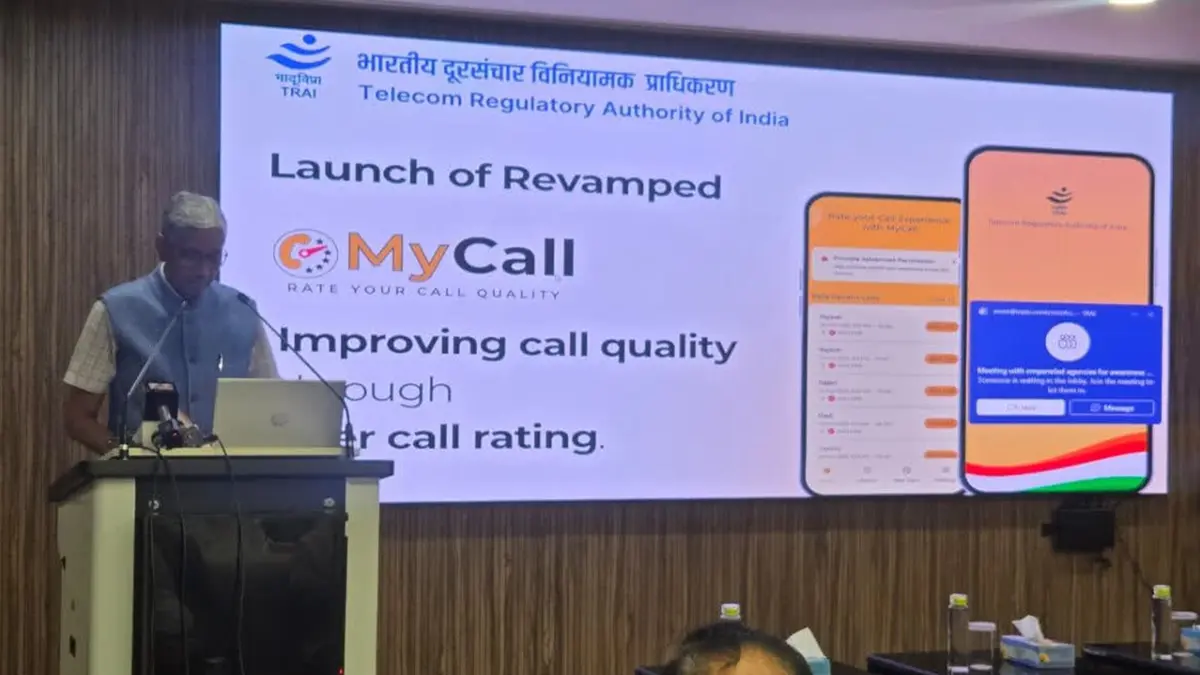
Why in news?
India launched a revamped MyCall application for Android users. It collects feedback about mobile calling quality after calls. Users can report defects alongside a one-to-five-star rating. Anonymised network information supports regulatory and operator analysis.
Background
Parliament created the Telecom Regulatory Authority of India (TRAI) under the TRAI Act, 1997. The regulator began functioning on 20 February 1997.
TRAI regulates telecommunications services, including tariffs, interconnection and service-quality standards. It also recommends policy while promoting fair competition and consumer protection.
A 2000 amendment separated regulation from adjudication, creating the Telecom Disputes Settlement and Appellate Tribunal. TRAI itself does not decide every individual subscriber complaint.
The original MyCall application collected voluntary customer ratings, while the 2026 version updated its interface and diagnostic features. It aims to capture experience across India's very large and diverse mobile network.
How the revamped application works
After a call, a user may rate its quality from one to five stars. The application can ask whether the call occurred indoors, outdoors or while travelling. Context helps distinguish network conditions affecting the experience.
Users can identify call drops, echo, broken voice, audio delay, cross-connections, slow establishment or one-way hearing. These descriptions convert a vague poor call into more useful categories.
The application includes a feedback map and a coverage signal test. Relevant network parameters accompany voluntary reports in anonymised form. TRAI and telecom service providers can examine patterns across locations and technologies.
Quality of service and quality of experience
Quality of Service describes measurable network performance, including call setup success, drop rates, latency and fault repair. Operators report many such measures through prescribed regulatory methods.
Quality of Experience concerns what a person actually perceives. Two calls with similar technical readings can feel different because of handsets, buildings or movement. MyCall attempts to connect this human experience with selected network information.
The two evidence types complement each other because crowdsourced ratings reveal localised problems hidden by broad averages. Controlled network measurements remain necessary for enforcement and reliable comparison.
Benefits and limitations
A large volume of geolocated feedback can identify repeated weak spots. Operators may prioritise tower optimisation, indoor coverage or capacity upgrades. Regulators can compare user reports with mandatory performance submissions.
However, the sample is self-selected because only participating Android users report calls. Dissatisfied users may respond more often, while rural users with limited smartphones may remain underrepresented. Ratings therefore cannot represent every subscriber automatically.
Phone hardware, buildings and movement affect results, so one poor rating does not prove operator negligence. Analysis must consider signal conditions, technology and repeated observations.
Privacy and accountability
Location-linked network data can become sensitive over time, making clear consent, data minimisation and secure retention essential. Users should understand which information travels with each report.
Publicly reported improvements would strengthen trust in the application. Useful measures include resolved problem clusters and validation against independent drive tests. Download counts alone would not demonstrate better service.
Conclusion
MyCall can make consumer experience more visible within telecom oversight. Its value depends upon representative participation, privacy safeguards and verified network action.